Flying to the Olympics on high hopes
pp. 46-47 · Read in the full issue
Olympic Games
By Atama Raganivatu
S, i t-x *r* i * ... , outh Pacific athletes travelled to the Atlanta Olympics, which com menced as Pacific Islands Monthly went to press, with unprecedented hopes of success.
It is highly unlikely that any of them will emulate American Samoan diver Greg Louganis, who won a brace of gold medals at both Los Angeles and Seoul (in 1984 and 1988 respectively). However, never before have so many of our com petitors had the capability to match the best in an Olympiad. Nauruan weightlifter Marcus Stephen is the region’s prime prospect (see accompany ing story). However, men’s windsurfing will probably be the event followed with most interest for we have two amongst the world’s top seven in the sport.
New Caledonian Michel Quintin, a
former Olympic-class world champion
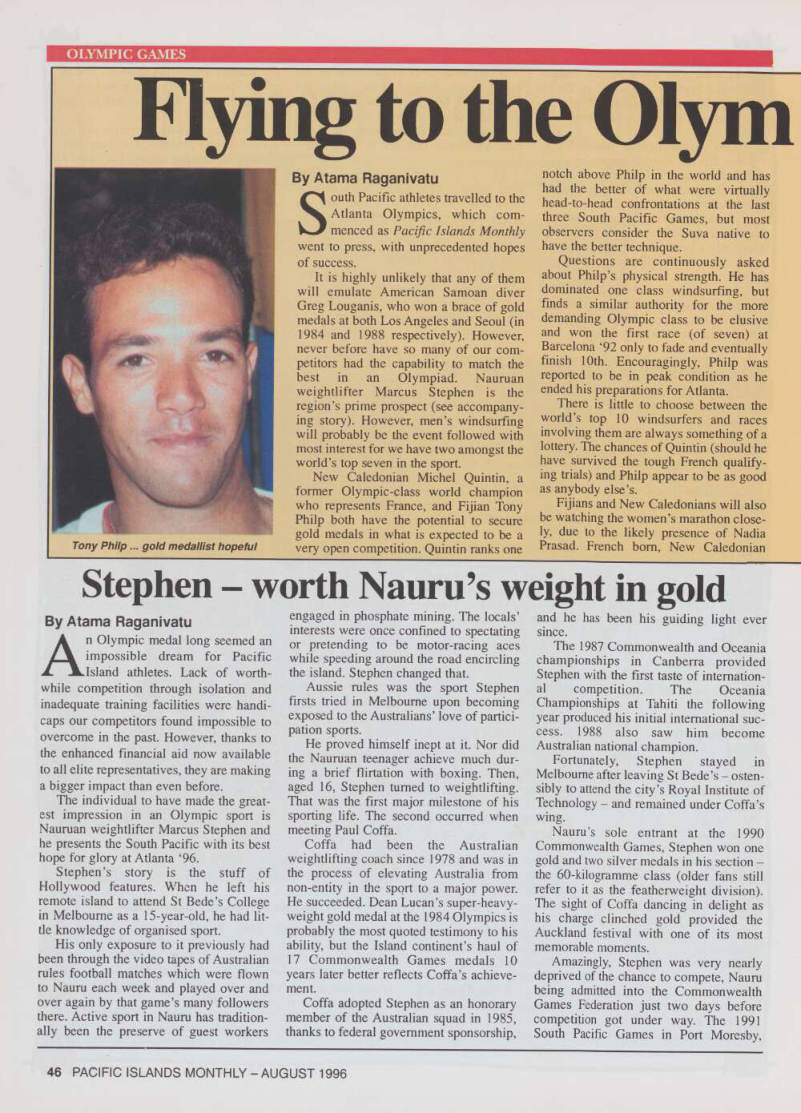
who represents France, and Fijian Tony Philp both have the potential to secure gold medals in what is expected to be a very open competition. Quintin ranks one
notch above Philp in the world and has had the better of what were virtually head . to . head confrontations at the last three South Pacific Games, but most observers consider the Suva native to have the better technique, Questions are continuously asked about Philp’s physical strength. He has dominated one class windsurfing, but finds a similar authority for the more demanding Olympic class to be elusive ar *d won the first race (of seven) at Barcelona ‘92 only to fade and eventually finish 10th. Encouragingly, Philp was reported to be in peak condition as he ended his preparations for Atlanta, There is little to choose between the world’s top 10 windsurfers and races involving them are always something of a lottery. The chances of Quintin (should he have survived the tough French qualify big trials) and Philp appear to be as good as anybody else’s.
Fijians and New Caledonians will also be watching the women’s marathon close due t 0 the likely presence of Nadia Prasad. French bom, New Caledonian
Tony Philp...gold medallist hopeful
raised and married to a Fijian, Prasad won two gold medals when 15 years old in the 1500 metres and 3000 metres at the 1983 South Pacific Games. She concentrates on the marathon these days and is regularly ranked amongst the world’s top 20. Most experts believe that she has yet to run the race of her life and Atlanta would be the ideal place to produce it.
Like Prasad, Western Samoan discusthrower Beatrice Faumuina is a dark horse with the ability, in the best Olympic tradition, of coming through to snatch a medal.
Currently the world’s number 10, Faumuina has limited expectations of heN self in Atlanta; believing she is there largely to gain experience for Sydney four years hence when a gold medal will be a definite goal. With no pressure upon her, the 21-year-old might just pull an exceptional throw out of the bag, as she did when poaching a silver medal at the last Commonwealth Games. The boxing arena was the scene of the South Pacific’s greatest moment in Barcelona, when Western Samoan David Tua claimed a bronze medal, and we are entitled to harbour
hopes for a similar success this time, Tongan super-heavyweight Paea Wolfgramm has already gained a formidable international record. At the 1995 Oceania Championships, he knocked his Western Samoan opponent, Fai Falamoe, out of the ring just 84 sec onds into their final. The pair were also scheduled to meet on the last evening of
the Oceania Olympic Qualifying
Tournament at Sydney this year, but Falamoe was unable to fight through what may well have been a fortuitous injury sustained in his semi-final.
A Commonwealth Games bronze medallist in 1994, Wolfgramm has bene fitted from a stint under the wing of famous American trainer Lou Duva last year. Duva polished the giant Tongan’s ringcraft. However, awesome punching power remains his best asset, Papua New Guinea’s Henry Kunsi is a very different boxer. A true stylist, he totally outclassed the highly rated Australian John Simpson to win the lightweight division in Sydney. Kunsi, though, is a virtual unknown outside of
Oceania and the element of surprise may well prove invaluable to him in Atlanta.
Given some luck, particularly with the draw, he could enjoy an extended run.
Wolfgramm and Kunsi are the best per formed of the 10 South Pacific boxers expected to front up in Georgia. Five qual ified through their efforts in Sydney, while the rest benefitted from the International Olympic Committee’s wildcard scheme.
This scheme was devised to increase the opportunities for athletes from the “developing countries” to participate in world sport’s most glamorous carnival.
Thus, Fijian weightlifter Rupeni Varea, Tongan boxer Shane Hbaps and Western Samoa discus thrower Chris Mene, among many others, have been given the opportu nity to rub shoulders with the likes of Carl Lewis despite failing to meet their original
qualifying requirements.
It is the Vareas, Heaps and Menes who make the Olympics a very special occa sion, and taking part will always be more important than winning. However, would n’t it be wonderful to see our boys and girls on the winning dais? ■