to independent
pp. 35-39 · Read in the full issue
Solomons Feature
From British colony to independent Island state
Last month, the Solomon Islands cel ebrated their 14 years of indepen dence and, while doing that, the people looked back on history and all the events leading up to this very important date on their calendar.
A member of the Commonwealth, the Solomon Islands’ first discovery by the Europeans was in 1567 by Spanish explor er Alvaro de Mendana, The country consists of a double chain of six large islands and many smaller ones.
The major island is Guadacanal and is" the location of the capital, Honiara.
In 1567, Mendana set out from Peru to seek the legendary Isles of Solomon.
In February 1568, after sighting Nui in the Tuvalu group, Mendana came upon a l ar S e mountainous island which he named Santa Isabel. Other large islands, including „ , . i A c r - k f Guadacanal, Malaita and San Cristobal, anc a num b er G f smaller islands were discovered over the next six months.
The m ost interesting episode in the
early history of European contact with
Solomon Islands was during the time of French explorer La Perouse. In January 1788, together with his ships Boussole and Astrolobe, he arrived at Botany Bay. He sailed the following month and was never seen a g a i n- Despite many rumours and an official search by the d’Entrecasteaux expedition, no positive clue was found to
La Perouse’s fate for almost 40 years.
The mystery was unveiled by Captain Peter Dillion, an Irishman, who came across some articles of European origin . • . .. . u during a visit to Tikopia m 1826. He was told that the articles were from the neigh bouring island of Vanikolo.
Dillion visited Vanikolo and found more articles which had washed ashore.
He was told the Frenchman’s ships had been wrecked in a storm and the survivors had lived ashore for a while during which they built a boat from local timber.
They had eventually sailed away and were never heard of again.
In 1893, Britain declared a protectorate over the southern Solomon Islands and in
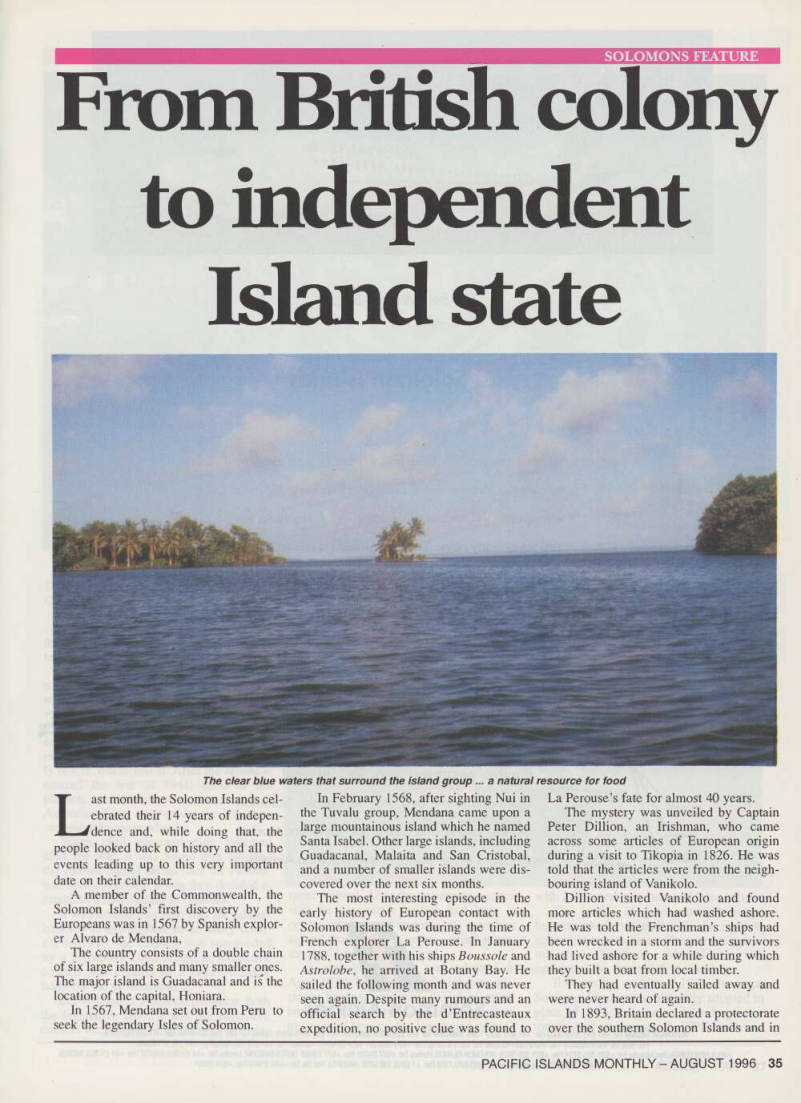
The clear blue waters that surround the island group...a natural resource for food
1898 and 1899 the islands in the Santa Cruz group.
There were further additions in 1900.
When the protectorate was established there were over four dozen European traders resident in the group.
In 1905, there was a move to open up the country commercially. Traders came in and bought land where they started culti vating. A few years later Bums Philp and Co Ltd of Sydney and the Malaita Co acquired interests. The economic develop ment of the country progressed very slow ly before World War 11. After the Japanese entered the war in 1941, most of the planters and traders were evacuated to Australia. Soon afterwards, the Japanese occupied the main islands.
When civil administration resumed after the war, it was found that Tulaghi, the former capital on an islet off Florida, had been destroyed. It was then decided to establish a new capital at Honiara.
It was around this time that the admin istration re-established an advisory coun cil. In 1960, the council was superseded by a legislative council and an executive council was created as a policy-making body for the protectorate.
In 1970, under a new constitution, both the legislative council and the executive council were replaced by a single govem-
ment council. After the governing council with its committee system had been in operation about 18 months, its members agreed that a system under a chief minis ter would be more practical.
A new constitution was adopted in April 1974. Under this, the high commis sioner became governor, the chief secre tary became deputy governor, the govern ing council became the legislative council
with 24 elected members and three officio.
' The leader of government business became chief minister with the right to select his own cabinet. The current prime minister, Solomon Mamaloni, was appointed the first chief minister.
Towards the middle of 1975, the name Solomon Islands was officially adopted in place of British Solomon Islands protec torate. And on January 2, 1976, Solomon
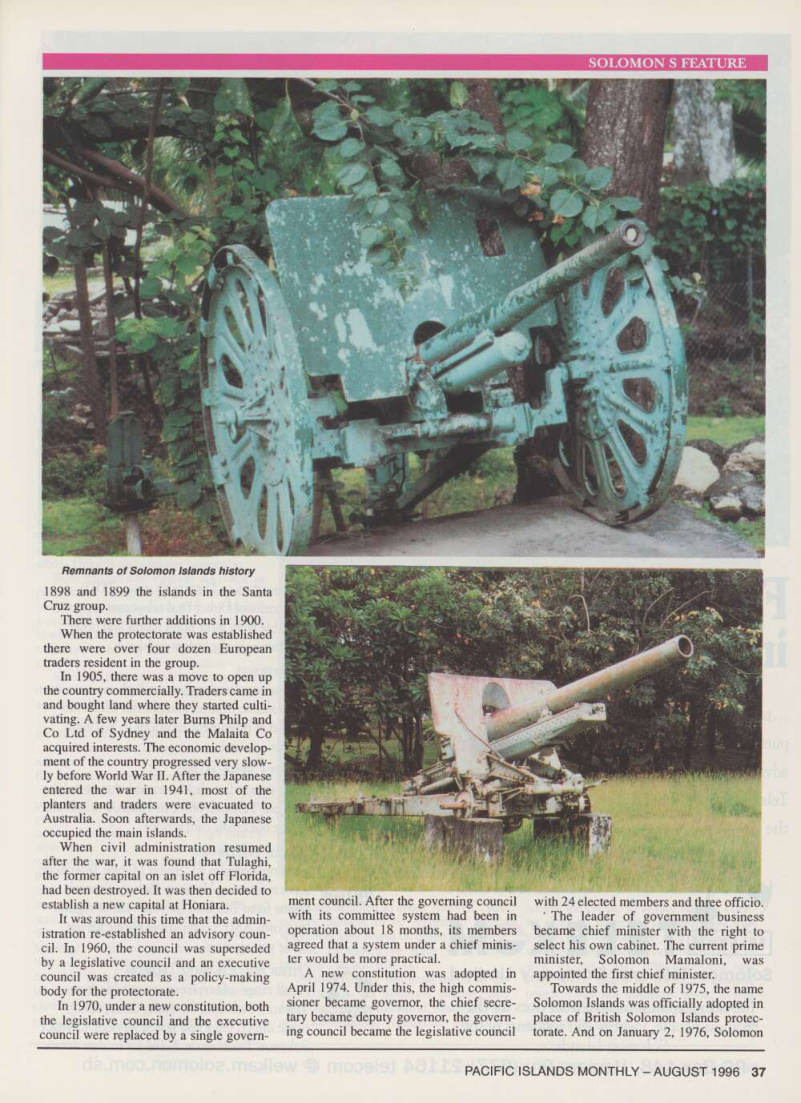
Remnants of Solomon Islands history
Islands became an internally self-govern
ing state. Independence followed on July
7, 1978. Since independence politics has been generally stable although there have been frequent changes in prime minister
ship.
The official language on the islands is
English although the effective language is
Pidgin. In addition, about 87 different ver nacular forms of speech are used, with people living in villages only a few miles apart frequently unable to understand each other. There is no common vernacular.
Both Pidgin and English are used in
parliament. Religion plays an important
role in most communities with the church a central focus in most villages. Extended families, tradition and custom dictate a major part of daily life. Christians com prise 95 per cent of the population.
Solomon Islanders love sports and take their soccer, basketball, rugby, tennis and
athletics quite seriously.
The primary production for the country includes copra and alluvial gold.
Activities like fishing and swimming are more necessities than choice; the first for food, the second for cleanliness.
Traditional canoes can still be seen, particularly in the outer islands, where people are proud of their production and sailing. Craft work is also of high quality with much work done with wood inlaid with mother-of-pearl. Although there has been a decline in tourism over the past few years, the country has great potential to attract adventure travellers interested in scuba diving and in wilderness areas.
Solomon Islands has many of the natural resources required for successful eco tourism. Archaeological research has revealed that Solomon Islands has been inhabited for at least 3000 years. Material excavated on Santa Ana, Guadanacanal and on Gawa in the Reef Islands has been
radiocarbon-dated to about 1000 BC. Red pottery thought to be related to Lapita ware, was also found on Santa Ana where it was estimated to have been used between 140 and 670 AD.
Similar pottery has been found in the Reef Islands. As Solomon Islands, like other countries of the world, heads into the next millennium, Mamaloni has chal
lenged the people to ensure that the coun try does so in peace, harmony and with greater confidence. He said the past 12 months brought many mixed blessings as well as trials and tribulations.He said while these might be taken for granted, people must not complain about events and issues threatening the peace and har mony of the nation. ■
Mamaloni...ushering the Solomons into the next millenium with peace and harmony
A scenic view of Guadacanal