Tonga Feature
pp. 40-45 · Read in the full issue
Getting to know the world's smallest Island kingdom
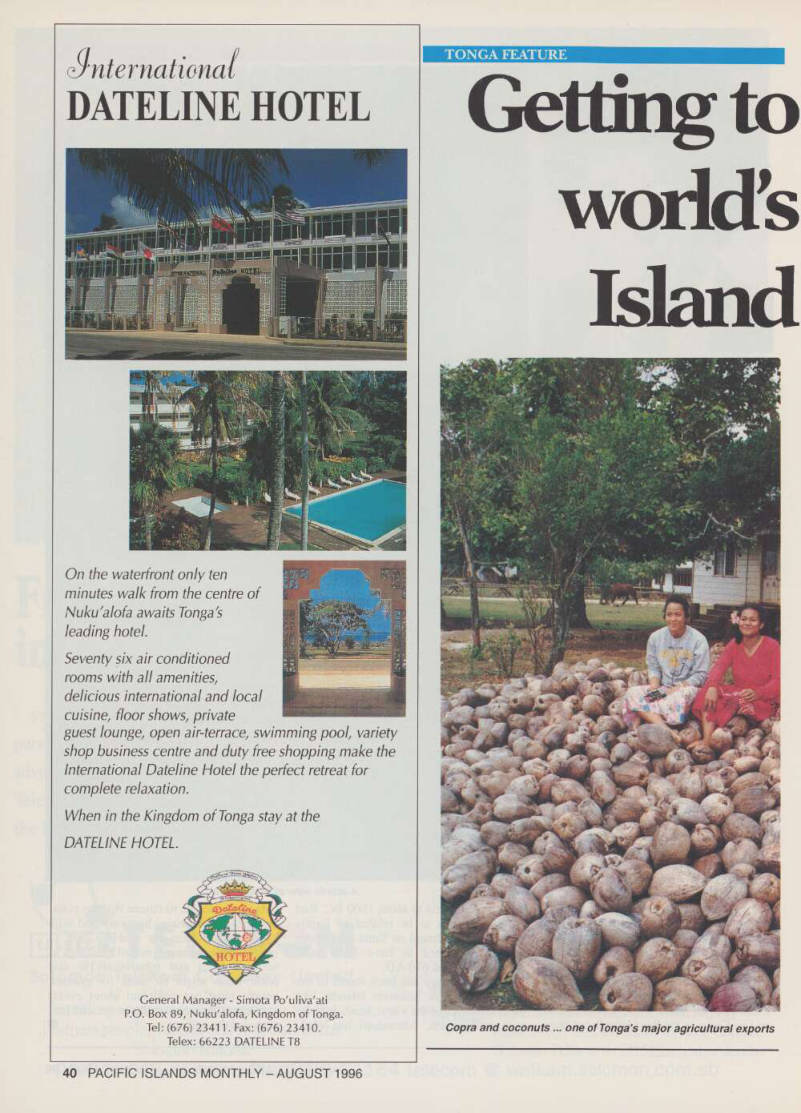
Copra and coconuts...one of Tonga’s major agricultural exports
THE Kingdom of Tonga, the world’s smallest kingdom, con sists of 150 islands of which only 36 are permanently inhab ited. The largest is Tongatapu which is distinctively flat, its highest point being only a few metres at a low hillock near the royal palace. The capital is Nuku’alofa which is on the island of Tongatapu.
The other islands are the Ha’apai Group, Vava’u Group, Niuas, Niuatoputapu, Tafahi, Niuafo’ou and Falcon Island.
The first European discovery of Tonga was by members of the Dutch expedition of Schouten and Le Maire. They came upon the northern Tafahi and Niuatoputapu in 1616 when crossing the Pacific to the West Indies.
In 1643, their countryman, Abel Janszoon Tasman, approached the archipelago from the south.
He sailed with the ships Heemskerck and Zeehaan. He sighted the southernmost island, Ata, before coming upon ‘Eua and Tongatapu, which he named Middleburgh and Amsterdam respec
tively.
He spent three days at Tongatapu, and a week at Nomuka to the northward, taking in provisions. Nomuka was named Rotterdam.
In 1767, Captain Samuel Wallis, the first European to come across Tahiti, came upon the two northern islands as seen by Schouten and Le Maire.
Unaware of their prior discovery, he gave the name Boscawen to Tafahi and Keppel to Niuatoputapu - names they bore on European charts for the next century or so.
In October 1773, Captain James Cook made the first of the three visits to Tonga.
In the following June, Cook returned to Tonga. His third visit was in 1777. It was during this visit he named Lifuka(Ha’apai) group the
Friendly Islands.
Captain Alessandro Malaspina was the last European explorer to visit Tonga before the arrival of the first permanent European set tlers.
Tonga is the only island in the South Pacific which, even after 26 years of independence, has a monarch as the head of state. Although Tonga is a constitutional monarchy on the British model, the king, in fact, exercises wide influence. The government consists of the king, the privy council, cabinet and the legislative assembly and the judi
ciary.
The constitution was handed down by King Tupou I on November 4, 1857. The king voluntarily limited his own powers after emancipating his people from the semi-serfdom which they had lived in for centuries.
The members of the legislative assembly are the speaker, mem bers of the cabinet, nine nobles elected by the 33 nobles of Tonga and nine representatives of the people elected by the universal adult suffrage. The prime minister is the head of government and admin-
isters a number of ministerial departments as well as district and town offices. The king appoints the speaker and the cabinet which includes ministers of the crown and the governors of Ha’apai and Vava’u, presided over by the prime minister. All the ministers are permanently appointed by the king and retain office until retire ment. The only form of local government is through town and district officers.
Town officers make up the government in a village. District officers have authority over a group of villages. Ha’apai and Vava’u have their own governors.
Tonga gained its independence from Britain on June 4, 1970.
Up until 1953, Tonga was still very much out of the limelight as far as relationships with the outside world were concerned.
But two events brought Tonga into the world spotlight.
In June 1953, Queen Salote attended the coronation in London of Queen Elizabeth II and spent about two months in Britain dur ing which she endeared herself to all who saw and met her.
In December of the same year. Queen Elizabeth accompanied by her husband, the Duke of Edinburgh, visited Tonga.
In 1958, a new treaty of friendship was signed between Tonga and Britain and tactified in May 1959.
The treaty provides for the appointment of a British commis sioner and consul to be responsible to the Governor of Fiji, who held the office of British chief commissioner for Tonga. In 1965, the British commissioner and consul of Tonga became directly responsible to the British secretary of state for the colonies.
When Queen Salote died in 1965, Prince Tungi acceded to the throne as King Taufa’ahau Tupou IV and his brother, Prince Tu’ipelehake, became premier.
After independence the title prime minister was substituted for
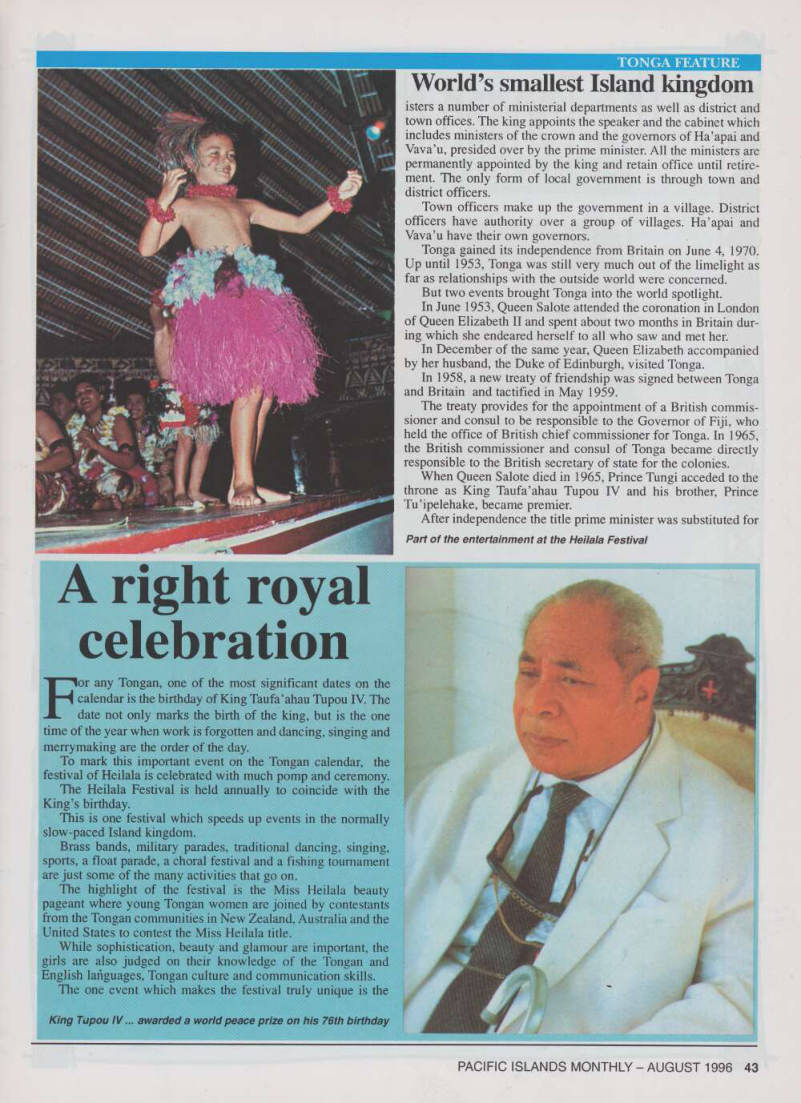
Part of the entertainment at the Heilala Festival
premier. Also after independence Britain
appointed a high commissioner to Tonga
and Tonga joined the Commonwealth and appointed a high commissioner in London.
Recent archaeological research has revealed that the Tongan archipelago was inhabited at least 3000 years ago.
The Tongans of those days were mak ers of elaborately decorated Capita pot tery, like that found in Fiji, but a few cen turies later they were only making plain ware. Only a small amount of pottery was in use when the first European explorers arrived.
The Tongans are Polynesians and the Tongan language is part of the widely scattered language family known as Austronesian or Malayo-Polynesian.
It was reduced to written form by the Wesleyan missionaries of the early 19th Century. The first book in the Tongan lan guage was printed on April 14, 1831.
Tongans actively maintain many of their traditional customs in their daily lives.
The wearing of the ta’ovala and kiekie, fine mats and fancy waist decora tions, which show respect for authority is perhaps the most observed custom. The fancy kiekie is often worn by young women over their jeans, an interesting sign of cultural transition.
There is a pyramid of social hierarchy, with the royal family at the pinnacle, fol lowed by 33 nobles. The rest of Tongan society form the base.
Agriculture, fisheries and forestry are
the leading productive sectors. Products which Tonga exports are coconut oil, des iccated coconut, bananas, vanilla beans and root crops.
Tourism is a major contributor to the economy and attractions include game fishing and sailing around the islands of Vava’u.
Tonga has one weekly newspaper, the Tonga Chronicle, which is published every Thursday in Tongan and English. It is government owned and covers items of local and international interest.
There is also an independent Tongan language paper, Ko’e’ Kele’a, a bimonth ly Matangi Tonga and a monthly maga
zine called Tonga Today.
Currency used is pa’anga (banknotes) and seniti (cents). ■