employment opportunities
p. 33 · Read in the full issue
Leaders mull over employment opportunities
In the face of the economic crises of the region and the need to down size public service bodies, the sth Pacific Islands Conference of Leaders looked at ways to boost the economy and create more jobs
By Margaret Wise
The creation of employment, in the formal, informal and subsistence sectors is the greatest challenge facing Pacific Island countries today.
Delegates to the Fifth Pacific Islands Conference of Leaders held in Fiji recog nised job creation as vital if the region was to improve its standard and quality of life.
“When people have a livelihood and when they go home to their families and are able to bring a paycheck home, there is less friction - so there is a lot of joy in work,” said the special guest speaker, world-renowned tennis player and man agement guru, Peter Burwash.
Employment is created by two things: Great leadership and outstanding service, Burwash told the three-day conference at the Sheraton Resort in Nadi, Fiji.
On discussion of the conference theme,
Population, Employment Creation and
Resource Management, Pacific Island leaders concluded that the problems and solutions identified were not new. But they valued the opportunity to share expe riences and realise that not only must they act decisively within their respective countries, but that they must act together in a concerted effort to help each other whenever necessary.
The key to employment creation is economic growth. Pacific Island countries and territories are inexorably a part of the global economy. And strong and sustained growth can only come about when gov ernments adopt policies which would enhance their international competition.
To achieve such growth, the leaders agreed to support the private sector and, in turn, be open to foreign investment for the
much-needed capital, technology and
expertise. The leaders agreed to ensuring
within their countries an environment of political stability and one where investors, local and foreign, would feel secure. The leaders identified increased investment in small- and medium-sized businesses, export-based industries, service industries like tourism, the development of natural resources, including agriculture and agro-
based industries, timber and minerals, and marine resources as the highest priority.
They agreed that public-sector reform, particularly the reduction in size and cost of governments, was urgent. None of the Island countries have welfare systems to support the unemployed. Those made redundant would have to be retrained - an exercise requiring resources.
Of particular concern, was the finan cial difficulties faced by the East West Centre in Honolulu, Hawaii. Drastic cuts in United States federal grants to the cen tre have severely affected the Pacific Islands Development Programme’s applied research activities. The research programme focuses mainly on business related studies. Following the 1994 US Congressional elections, the EWC appro priation was cut by more than 50 per cent this year from sUS24million to $U511.75 million. Chairman of the Standing Committee Sir Geoffrey Henry called for a review of the legal and institutional sta tus of the PIDP within the EWC. Because the PIDP is an integral part of the centre, it cannot directly receive financial contri butions from outside soources. Sir Geoffrey recommended that the status of the PIDP secretariat be changed to a con
sortium, allowing it to maintain links with the centre as well as free it to develop co operative research arrangements with other universities. Fiji Prime Minister Sitiveni Rabuka was appointed chairman of the Standing Committee of the confer ence to supervise the work of the PIDP until the next conference.
The leaders expressed concern about the natural and social environment and agreed to do all they could to ensure that the exploitation of their primary resources would not result in the wholesale degrada tion of their physical surroundings.
Also of concern was the need the lead ers felt of protecting their cultural heritage while modernising the economy, which would lay emphasis on the value of indi vidual effort and material success.
However, the leaders felt that for Island countries, communal harmony and
spiritual development of the people were
as important as their material well-being and progress. Here, perhaps the best advice came from Fiji President and founding father of the PICL Ratu Sir Kamisese Mara, who said that in planning and executing new strategies, it was better to “build on what you have rather than scrap the lot and start again”. ■
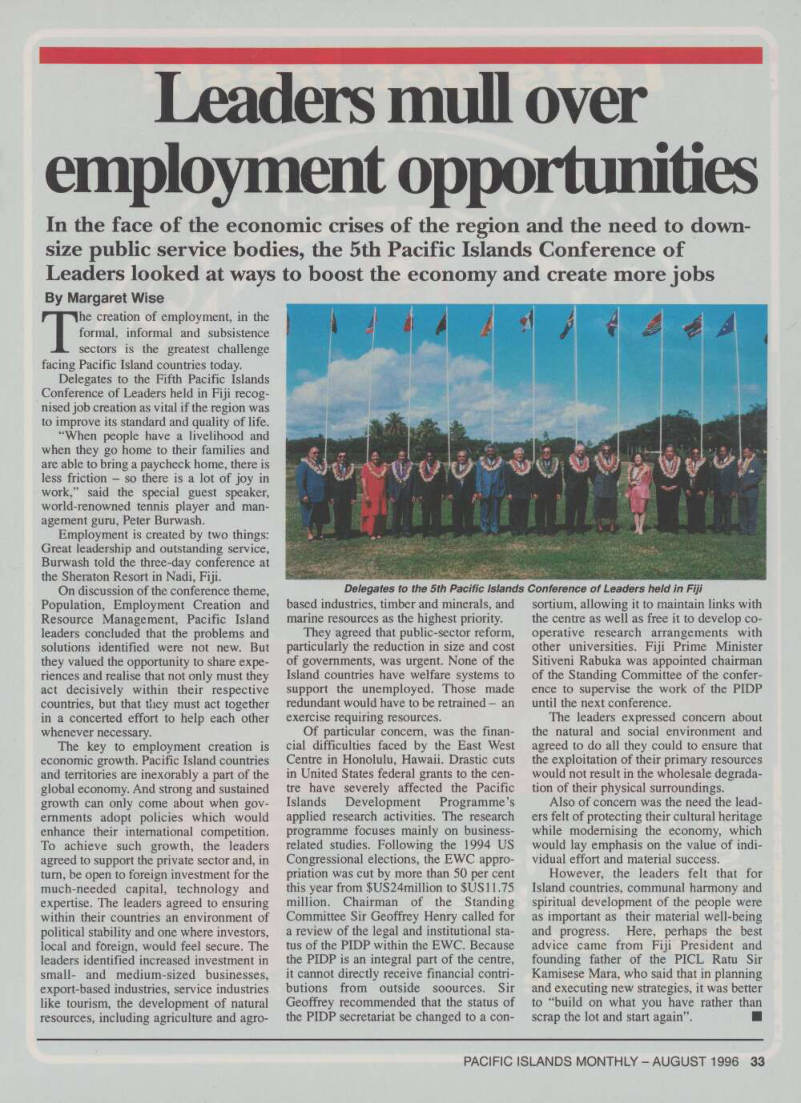
Delegates to the sth Pacific Islands Conference of Leaders held in Fiji