Freedom of expression -
pp. 15-16 · Read in the full issue
Cover Stories
Freedom of expression an endangered institution
By Bernadette Hussein
Freedom of expression is becoming a
more and more fragile and endan gered institution in the Pacific, with constant threats to control the media by the powers that be, justified by claims that such action would guard against cultural insensitivity and breaches of confidential ity and violation of privacy.
Media reports revealing facts which are negative or unfavourable are criticised for being culturally insensitive or threat ening the security of a country.
And if the media organisation happens to be foreign owned, it is accused of not understanding local cultures and tradi tions.
There have been numerous incidents in Fiji, the reporting of which have seen the government cry foul and accuse the media of being culturally insensitive and work ing against the interests of the nation.
But it is not only the media which comes under pressure for speaking out.
In July 1995, three government minis ters gave up their cabinet posts over an amendment moved by the prime minister.
Leo Smith and Taufa Vakatale, the then ministers for infrastructure and education, respectively, voted against the amendment on an opposition motion condemning French nuclear testing. The third, then minister for information Isimeli Bose, had abstained.
The amnedment was defeated and the next day saw Prime Minister Sitiveni Rabuka requesting the resignation of the three ministers. Vakatale resigned. Smith and Bose refused to resign and were sacked.
“If we are to be effective as a govern ment, it is critically important to have a cabinet that is solidly together as a team,”
Rabuka was reported as saying at the time.
In his speech on May 6, Media Freedom Day, the prime minister told journalists that the government was look
ing into introducing confidentiality and
privacy laws imposing restrictions on what could and couldn’t be reported, cit
ing Singapore, Malaysia and Thailand as
examples.
The media in these countries accepted as essential checks and balances desigend for national security, social cohesion and economic progress, he said.
“We must not be slaves to definitions of Press freedom and democracy propa gated by the Western world,” he said.
Doctor Tupeni Baba, however, places a somewhat different slant, on the govern ment’s motives to find it necessary to try and control media freedom by Doctor
Tupeni Baba.
“The degree of sensitivity of the gov ernment is closely associated with its sense of insecurity. The more it becomes insecure, the greater is its sensitivity to media treatment that exposes its inadequa cies as in financial dealings of its senior members or the financial affairs of the nation generally,” Dr Baba said in Media Aware, a newsletter published by Fiji Media Watch.
In his piece, titled “Culture and the media”. Dr Baba, a lecturer at the University of the South Pacific, urges the media to “expose apsects of Fijian culture to critical analysis”.
This, he said, would lead to greater understanding of the culture and its rela tion to modem Fijians.
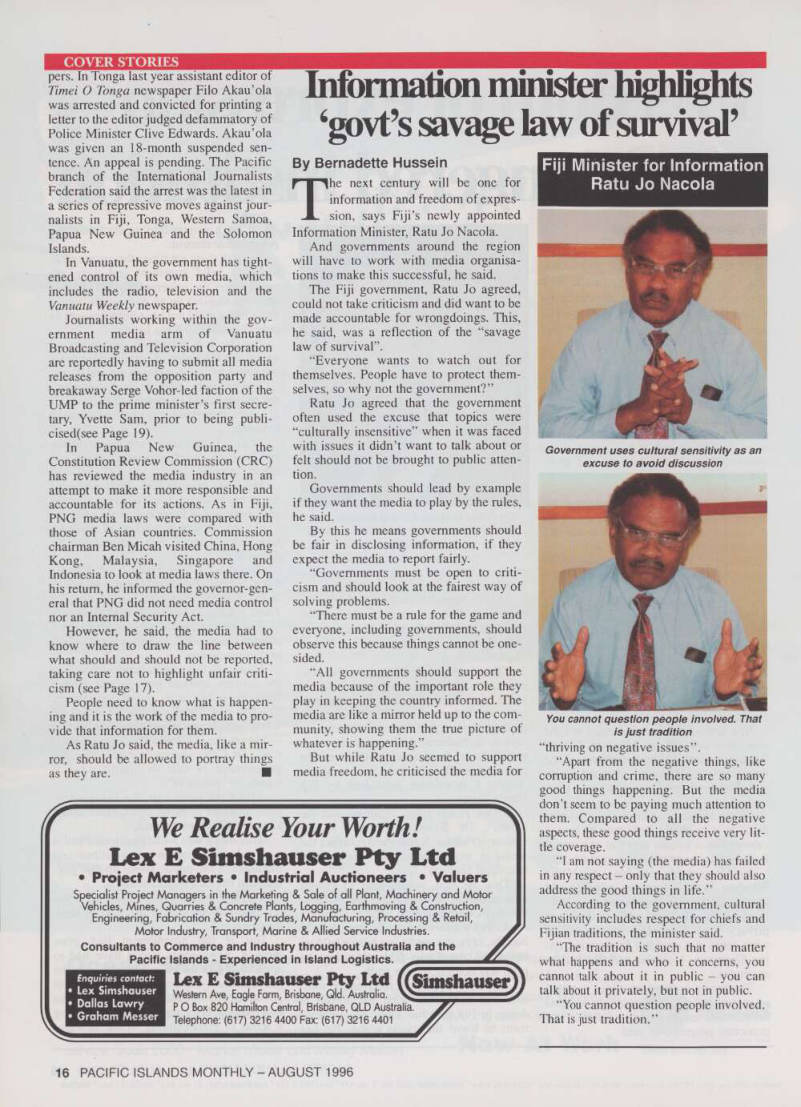
As Fiji’s information minister, Ratu Jo Nacola, says, the media is a mirror held up before the community. It should reflect the truth and nothing but the truth.
The newly appointed information min ister has supported what the media is doing in Fiji and has urged the govern ment to leave the media alone. He has
asked for a responsible media free from government control.
“I think there are times the government makes a valid statement and there are times when the government uses it (cul tural sensitivity) as an excuse for some thing that should not have been brought to public attention,” Ratu Jo said.
But he has called on journalists to appreciate the rights of certain individuals or groups to do what they want and value.
For example, Ratu Jo said, although the people could be critical of the actions of chiefs, the criticism could not be voiced
in public.
“I’m a Fijian and sensitive to culture and I will never write anything against tra dition,” he said.
However, Ratu Jo feels that for a coun try to move ahead, it is very important to have freedom of Press and expression.
A country which worked to suppress this could never be democratic, he stressed.
The most recent example of govern ment control over freedom of expression in Fiji was the attempted ban on The Fiji Times columnist Doctor Ronald Gatty.
The government described Dr Gatty’s columns as “racist” and branded the writ
er “irresponsible”.
However, this government response to the column sparked outrage and protest from the public and opposition parties.
The ban was lifted within a week and Dr Gatty was given leave to continue writing - but on the condition that he be “sensi tive”. Dr Gatty claims, however, that the government is still to clarify what it means by “sensitive”.
About six years ago, the Fiji govern ment planned to bring newspapers under annual registration control.
This move was widely criticised and it was only after media organisations and members of the public spoke up that gov ernment decided to go against it.
The law requires newspapers to regis ter their publications at the start of busi
ness only.
But if the amendment had gone through, newspapers would have had to apply to register anew every year with the Administrator-General’s Office. The Fiji government’s reason for the move was that the new laws were aimed at instilling a sense of responsibility in the newspa
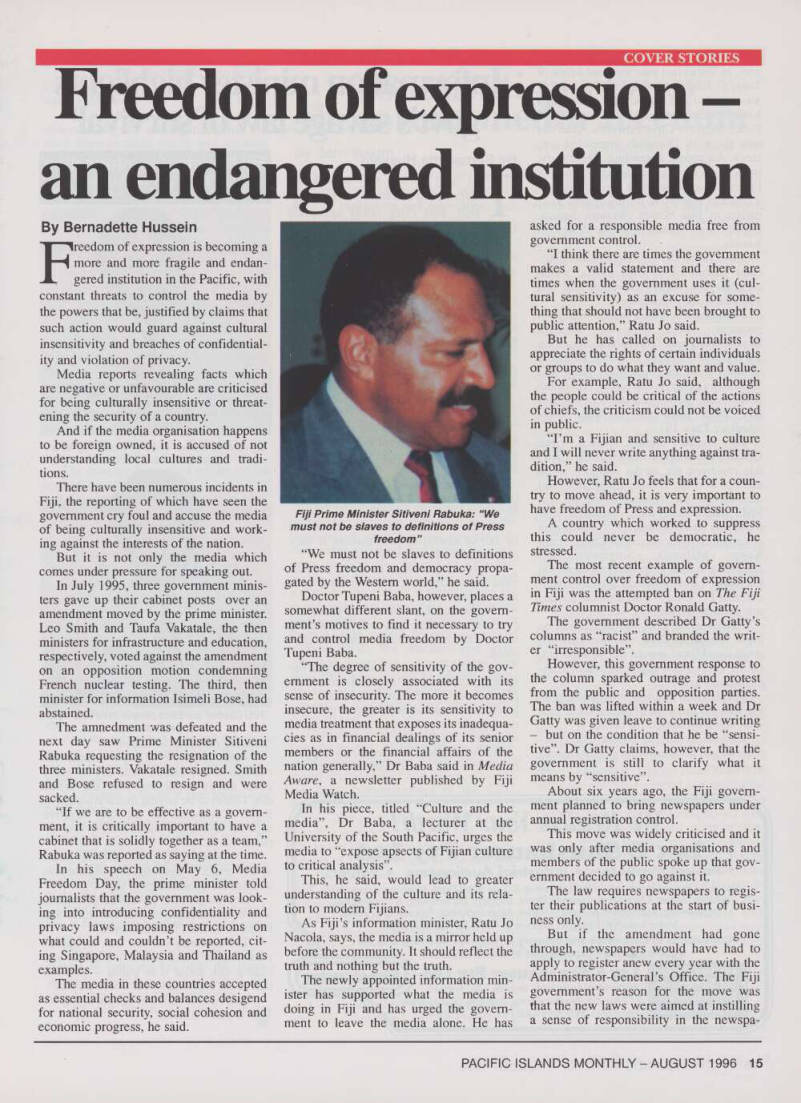
Fiji Prime Minister Sitiveni Rabuka: “We must not be slaves to definitions of Press freedom”
pers. In Tonga last year assistant editor of Timei O Tonga newspaper Filo Akau’ola was arrested and convicted for printing a letter to the editor judged defammatory of Police Minister Clive Edwards. Akau’ola was given an 18-month suspended sen tence. An appeal is pending. The Pacific branch of the International Journalists Federation said the arrest was the latest in a series of repressive moves against jour nalists in Fiji, Tonga, Western Samoa, Papua New Guinea and the Solomon Islands.
In Vanuatu, the government has tight ened control of its own media, which includes the radio, television and the Vanuatu Weekly newspaper.
Journalists working within the gov ernment media arm of Vanuatu Broadcasting and Television Corporation are reportedly having to submit all media releases from the opposition party and breakaway Serge Vohor-led faction of the UMP to the prime minister’s first secre tary, Yvette Sam, prior to being publi cised(see Page 19).
In Papua New Guinea, the Constitution Review Commission (CRC) has reviewed the media industry in an attempt to make it more responsible and accountable for its actions. As in Fiji, PNG media laws were compared with those of Asian countries. Commission chairman Ben Micah visited China, Hong Kong, Malaysia, Singapore and Indonesia to look at media laws there. On his return, he informed the governor-gen eral that PNG did not need media control nor an Internal Security Act.
However, he said, the media had to know where to draw the line between what should and should not be reported, taking care not to highlight unfair criti cism (see Page 17).
People need to know what is happen ing and it is the work of the media to pro vide that information for them.
As Ratu Jo said, the media, like a mir ror, should be allowed to portray things as they are. ■