Cohens - free at last
pp. 12-13 · Read in the full issue
Focus
But what does the future hold for New Zealand’s mother and son who made world headlines when convicted on drug charges in Malaysia?
Will release from prison be able to give them a true taste of freedom?
By Atama Raganivatu
Asad and sordid episode ended on June 29 when New Zealanders Lorraine and Aaron Cohen were released from a Malaysian prison, 11 years after being convicted on drugs
charges.
The story really began in 1960 and the time Lorraine gained a liking for heroin.
By 1966, her intake had become so high that when she gave birth to Aaron that year he was addicted.
For the next 19 years, heroin ruled the Cohens’ lives or, to be more precise, the pursuit of sufficient money to enable them
to indulge in their habit did. Between 1960 and 1982, Lorraine clocked up 38 convictions for prostitution, theft and drug offences.
Aaron, too, became a familiar figure in the law courts and was on bail when the two were arrested at Penang Airport in 1985 and charged with trafficking heroin.
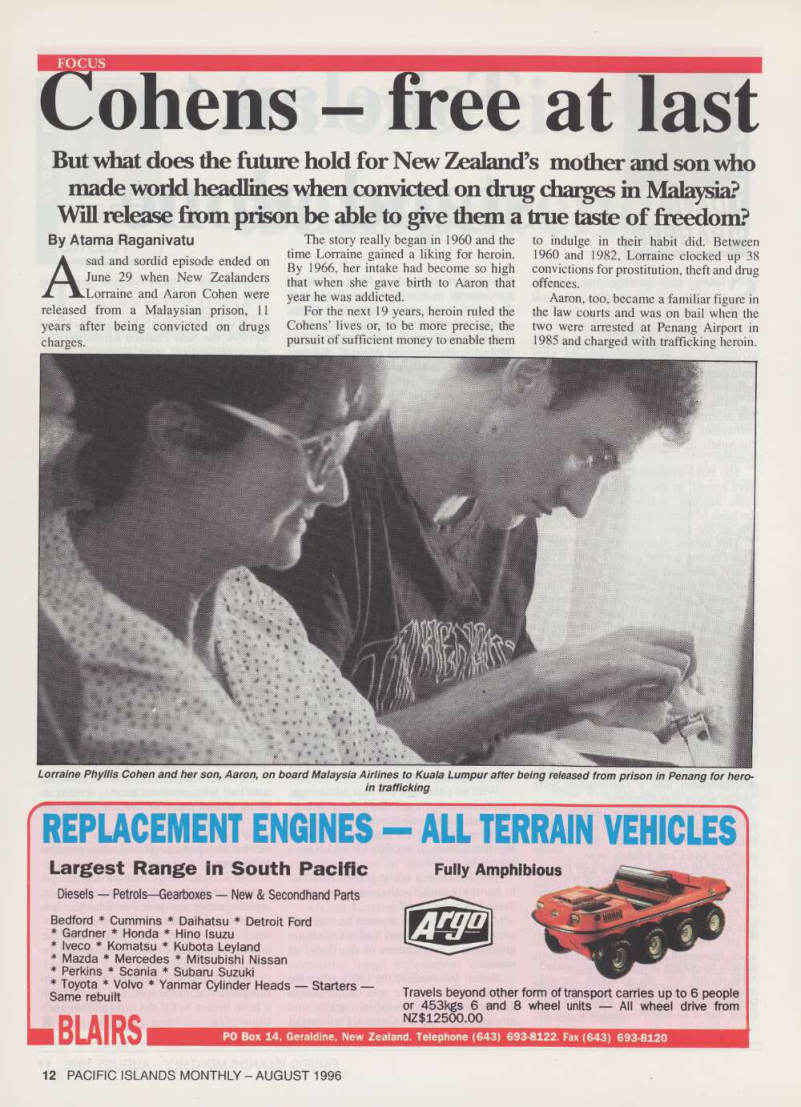
Lorraine Phyllis Cohen and her son, Aaron, on board Malaysia Airlines to Kuala Lumpur after being released from prison in Penang for hero in trafficking
Thirty months were required for the Cohens to come to trial. Both pleaded not guilty: Lorraine to trafficking in 140 grams of heroin and Aaron to trafficking in 34 grams of the same substance. Their cases always appeared feeble and Lorraine was sentenced to death and her son to life imprisonment plus six strokes of the ratan cane.
Despite Malaysia having originally
introduced severe penalties for drug offences largely at the behest of Western “consumer nations” like New Zealand, a campaign commenced in the Cohens’ home country to reduce their punish ments.
An unlikely supporter was John Banks,
an influential right-wing politician
renowned for his law and order crusades who had once been a neighbour of Lorraine and Aaron.
Although not making an official protest over the sentences, the New Zealand government let its concerns be
known through diplomatic channels.
The Malaysian authorities have, under
standably, displayed cynicism towards
Westerners who tolerate, and even encour ag, Asian drug smugglers being hung but protest vehemently when their equally guilty compatriots face this ultimate indignity. Since Kuala Lumpur introduced the death sentence for narcotics traffick ing in 1975, approximately 230 offenders have been executed. Among them were
Australians, Britons and Germans.
Malaysia’s government, then, would not have been swayed solely by the noises coming from New Zealand. However, their good relations with Wellington almost certainly contributed to Lorraine’s sentence being commuted to life impris onment two years after an appeal was
lodged.
The endeavours of the Cohen’s ener
getic lawyer, Karpal Singh, in persuading
the appeals court that the heroin she was carrying in Penang had been intended for her personal use and not for financial gain
probably had equal weight in influencing
the decision. Tlte fear of bad publicity
engendered through executing a woman
would also have helped her. Aaron’s appeal was dismissed though and, in December, 1991, he received six ratan strokes.
A greater trauma befell Lorraine dur ing 1992 when she was diagnosed with cancer and, in November of that year, her left breast had to be removed. Lorraine’s health problems formed the basis of
Karpal Singh’s annual applications for a
pardon.
Thirteen years is the normal jail term those sentenced to “life” have to endure in Malaysia. And the Cohens can perhaps consider themselves lucky their releases came 11 '/ 2 years after being first detained at Penang.
New Zealand Prime Minsiter Jim Bolger had “raised the matter” when meeting his Malaysian counterpart. Dr Mahathir, three months earlier. Such is the secrecy surrounding all aspects of interna tional diplomacy, one can only speculate upon how significant that get-together was in the Cohens gaining liberty.
Conjecture over the Cohens’ future would be equally inconclusive.
Singh claims both are now free of drug addiction, yet Lorraine recently admitted she “occasionally feels a pang for heroin” and friends of Aaron believe “he still has a problem”. Media reports that Aaron is booked into an Auckland detoxication centre supports this pessimism. Drugs, apparently, are readily available in
Malaysian prisons.
An exclusive story deal with a women’s magazine will earn the Cohens at least SUS 13,000 and the book they intend to write may well yield consider ably more. Even so, the long-term prospects for Lorraine and Aaron, who are now 53 and 29 respectively, appear most uncertain.
First of all, they have to adjust to life beyond the prison walls. Once this has been achieved, the Cohens will discover the New Zealand of today is different from the New Zealand of 1985 and legiti mate work opportunities for ex-criminals are rarer than ever before. Lorraine’s age
also handicaps her in the job market.
The fact most of their friends and acquaintances are criminals augurs badly for them too.
It will not be easy for the Cohens to become part of the New Zealand social mainstream they have rejected in the past, if they wish to embrace it now, as both insist.
The Cohens will find the media spot light irksome and intrusive as they endure affronts like Press headlines proclaiming Aaron contracted AIDS (Acquired Immune Deficiency Syndrome) in Malaysia (which he denies). They will hope that members of their very extended family can offer temporary shelter from the public’s gaze.
Lorraine’s four children have four dif ferent fathers. Alas, Aaron’s is not on hand to help. Denny Cohen, a professional musician and long-time junkie, died in Bangkok two years ago.
Although Lorraine and Aaron are sure to relish their liberty from prison, they may never be able to savour true freedom.
The Cohens saga may yet have an unhappy ending. ■
As Pacific Islands Monthly went to press, Woman’s Day magazine published its exclusive interview with Lorraine Cohen. Among the snippets includ ed in the feature were: • Lorraine’s current attempt to give up using heroin is the 17th of her life; • Lorraine claims she was denied access to drugs in Penang Prison, but Aaron received a con stant supply. Apparently, warders in the men’s section are more cor rupt than their female counter parts; • Lorraine had a miscar riage shortly after being arrested in Malaysia and flushed the baby down the drain without informing prison authorities; • Aaron learned Malay in prison and is now fluent in the lan guage - a fact which should consid erably enhance his employment prospects; • Lorraine was diagnosed as having cancer six months after alerting prison medical officers to the lump in her breast which proved to be malignant.
The Cohens are said to be resid ing in Auckland’s North Shore dis trict. To date, they have succeeded in maintaining a low profile. ■
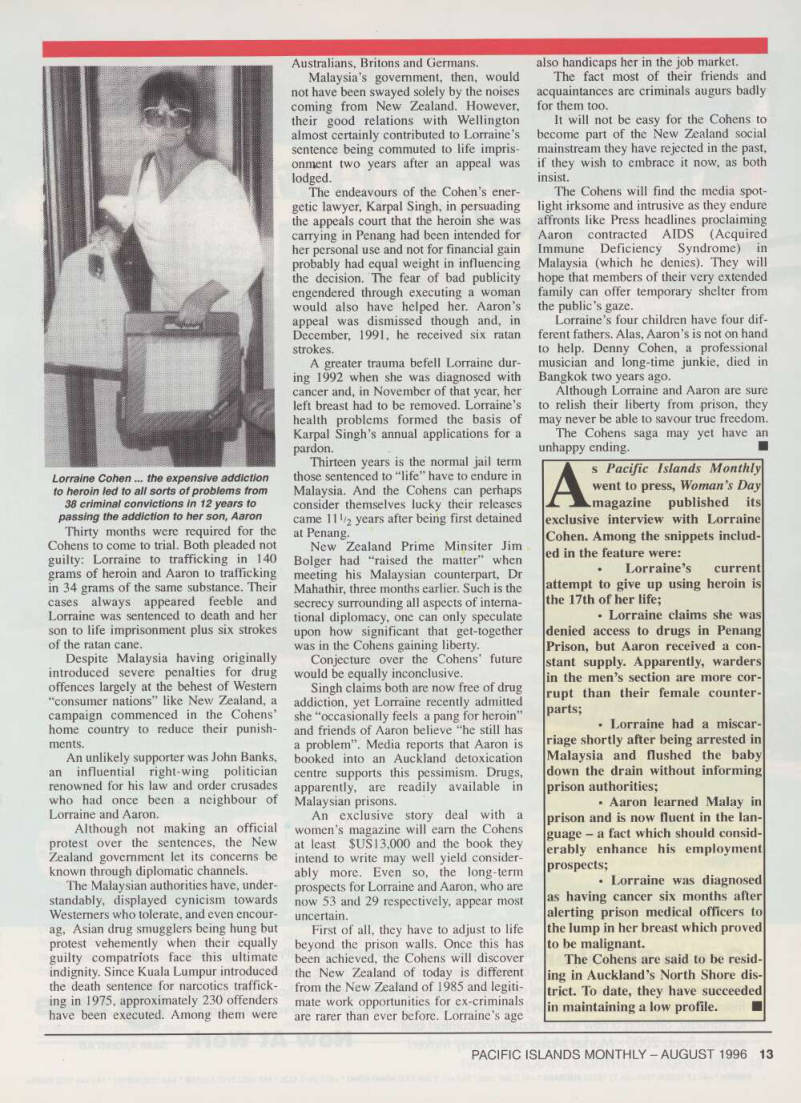
Lorraine Cohen...the expensive addiction to heroin led to all sorts of problems from 38 criminal convictions in 12 years to passing the addiction to her son, Aaron