Information minister highlights
pp. 16-17 · Read in the full issue
‘govt’s savage law of survival’
By Bernadette Hussein
The next century will be one for information and freedom of expres
sion, says Fiji’s newly appointed
Information Minister, Ratu Jo Nacola.
And governments around the region will have to work with media organisa tions to make this successful, he said.
The Fiji government, Ratu Jo agreed, could not take criticism and did want to be made accountable for wrongdoings. This, he said, was a reflection of the “savage law of survival”.
“Everyone wants to watch out for themselves. People have to protect them selves, so why not the government?”
Ratu Jo agreed that the government often used the excuse that topics were “culturally insensitive” when it was faced with issues it didn’t want to talk about or felt should not be brought to public atten tion.
Governments should lead by example if they want the media to play by the rules, he said.
By this he means governments should be fair in disclosing information, if they expect the media to report fairly.
“Governments must be open to criti cism and should look at the fairest way of
solving problems.
“There must be a rule for the game and everyone, including governments, should observe this because things cannot be one sided.
“All governments should support the media because of the important role they play in keeping the country informed. The media are like a mirror held up to the com munity, showing them the true picture of whatever is happening.”
But while Ratu Jo seemed to support media freedom, he criticised the media for
rt
“thriving on negative issues”.
“Apart from the negative things, like corruption and crime, there are so many
good things happening. But the media
don’t seem to be paying much attention to them. Compared to all the negative aspects, these good things receive very lit tle coverage.
“I am not saying (the media) has failed in any respect - only that they should also address the good things in life.”
According to the government, cultural sensitivity includes respect for chiefs and Fijian traditions, the minister said.
“The tradition is such that no matter what happens and who it concerns, you cannot talk about it in public - you can talk about it privately, but not in public.
“You cannot question people involved.
That is just tradition.”
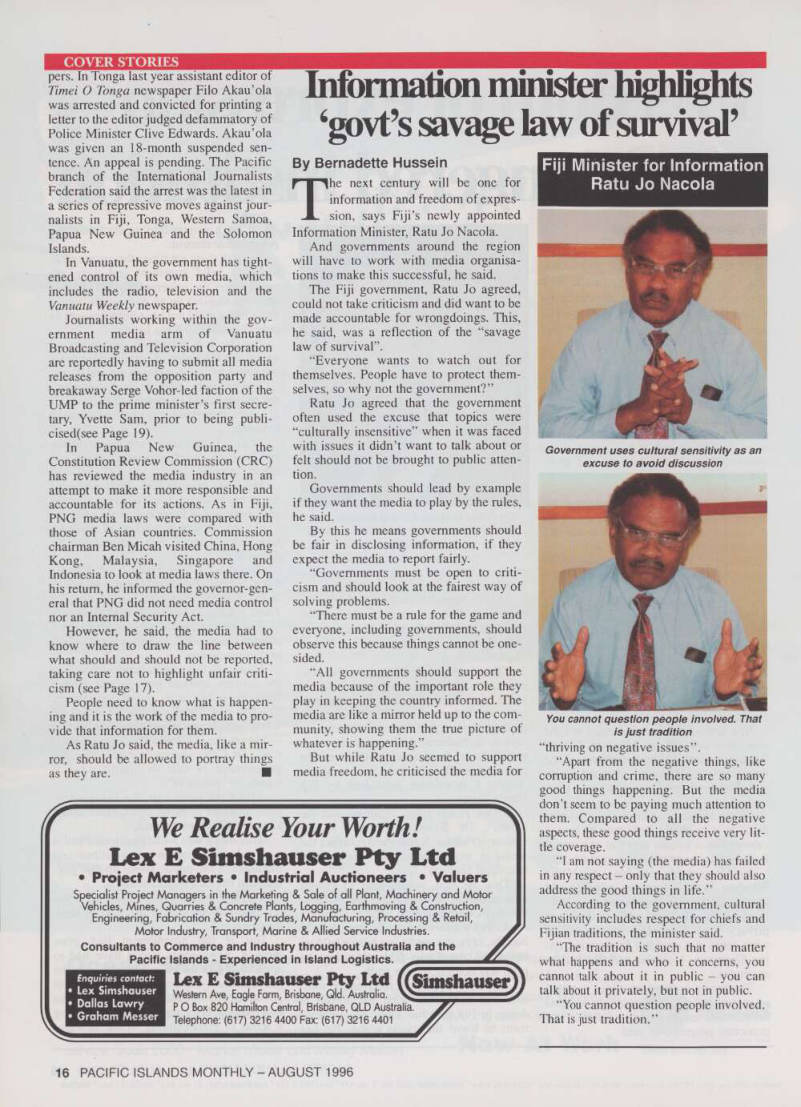
Government uses cultural sensitivity as an excuse to avoid discussion
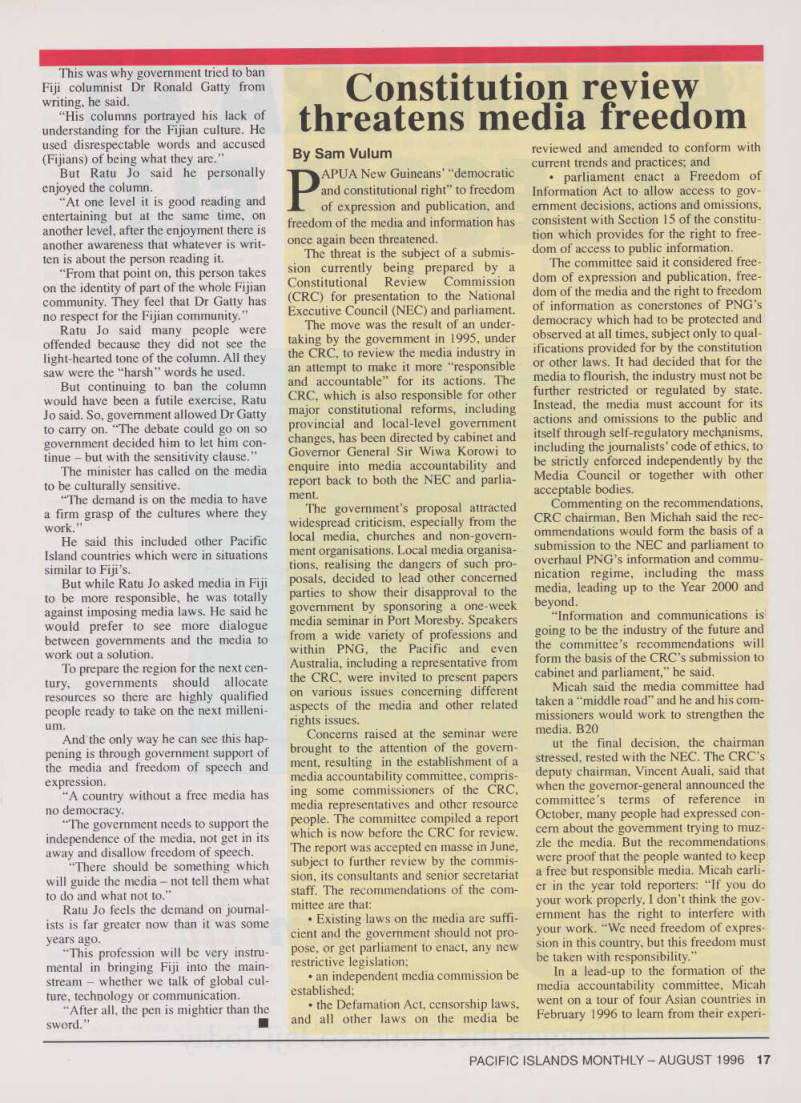
You cannot question people involved. That is just tradition
This was why government tried to ban Fiji columnist Dr Ronald Gatty from writing, he said.
“His columns portrayed his lack of understanding for the Fijian culture. He used disrespectable words and accused (Fijians) of being what they are.”
But Ratu Jo said he personally enjoyed the column.
“At one level it is good reading and entertaining but at the same time, on another level, after the enjoyment there is another awareness that whatever is writ ten is about the person reading it.
“From that point on, this person takes on the identity of part of the whole Fijian community. They feel that Dr Gatty has no respect for the Fijian community.”
Ratu Jo said many people were offended because they did not see the light-hearted tone of the column. All they saw were the “harsh” words he used.
But continuing to ban the column would have been a futile exercise, Ratu Jo said. So, government allowed Dr Gatty to carry on. “The debate could go on so government decided him to let him con tinue - but with the sensitivity clause.”
The minister has called on the media to be culturally sensitive.
“The demand is on the media to have a firm grasp of the cultures where they work.”
He said this included other Pacific Island countries which were in situations similar to Fiji’s.
But while Ratu Jo asked media in Fiji to be more responsible, he was totally against imposing media laws. He said he would prefer to see more dialogue between governments and the media to work out a solution.
To prepare the region for the next cen tury, governments should allocate resources so there are highly qualified people ready to take on the next milleni um.
And the only way he can see this hap pening is through government support of the media and freedom of speech and
expression.
“A country without a free media has no democracy.
“The government needs to support the independence of the media, not get in its away and disallow freedom of speech.
“There should be something which will guide the media - not tell them what to do and what not to.”
Ratu Jo feels the demand on journal ists is far greater now than it was some years ago.
“This profession will be very instru mental in bringing Fiji into the main stream - whether we talk of global cul ture, technology or communication.
“After all, the pen is mightier than the sword.” ■