local environment
pp. 51-52 · Read in the full issue
Environment
Bringing back the local environment
Working with nature to restore natural ecosystems. Liz Thompson reports
I. . ... n the last 50 years, the South Pacific region has experienced major environmental changes and now faces contmuai pressure from population growth and primary industries such as logging, mmmg and agriculture. With the growing awareness of the consequences of environmental exploitation, soil degradation, habitat loss and climatic changes it has become paramount that action is taken.
On a global level, these problems often seem overwhelming, with responsibility lying in the hands of government authorities and multinational corporations.
However, at grassroots level there are many ways by which, individually and communally, we can make positive environmental contributions. One of the most important ways is by protecting and
, encouraging our local indigenous environ
ment- .
The Native Garden Restoration Company was established with the mten tion of assisting people and community groups make positive changes to their local environment by regenerating, or ere ating indigenous or native habitats, in both urban and rural areas.
By transforming people s personal properties they hope to encourage a greater awareness as to the advantages and qualities of indigenous environments.
In an attempt to diminish the degrada tion taking place as a result of the invasive nature of many exotic species, they encourage property owners to create indigenous or at least bush-friendly gar dens/reserves, that is gardens in which
highly invasive exotics and weed species are removed.
Indigenous gardens provide habitat for
local and migratory animal species.
Foreign plants, on the contrary, do not provide the correct structure for a compli cated food web or the viable ecosystem upon which many local insects, birds, and animal species are dependent. As a result, exotic gardens are often devoid of animal life.
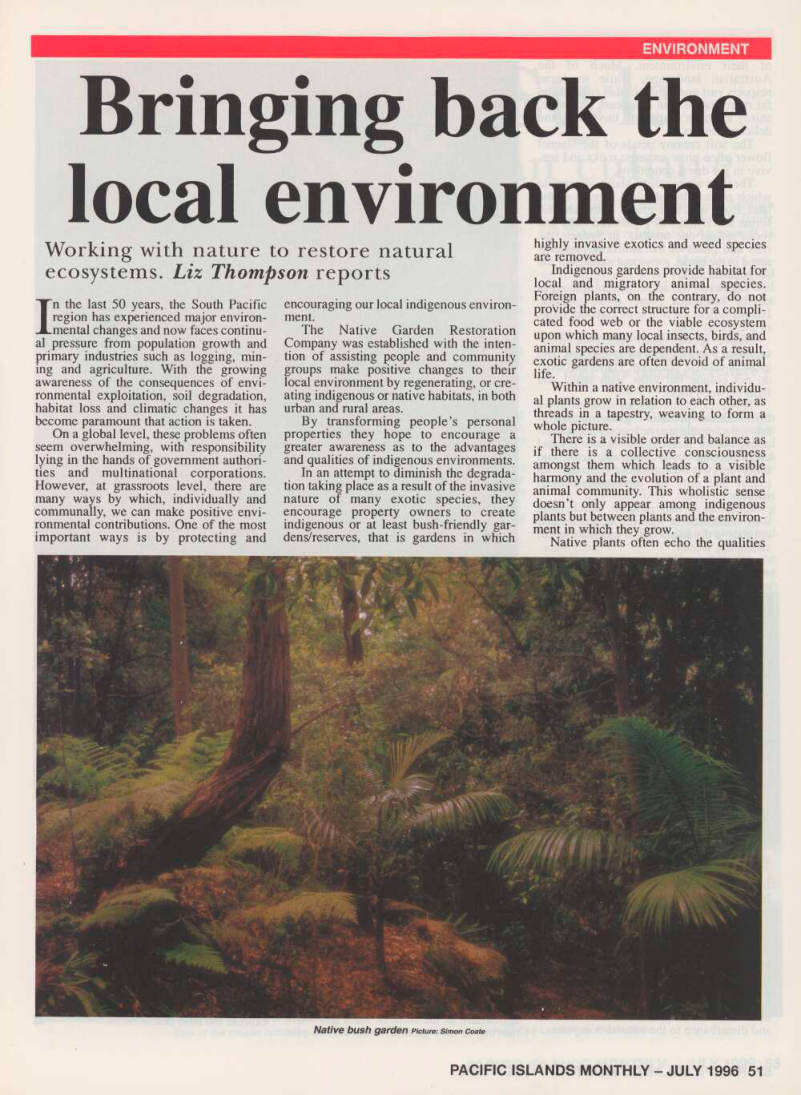
Within a native environment, individu al plants grow in relation to each other, as threads in a tapestry, weaving to form a
whole picture.
There is a visible order and balance as if there is a collective consciousness amongst them which leads to a visible harmony and the evolution of a plant and animal community. This wholistic sense doesn’t only appear among indigenous plants but between plants and the environ ment in which they grow.
Native plants often echo the qualities
Native bush garden Picture: Simon Coate
of their environment. Much of the Australian landscape, while in some respects vast and hardy, is also ancient and far more fragile than it appears. Likewise, sturdy tee trees erupt with tiny white and delicate flowers.
The soft creamy petals of the flannel flower often grow amongst rocks and sur vive in the driest conditions.
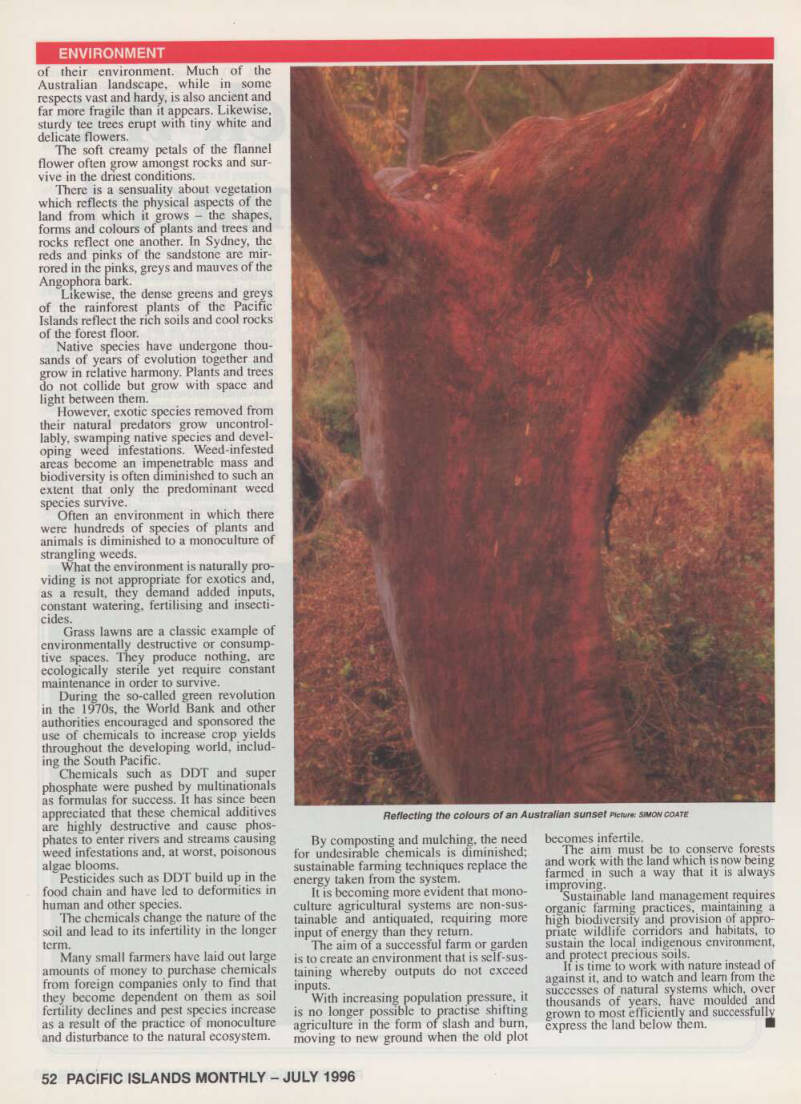
There is a sensuality about vegetation which reflects the physical aspects of the land from which it grows - the shapes, forms and colours of plants and trees and rocks reflect one another. In Sydney, the reds and pinks of the sandstone are mir rored in the pinks, greys and mauves of the
Angophora bark.
Likewise, the dense greens and greys of the rainforest plants of the Pacific Islands reflect the rich soils and cool rocks of the forest floor.
Native species have undergone thou sands of years of evolution together and grow in relative harmony. Plants and trees do not collide but grow with space and light between them.
However, exotic species removed from their natural predators grow uncontrol lably, swamping native species and devel oping weed infestations. Weed-infested areas become an impenetrable mass and biodiversity is often diminished to such an extent that only the predominant weed
species survive.
Often an environment in which there were hundreds of species of plants and animals is diminished to a monoculture of
strangling weeds.
What the environment is naturally pro viding is not appropriate for exotics and, as a result, they demand added inputs, constant watering, fertilising and insecti cides.
Grass lawns are a classic example of environmentally destructive or consump tive spaces. They produce nothing, are ecologically sterile yet require constant maintenance in order to survive.
During the so-called green revolution in the 19705, the World Bank and other authorities encouraged and sponsored the use of chemicals to increase crop yields throughout the developing world, includ ing the South Pacific.
Chemicals such as DDT and super
phosphate were pushed by multinationals
as formulas for success. It has since been appreciated that these chemical additives are highly destructive and cause phos phates to enter rivers and streams causing weed infestations and, at worst, poisonous
algae blooms.
Pesticides such as DDT build up in the food chain and have led to deformities in human and other species.
The chemicals change the nature of the soil and lead to its infertility in the longer term.
Many small farmers have laid out large amounts of money to purchase chemicals from foreign companies only to find that they become dependent on them as soil fertility declines and pest species increase as a result of the practice of monoculture and disturbance to the natural ecosystem.
By composting and mulching, the need for undesirable chemicals is diminished; sustainable farming techniques replace the energy taken from the system.
It is becoming more evident that mono culture agricultural systems are non-sus tainable and antiquated, requiring more input of energy than they return.
The aim of a successful farm or garden is to create an environment that is self-sus taining whereby outputs do not exceed inputs.
With increasing population pressure, it is no longer possible to practise shifting agriculture in the form of slash and bum, moving to new ground when the old plot
becomes infertile.
The aim must be to conserve forests and work with the land which is now being farmed in such a way that it is always improving.
Sustainable land management requires organic farming practices, maintaining a high biodiversity and provision of appro priate wildlife corridors and habitats, to sustain the local indigenous environment, and protect precious soils.
It is time to work with nature instead of against it, and to watch and learn from the successes of natural systems which, over thousands of years, nave moulded and grown to most efficiently and successfully express the land below them. I
Reflecting the colours of an Australian sunset picture: SIMON COATE