Eye-Land Style
pp. 53-54 · Read in the full issue
Culture
Eye-Land Style Resurrecting Samoan culture
By Liz Thompson
Dhntnnwnhu Cwo_i onri Hnotograpny py tye-Lano oiyie Productions and Sophie Howarth / / nee upon a time, a long time Qago in .he South Pacific Ocean, lived my ancestors, The creator of this Earth planted in Samoa a branch of the first tree, the ancestor sun, and tnv anrestors <rrew from it The ere and my ancestors grew trom it. Ihe ere ator plucked the flowers of the Tree of Samoa and flung them to the north, east, south and west. All the lands of the earth were made bv the verv same nerson “At last things were finished according to the creator’s thought. ‘Enough, it is fin ished, I go now, never to return.’ The ere ator left and lives in the highest of all heavens, watching over all the trees it lanted ”
Only after his father s death did Leo become more interest ed in learning about his own . entage This is a story told by Leo Tanoi, a
young Samoan who lives in Sydney. Leo is tbe son of tbe i ate Leatuavoa Alapati Tanoi. Leatuavao literally means the “God of the land”. When Leo’s father died he J, eft bebmd a book which documents the Leo become interested in learning more about his own heritage and, reading the records b * s be S an t 0 eam °f b i § OWn fascinatin S famil Y history. j t was dunn g t hj s time that Leo, along w j t h his long-time partner Maud Page, established Eye-Land Style Productions.
Part °f Leo’s motivation was an effort to appease his own sense of cultural loss. , . The realisation of this loss overcame bim Wlth *\P a J sl " g awa £ ° f tW ° °/ t hIS brothers and his father m the space of two year , s A-, u . • f , , W . ltb hls . fath f r s access to traditional modes of thinking, which he believes might have helped him deal with the death of loved ones, closed, Catholicism seemed irrelevant with its moralistic sense of sin, hell and purity.
It was at this point he had made a con scious decision to search for his past to understand and gain assistance from his
own culture. He began studying Samoan culture, the geneaology works his father i e ft, European reference books, as well as speaking to chiefs and elders.
During this process, Maud took a uni writing side of Eye-Land Style Productions, , In the desire to be accepted, mio-ran+c rAiArt
children of migrants reject
their own language, culture and customs Although Leo had learned of his own culture during his childhood, he was aware that growing up in New Zealand and Australia, there was an attempt, as a Polynesian, to integrate into the mam stream culture He had had little contact with his homeland, Samoa, and without going home to receive it was not given the tradi tional title his father could have bestowed upon him.
During this personal experience, he
became increasingly aware of the growing numbers of young Pacific Island children
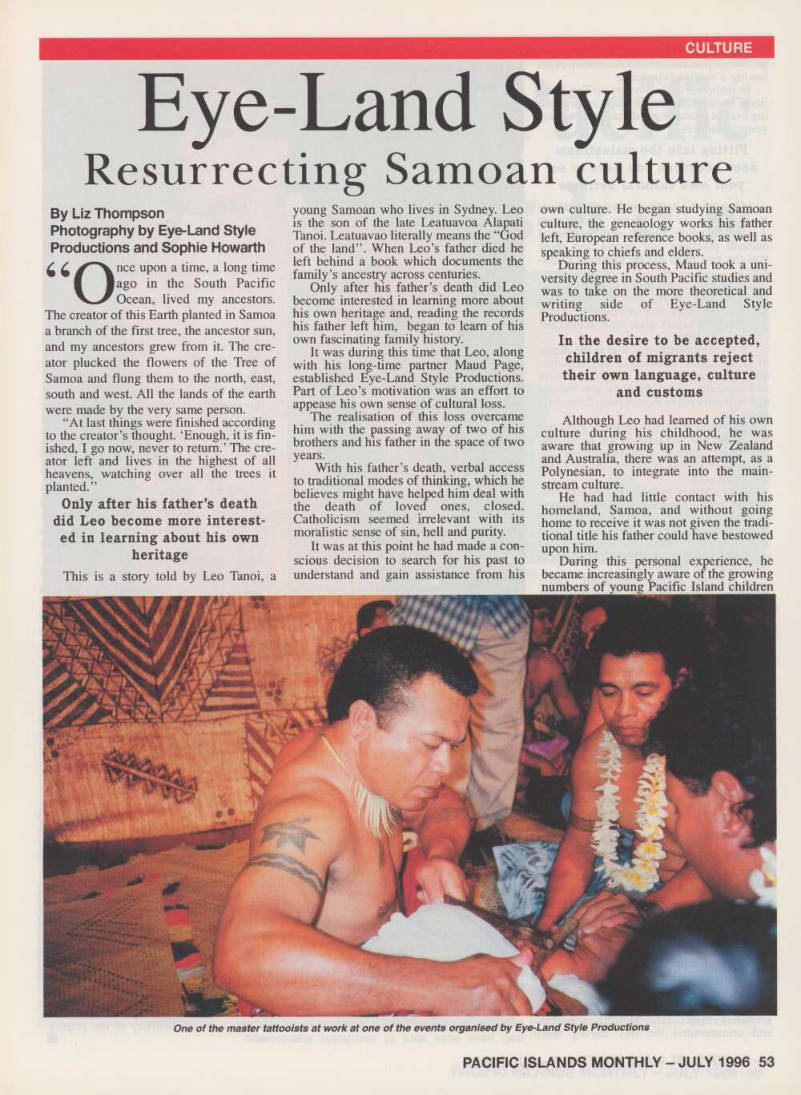
One of the master tattooists at work at one of the events organised by Eye-Land Style Productions
growing up in and around Australian cities
having a similar experience.
In response to this, he set up Eye-Land Style Productions in the hope of organis
ing events promoting cultural pride among
young islanders.
Fitting into the mainstream does not mean you have to ect your own cultural heritage One of the ways he believes this is most likely is to marry mainstream Australian youth culture with traditional cultural practices and events and show that the two need not be mutually exclu sive.
He hopes, by example, to show young migrants that fitting into the Australian mainstream does not necessarily mean you have to reject your own traditional
cultural heritage.
It is undoubtedly true that in the desire to be accepted, children of migrants fre
quently reject their own language, culture
and customs, believing they are foreign
and will only act to isolate them from their peers.
The need to juggle between a culture which is kept privately in the home and the culture ‘outside’ with its different val ues and problems is often very difficult
and confusing.
In an attempt to bring Polynesian cul ture to young islanders who feel trapped between these two experiences, Eye-Land Style tries to combine these two worlds and create some kind of a resolution. At organised events, an array of Polynesian influences are drawn upon.
A recent feature included Tali’s Samoan dance troupe and Jeanette Fabila’s Tahitian group. There were differ ent Pacific island deejays, rappers and bands. On display were wastapa (bark cloth) from Samoa, Tonga and Fiji and visual projections containing material and archival photographs from all over the Pacific, courtesy of Sydney Powerhouse Museum.
The bridge through which these cultur al aspects are presented to young islanders and other Australians is Hip Hop. Hip Hop music is a contemporary form of expres sion used by minority groups or simply by a generation of young people trying to have their say.
In order to reach as wide a public as
possible, Eye-Land Style presents events
Traditional tattooing is where Leo believes the strongest sense of Samoan identity may be built in more conventional spaces like muse ums. This allows for people of different age groups and interests to see Polynesian traditions. A recent tattooing exhibition was held at the Powerhouse Museum, dur ing which master tattooist Suluape Mikaele displayed his skills to a very enthusiastic audience. The public pro grammes officer, Jana Vytrhlik, attended and commended the day saying that
“almost 600 people attended and com mented very positively on their experience and unique chance to leam about Samoan traditions”. The practice and display of traditional tattooing is where Leo believes the strongest sense of Samoan identity may be built. Tattooing was frowned upon by the early missionaries but it survived in Samoa and has seen a resurgence, espe cially with young people.
This permanent visual inscription is therefore seen almost as a defiance of
Anglo-Saxon ideas of propriety.
The cultural labelling function of tat tooing is ideal for Samoans seeking a link with their heritage.
Leo organised a similar event at Kinselas, a Sydney nightclub. This attract ed large numbers of young people from the city and surrounding suburbs.
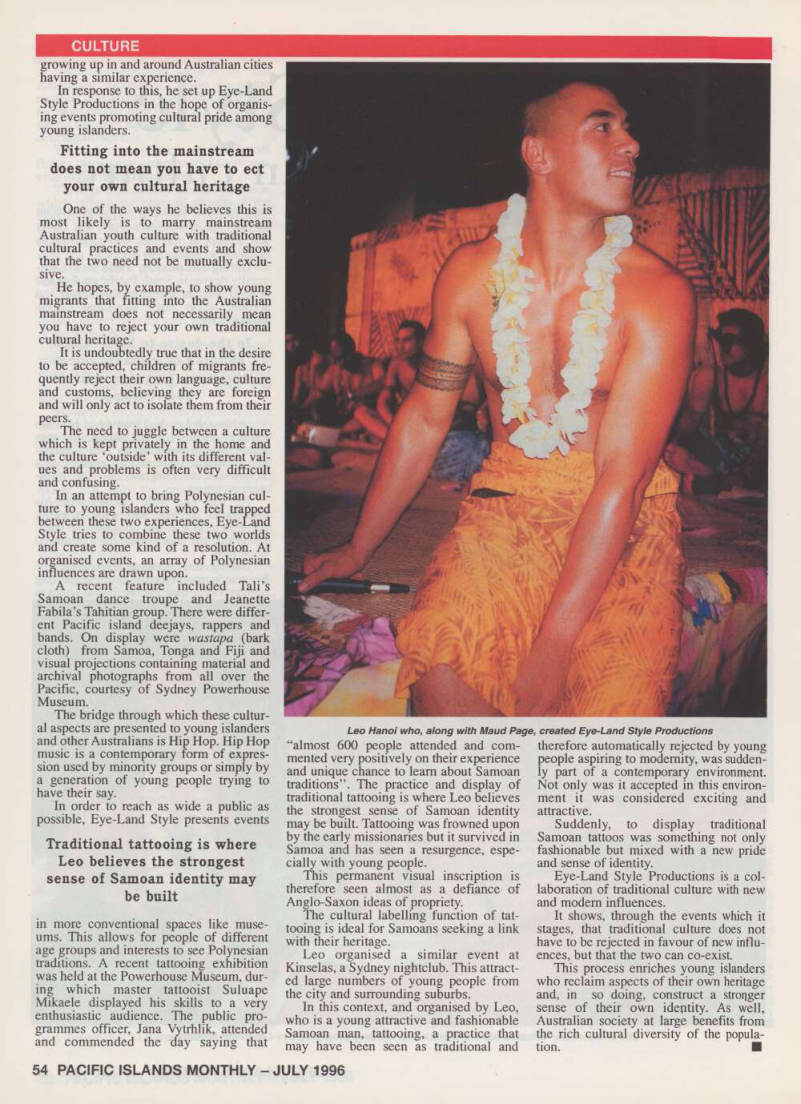
In this context, and organised by Leo, who is a young attractive and fashionable Samoan man, tattooing, a practice that may have been seen as traditional and
therefore automatically rejected by young
people aspiring to modernity, was sudden ly part of a contemporary environment.
Not only was it accepted in this environ ment it was considered exciting and attractive.
Suddenly, to display traditional
Samoan tattoos was something not only fashionable but mixed with a new pride and sense of identity.
Eye-Land Style Productions is a col laboration of traditional culture with new and modem influences.
It shows, through the events which it stages, that traditional culture does not have to be rejected in favour of new influ ences, but that the two can co-exist.
This process enriches young islanders who reclaim aspects of their own heritage and, in so doing, construct a stronger sense of their own identity. As well, Australian society at large benefits from the rich cultural diversity of the popula tion. ■
Leo Hanoi who, along with Maud Page, created Eye-Land Style Productions