Robert Langtlon - madman or genius?
pp. 48-50 · Read in the full issue

Literature
Nicholas Rothwell discusses the literary career of Robert Langdon, the “enfant terrible” of the Pacific. Are his politically incorrect but exciting theories on the peopling of the Pacific pure heresy, or are they close to the truth?
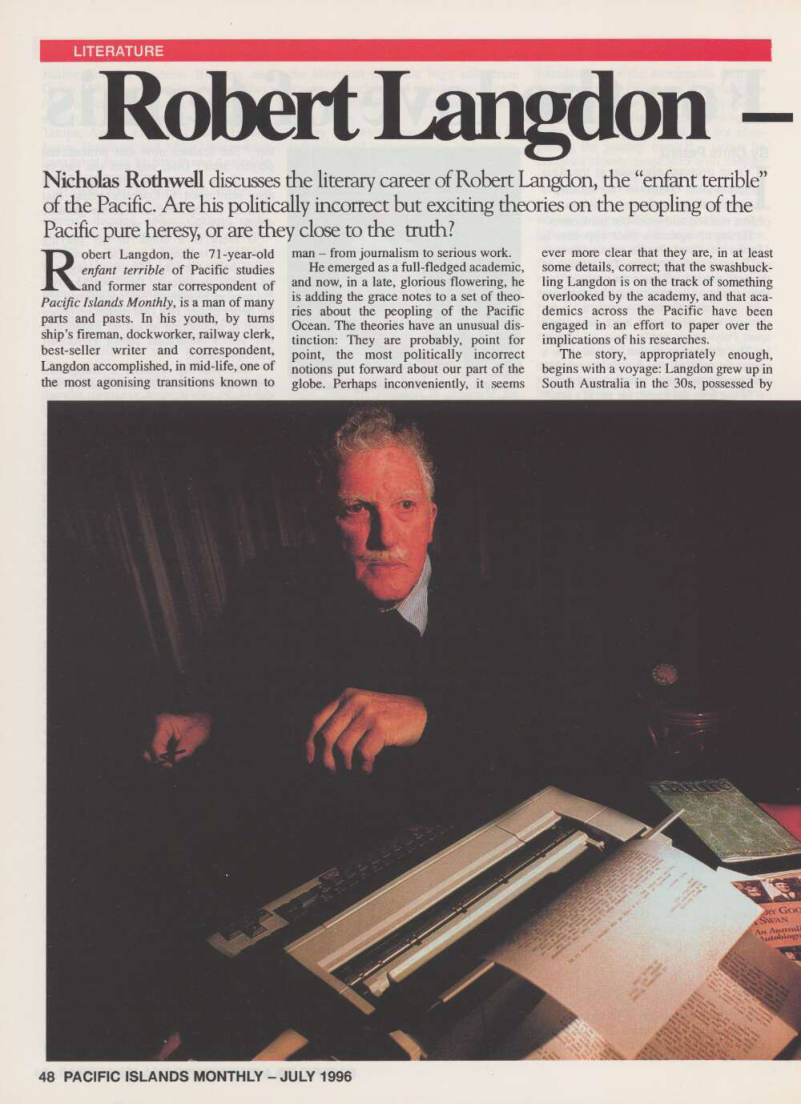
Robert Langdon, the 71-year-old enfant terrible of Pacific studies and former star correspondent of Pacific Islands Monthly, is a man of many parts and pasts. In his youth, by turns ship’s fireman, dockworker, railway clerk, best-seller writer and correspondent, Langdon accomplished, in mid-life, one of the most agonising transitions known to
man - from journalism to serious work.
He emerged as a full-fledged academic, and now, in a late, glorious flowering, he is adding the grace notes to a set of theo ries about the peopling of the Pacific Ocean. The theories have an unusual dis tinction: They are probably, point for point, the most politically incorrect notions put forward about our part of the globe. Perhaps inconveniently, it seems
ever more clear that they are, in at least some details, correct; that the swashbuck ling Langdon is on the track of something overlooked by the academy, and that aca demics across the Pacific have been engaged in an effort to paper over the implications of his researches.
The story, appropriately enough,
begins with a voyage: Langdon grew up in South Australia in the 30s, possessed by
fierce literary ambitions. After wartime naval service, he set out to see the world as a prelude to his dreamed-of career. He took passage on board a Panamanian freighter, the Nymphe, steaming through the Pacific Islands to Asia. In Malaya, the crew decided upon a mutiny to protest the lamentable conditions on board, and appointed Langdon as their spokesman because of his skills as a ‘talker’. Post-war London proved an uncomfortable inter lude; our hero was soon in Bolivia, wit nessing coups and revolutions, before set ting out on a further round of globe-trot ting adventures, which took him through
South America, Spain, Canada and the South Seas. The episodes are recounted in the latest Langdon saga, Every Goose a Swan, the first volume of his Australian autobiography. Its title comes from a Charles Kingsley poem which opens: “When all the world is young, lad,/ And all the trees are green;/ And every goose a swan, lad,/ And every lass a queen.”
It’s easy to plunge into a book with photos bearing captions such as: “The author, looking slightly startled, in a danc ing booth and Andalusian hat...” or chap ter titles such as “Of Cockroaches and the Moving Finger”, and “Whip Calls Bishop Beast” - a hair-raising account of an episode of mis-hearing during Langdon’s day in the Canberra Press gallery in the 19505.
A certain flirtation with Pacific affairs was already evident in his first book.
Island of Love, a delightful account of Tahiti. This enthusiasm led Langdon to Pacific Islands Monthly. PIM was Langdon’s journalistic home and intellec tual proving-ground for the next six years, during which he travelled the ocean, pick ing up suggestive tales and catching the first hint of the mystery that would come to dominate his later years. This was the little-remarked discovery of a group of four ancient European cannons on the reef of Amanu, one of the Tuamotu atolls, far to the east of Tahiti.
Langdon worried away at this unusual problem developing the idea that Europeans had travelled through the islands of Polynesia long before the age of Pacific discovery. But who could those Europeans have been? Almost unnoticed by historians, a Spanish ship, the San Lesmes had vanished in the waters of the great ocean in 1526.
Until Langdon began his researches, it was simply assumed that the San Lesmes had sunk. But what about those cannons and the various legends of the atolls?
Langdon set out his case in a book, The Lost Caravel, and returned to the theme with a fuller presentation. The Lost Caravel Re-Explored, published in 1988.
The version of Pacific history these books present is exciting, and heretical.
The San Lesmes and her crew, the books argue, ran aground on the atoll of Amanu; the vessel was then refloated by ditching the complement of cannons. The crew began a transit through Polynesia, searching for a haven to make repairs.
They found one at Raiatea, one of the Society Islands, where some of them decided to settle.
The rest set out to return to Spain by sailing for the Cape of Good Hope but were blocked by the north island of New Zealand and got no further.
Given the amount of time that elapsed between the loss of the San Lesmes and the arrival of Captain Cook in the Pacific Islands - rather longer than the gap in time separating us from Cook’s voyages - the intrusion of 50 armed, technologically advanced westerners could well have had profound genetic and cultural effects on the population of Polynesia.
In short, many of the most puzzling aspects of the early European explorers’ reports on the Pacific might suddenly, as a result of Langdon’s hypothesis, become explicable - the blondeness of the Polynesians of certain islands, their pale skins, the incidence of blue eyes, even the strange, half-Christian echoes in their belief systems. Theory, you might well say, and nothing more; which is pretty much what the Pacific History establish ment did say, when Langdon first made his opinions known. He was regarded as an amateur lost in a professional disci pline; his views were recorded with faint interest, as curiosities; or they were simply ignored.
The orthodox view of Pacific history was such simpler and more impressive.
According to this view, the Polynesians staged extraordinary trans-Pacific odysseys in the past two millenia, expanding from island group to island group, colonising Tahiti, the Marquesas, far-flung Easter Island and New Zealand.
Conventional wisdom makes much of the sophistication of these precursor Polynesians, ancestors of many indepen dent Pacific Island states, and, of course, the tutelary fathers of modem Maori New Zealand.
The Langdon thesis is inconvenient: It suggests that the dominant Polynesian set tlement of New Zealand was spearheaded by Europeans; that Europeans played sig nificant roles during the 16th century in the Society Islands; and that some of their descendants reached other islands, even the most magical, most remote spot in the whole ocean - Easter Island itself. Perhaps the most striking discovery in the recent study of Easter Island was the finding by a French team that a group of pure-blood islanders carried certain genes found only among Europeans, and most commonly
Pacific scholar Robert Langdon... generat ing controversial theories
among Basques. Basques? - The Lost Caravel shimmers once more on the hori zon. Argument has swirled ever since this first report, which seems to bear out the views of early explorers that some Easter Islanders had strikingly European fea tures.
Langdon has written a series of papers, often rather provocatively titled, drawing evidence - linguistic, botanical and cul tural - for the spread of peoples across the ocean. There is “The banana as a key to early American and Polynesian history”, “On Being Impertinent”, and the darkly wonderful “New Light on Easter Island
Prehistory in a Censored Spanish Report
of 1770” - a paper Langdon defiantly (if
immodestly) regards as the most impor
tant to be published in his field in the last half-century. These studies, and those now being carried out by younger researchers, conjure up an image of the prehistoric Pacific quite at odds with the classic view of a virgin ocean, crossed in one, predictable direction by stately out rigger canoes. Instead, the waves posi tively seethe with busy explorers, cast aways and colonists, voyaging here and there in a promiscuous, intermingling confusion of cultures - Polynesian, American, Indian and Spanish. The intriguing thing about this clash of visions - or versions of history - is that it goes to the heart of our understanding of the way
civilisations rise and reproduce them selves. Thinkers such as Langdon and that other romantic of the Pacific, Thor Heyerdahl, believe small, heroic bands of men can produce astonishing effects. The historical profession, it would be fair to say, prefers a model of grand, gradual processes: The slow dissemination and
development of indigenous cultures,
rather than the “lightning-bolt effect” of new blood from afar. The matter seems on the verge of being decided. As Langdon himself puts it, “The Walls of Jericho might soon come tumbling down.” New evidence from a variety of different sources - archaeological, genetic, botani cal, historical - is beginning to emerge, and much of it seems to paint a more sub tle, variegated picture of the colonisation of the Pacific. Soon, a new Cambridge History of the Pacific, to which Langdon has contributed, will appear. In a sense, this will mark a triumph of respectability, for the buccaneer-tumed-scholar.
But where is the continuity between the youthful adventurer and voyager and the independent-minded scholar of the Pacific? As one considers Langdon, his intense curiosity and will to discover, it becomes plain his biography has fitted him perfectly for his most recent role: Inquisitive, far-travelled, educated. But by experience and learning, he knows the terrain he writes of. “ A virtuoso of per
sistent inquiry, Langdon is hardly resting
on his laurels - even if these include the distinction of being the only Australian born knight of the Kingdom of Spain.
Ideas for new books and papers, each more radical and revisionist than the last, flood from him. This year alone, at least three minor bombshells are due to deto nate in the pages of Pacific scholarship.
The distinctly establishment
Polynesian Society is publishing in its
journal a typical piece of Langdon detec tive work, “The Soapberry”, a paper claiming South American Indians played a significant role in the early prehistory of Eastern Polynesia. A new account of Easter Island’s rongo-rongo writing will appear; as will another examination of long-range voyaging in the ancient Pacific. And there’s a new book to be done for the 50th anniversary of the Kon Tiki expedition of course, looking back to the moment when a band of Nordic adventurers sailed westward from South America, just as a young Australian, dreaming of glory, was taking eastward passage on a rickety old steamer at the other end of the great ocean.
Nor should we forget the promised second volume of the Langdon autobiog raphy, in which our hero finds fulfilment in the archives, lost with his dreams of Spanish explorers, setting sail upon an unknown Pacific wave. ■