For the love of tennis
p. 47 · Read in the full issue
By Chris Peteru
It’s an overcast afternoon at the Apia Tennis club. Players of varying shapes and sizes are lumbering about on one of five cracked and wom-out hardcourts.
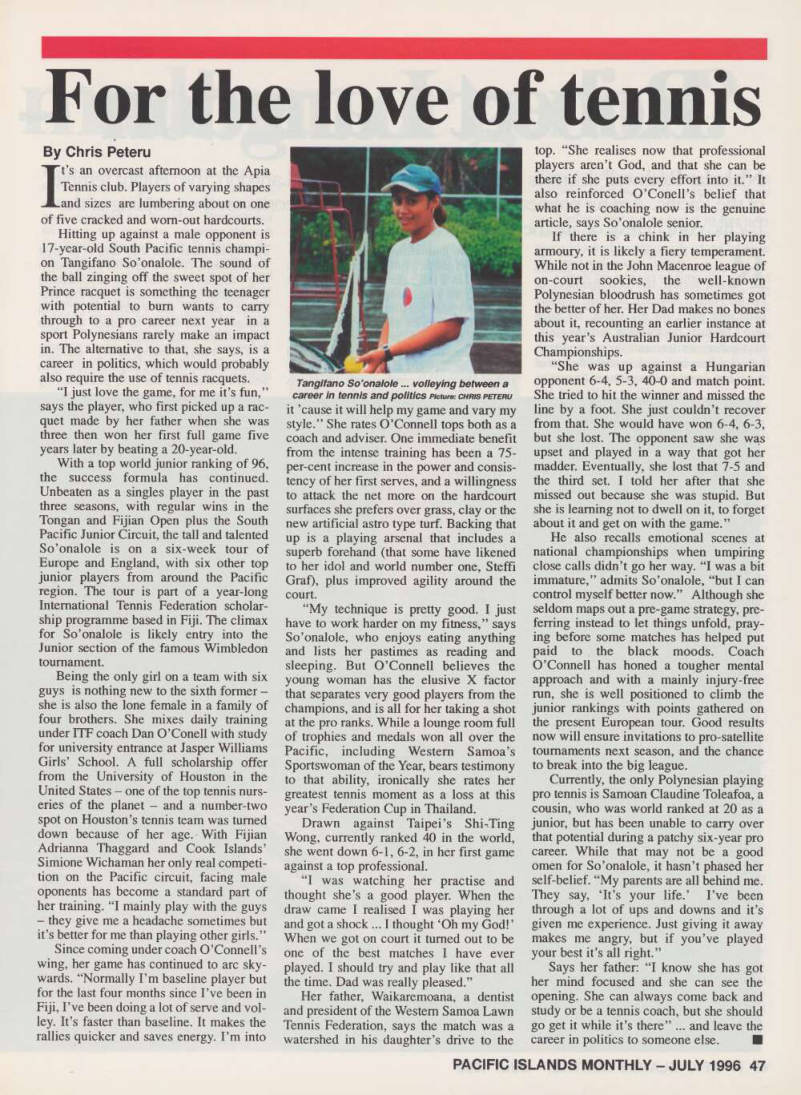
Hitting up against a male opponent is 17-year-old South Pacific tennis champi on Tangifano So’onalole. The sound of the ball zinging off the sweet spot of her Prince racquet is something the teenager with potential to bum wants to carry through to a pro career next year in a sport Polynesians rarely make an impact in. The alternative to that, she says, is a career in politics, which would probably also require the use of tennis racquets.
“I just love the game, for me it’s fun,” says the player, who first picked up a rac quet made by her father when she was three then won her first full game five
years later by beating a 20-year-old.
With a top world junior ranking of 96, the success formula has continued.
Unbeaten as a singles player in the past three seasons, with regular wins in the Tongan and Fijian Open plus the South Pacific Junior Circuit, the tall and talented So’onalole is on a six-week tour of Europe and England, with six other top junior players from around the Pacific region. The tour is part of a year-long International Tennis Federation scholar ship programme based in Fiji. The climax for So’onalole is likely entry into the Junior section of the famous Wimbledon tournament.
Being the only girl on a team with six guys is nothing new to the sixth former she is also the lone female in a family of four brothers. She mixes daily training under TTF coach Dan O’Conell with study for university entrance at Jasper Williams Girls’ School. A full scholarship offer from the University of Houston in the United States - one of the top tennis nurs eries of the planet - and a number-two spot on Houston’s tennis team was turned down because of her age. With Fijian Adrianna Thaggard and Cook Islands’
Simione Wichaman her only real competi tion on the Pacific circuit, facing male oponents has become a standard part of her training. “I mainly play with the guys - they give me a headache sometimes but it’s better for me than playing other girls.”
Since coming under coach O’Connell’s wing, her game has continued to arc sky wards. “Normally I’m baseline player but for the last four months since I’ve been in Fiji, I’ve been doing a lot of serve and vol ley. It’s faster than baseline. It makes the rallies quicker and saves energy. I’m into
it ’cause it will help my game and vary my style.” She rates O’Connell tops both as a coach and adviser. One immediate benefit from the intense training has been a 75per-cent increase in the power and consis tency of her first serves, and a willingness to attack the net more on the hardcourt surfaces she prefers over grass, clay or the new artificial astro type turf. Backing that up is a playing arsenal that includes a superb forehand (that some have likened to her idol and world number one, Steffi
Graf), plus improved agility around the
court.
“My technique is pretty good. I just have to work harder on my fitness,” says So’onalole, who enjoys eating anything and lists her pastimes as reading and sleeping. But O’Connell believes the young woman has the elusive X factor that separates very good players from the champions, and is all for her taking a shot at the pro ranks. While a lounge room full of trophies and medals won all over the Pacific, including Western Samoa’s Sportswoman of the Year, bears testimony to that ability, ironically she rates her greatest tennis moment as a loss at this year’s Federation Cup in Thailand.
Drawn against Taipei’s Shi-Ting
Wong, currently ranked 40 in the world, she went down 6-1, 6-2, in her first game
against a top professional.
“I was watching her practise and thought she’s a good player. When the draw came I realised I was playing her and got a shock ... I thought ‘Oh my God! ’
When we got on court it turned out to be one of the best matches I have ever played. I should try and play like that all the time. Dad was really pleased.”
Her father, Waikaremoana, a dentist and president of the Western Samoa Lawn Tennis Federation, says the match was a watershed in his daughter’s drive to the
top. “She realises now that professional players aren’t God, and that she can be there if she puts every effort into it.” It also reinforced O’Conell’s belief that what he is coaching now is the genuine article, says So’onalole senior.
If there is a chink in her playing armoury, it is likely a fiery temperament.
While not in the John Macenroe league of on-court sookies, the well-known Polynesian bloodrush has sometimes got the better of her. Her Dad makes no bones about it, recounting an earlier instance at this year’s Australian Junior Hardcourt
Championships.
“She was up against a Hungarian opponent 6-4, 5-3, 40-0 and match point.
She tried to hit the winner and missed the line by a foot. She just couldn’t recover from that. She would have won 6-4, 6-3, but she lost. The opponent saw she was upset and played in a way that got her madder. Eventually, she lost that 7-5 and the third set. I told her after that she missed out because she was stupid. But she is learning not to dwell on it, to forget about it and get on with the game.”
He also recalls emotional scenes at national championships when umpiring close calls didn’t go her way. “I was a bit immature,” admits So’onalole, “but I can control myself better now.” Although she seldom maps out a pre-game strategy, pre ferring instead to let things unfold, pray ing before some matches has helped put paid to the black moods. Coach O’Connell has honed a tougher mental approach and with a mainly injury-free run, she is well positioned to climb the junior rankings with points gathered on the present European tour. Good results now will ensure invitations to pro-satellite tournaments next season, and the chance to break into the big league.
Currently, the only Polynesian playing
pro tennis is Samoan Claudine Toleafoa, a cousin, who was world ranked at 20 as a junior, but has been unable to carry over that potential during a patchy six-year pro career. While that may not be a good omen for So’onalole, it hasn’t phased her self-belief. “My parents are all behind me.
They say, ‘lt’s your life.’ I’ve been through a lot of ups and downs and it’s given me experience. Just giving it away makes me angry, but if you’ve played your best it’s all right.”
Says her father: “I know she has got her mind focused and she can see the opening. She can always come back and study or be a tennis coach, but she should go get it while it’s there” ... and leave the career in politics to someone else. ■
Tangifano So’onalole ... volleying between a career in tennis and politics picture: CHRIS PETERU