Burger king or
pp. 20-22 · Read in the full issue
Business
Burger king or multi-national Goliath?
By Matthew Segal
Imagine the famous McDonald’s gold en arches in five or six locations
around Fiji, with Fiji products being
used for locally-produced Big Macs, shakes and sundaes.
These are the dreams of Marc McElrath, the man who introduced the McDonald’s era to Fiji with a gala opening at the hamburger chain’s first restaurant in Nadi, on the western side of Fiji’s main island of Viti Levu.
But it seems that for the time being, McElrath’s dreams are a long way off, as nearly all products used by McDonald’s
Fiji operation are imported and questions
are still being raised about the economic viability of the chain and whether the introduction of the world’s most famous burgers and fries are a blessing or a health risk for South Pacific Islanders.
“I think it’s great for Fiji,” said McElrath, 23, whose father is a prominent
Fiji developer.
“Everywhere else in the world there’s a McDonald’s. Finally there’s one here.”
However, it wasn’t easy. McDonald’s Australia, which approached McElrath two
years ago with an eye toward expanding to Fiji, provided minimal financial assistance for the venture. The corporation flies in consultants every two months to provide advice, offers marketing material and
trains managers at its “Burger University” in Sydney.
The rest of the investment for the Nadi outlet, an estimated SF3 million, came exclusively from McElrath. His mother
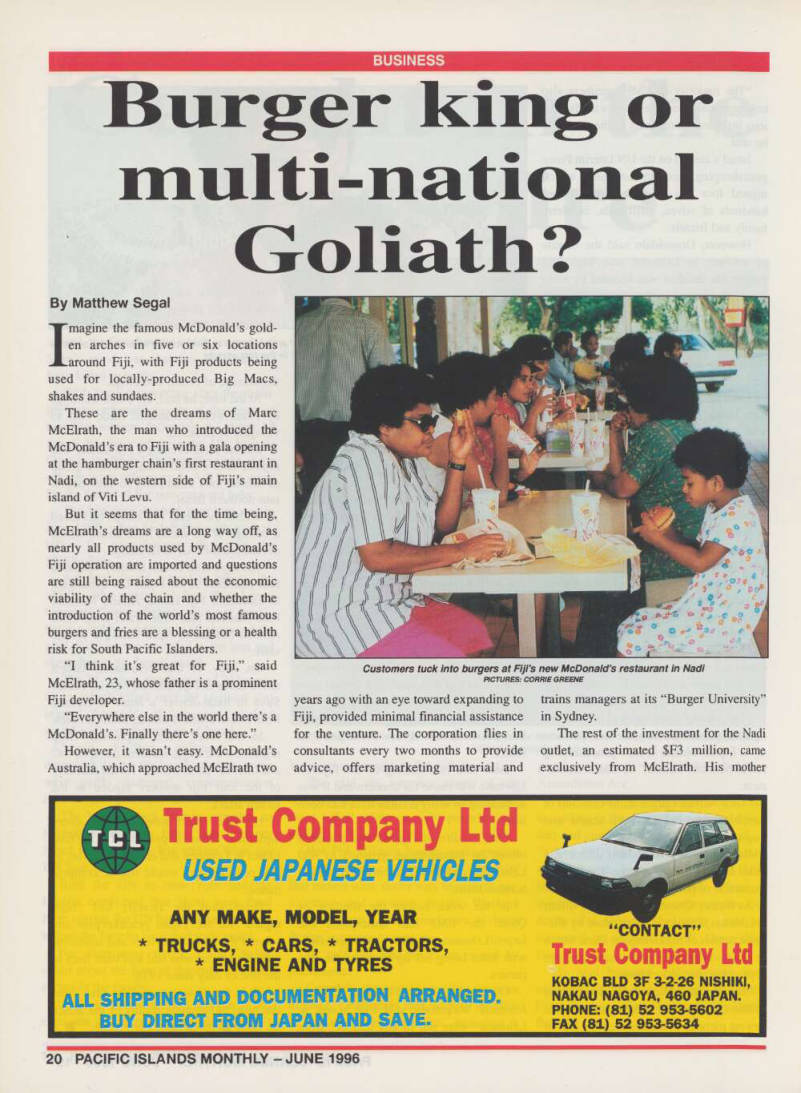
Customers tuck into burgers at Fiji’s new McDonald's restaurant in Nadi
Pictures: Corrie Greene
already owned the land where the restau rant was constructed.
“To make things easy we’ve started by importing everything, except for the buns and the lettuce. Right now we’re sighting sources for products locally,” McElrath said.
One of these sources is the Fiji Coffee
Company Limited, which hopes to begin
serving McDonald’s in the near future.
Both sides seem to think a deal is iminent.
“We feel very confident that we’ll be able to convince McDonald’s to start using Fiji Coffee,” said Fiji Coffee shareholder Neil Underhill.
But other areas could be more problem atic though. Beef and milk products, which are currently brought in from Australia and
New Zealand respectively, require large
production facilities. Likewise, paper products are also Australian imports.
Even items that are already produced in Fiji have strong foreign ties. The lettuce comes from Wonder Gardens of Lautoka, a locally incorporated - but Australian owned business. The buns are produced by the newly-created South Pacific Bakers Limited. The company is half-owned by Fiji’s Hot Bread Kitchen with the other half belonging to North’s Bun Company of New Zealand. The flour for the buns is produced by Flour Mills of Fiji in Suva, but the wheat is imported from Australia.
McElrath is quick to point out that local
production of goods simply can’t happen
overnight, especially with the quality stan
dards required by McDonald’s.
“For someone to set up a processing plant, the money required wouldn’t be worth it to support one store,” he said.
But for the time being though, cus tomers of McDonald’s Fiji don’t seem to mind the imported goods. In fact, they have welcomed them.
“Beautiful. It’s something different,” said Narendra Kumar of Suva, dining on Chicken McNuggets and french fries as fellow patrons crowded into the Nadi restaurant on its first weekend in business.
“It’s something new for the Fiji market.”
“For us, this is change,” said Emori Ramoka, also from Suva, eating a cheese burger and a Filet-o-Fish. “I think it’s good for Fiji. It’s got a bit of quality and the price is reasonable.”
The question, however, is whether Fiji
will still be as enchanted with the Big Mac in six months, when the novelty of McDonald’s has worn off, and the Fiji Police Band is no longer playing musical numbers in the Nadi parking lot to enter tain customers. It’s easy to draw parallels to Fiji’s Kentucky Fried Chicken, which also opened with a fanfare but eventually went out of business.
Jim Ah Koy, Fiji’s Minister for Commerce, Industry, Trade and Public Enterprise, called the Kentucky Fried Chicken experiment “premature” and said the country “hadn’t developed the level of sophistication” to support such a business.
“The number one reason why I pushed for McDonald’s is the labour factor,” Ah
Koy continued.
“We have about 12,000 kids coming out of school every year. They’ve got to find jobs for them.”
The Nadi McDonald’s employs 250 people. Theoretically, five or six outlets in Fiji could employ up to 1500. Ah Koy said the restaurant teaches young Fijians a good work ethic and trains them for manage ment jobs in the business world. He also agreed with McElrath that a string of McDonald’s restaurants could lead to the creation of local production facilities and
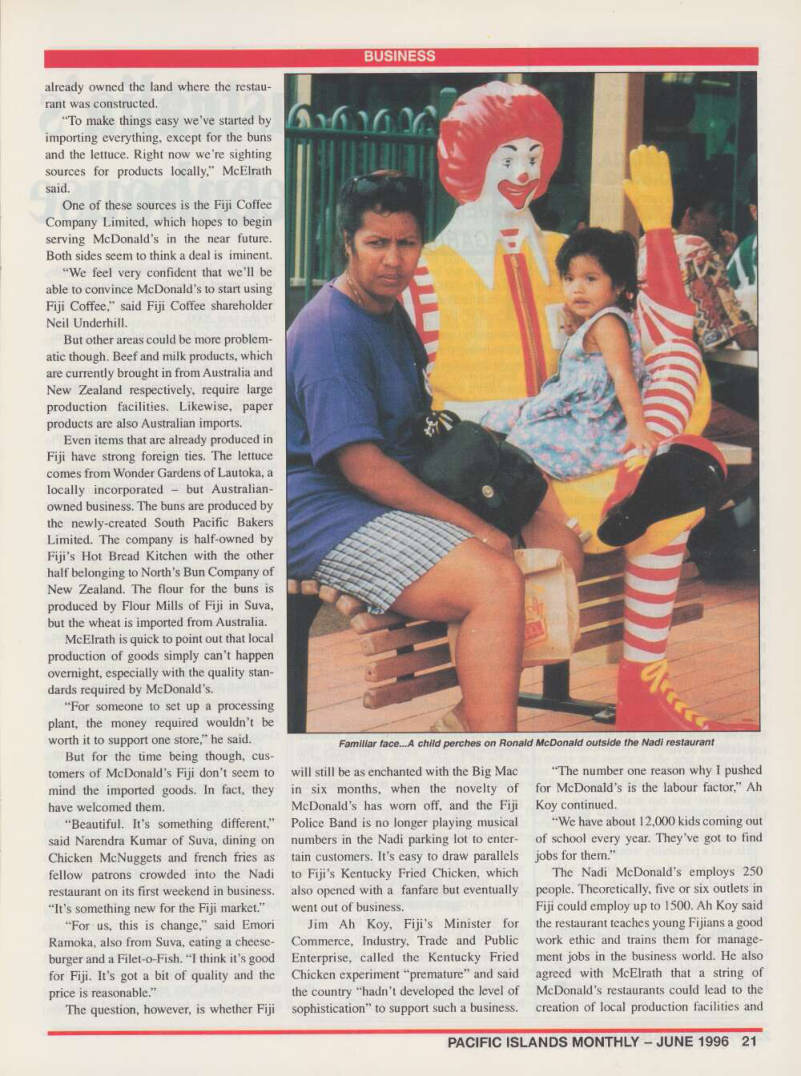
Familiar face...A child perches on Ronald McDonald outside the Nadi restaurant
more jobs.
Still, the minister wasn’t sure of the chain’s chances for success in a country which has grown up with an entirely dif ferent style of cuisine.
“A great question mark on that one, because for generations our fast food would always be a curry and rod, which is nutritious and inexpensive,” he said.
However, a spokesperson for the National Food and Nutrition Committee concurred: “It (McDonald’s) is of con cern, when you can get cheaper, more nutritious food. Why are you paying twice as much when you can pay 50 cents or $1?”
The spokesperson said direct compar isons between roti parcels and McDonald’s fast food were still prema ture, because not enough data had been collected. A study which will closely examine the nutritional value of both foods is expected to be done in the near future.
McDonald’s Fiji restaurant has made special dietary adjustments to accommo date local residents. They’ve introduced a Me Vegetable Burger, largely targeted for Fiji’s Hindu population which does not eat beef. And meat products are prepared in accordance with Halal standards for the country’s Muslim community.
Adaptation, said University of the South Pacific Economist Dr David Forsythe, will be the key to the success of McDonald’s Fiji. He said the corporation started off on the right foot by opening in Nadi, a town with more foreign tourists and a large professional work force. He said the same factors could support a restaurant in Suva.
But beyond this?
“I wouldn’t be all that optimistic. It depends how you can scale it down, and keep the character in place,” Forsythe said.
He said a possibility would be to set-up restaurants at local resorts. And he added it was hard to truly predict the success or failure of any business at such an early stage.
“It’s always a mistake to look at things in a totally static way. It could be a cata lyst which could encourage people to buy locally,” he said. ■