Australia’s
pp. 22-23 · Read in the full issue
Greenhouse
In the seven years since the South Pacific Forum Heads of Government issued their first warning about the
potentially disastrous implications of glob
al warming for the region, scientists have been working overtime.
Their research confirms the leaders were right to worry.
If predicted sea-level rises associated with global warming eventuate, as many as five island states could become uninhabit able before the next century is over and others will suffer badly from fiercer cyclones and other extreme weather condi tions.
Global warming is caused by “Greenhouse Gases”; gases put out by industry and agriculture which trap heat in the earth’s atmosphere.
Australia puts out more Greenhouse gases per head of population than any other country in the world.
When fears about the implications of global warming were first raised at the Kiribati Forum in 1989, Australia’s then Prime Minister Bob Hawke responded
quickly.
He announced a region-wide research programme and soon afterwards put Australia at the forefront of greenhouse action by committing it to reduce its greenhouse emissions to 20 per cent less than the 1988 level by the year 2005.
While this was nowhere near the 60 per cent reduction of carbon dioxide emissions scientists said would be necessary to sta bilise concentrations of greenhouse gases, it was a progressive step at the time.
Since then, Australia has transformed itself from a world leader into a country wanting to be exempted from targets wide ly regarded as only a weak first step.
When Australia signed the International Climate Change Convention
in 1992, it, like other industrialised coun tries, agreed to the less onerous target of reducing its emissions to the 1990 levels by the year 2000.
Australia’s Federal and State govern ments got together to draw up a blueprint for meeting that target which is known as the National Greenhouse Response
Strategy (NGRS).
Three years into implementation of the NGRS the Australian Conservation foun dation has produced a “Greenhouse Scorecard” based on a detailed examina tion of each government’s record.
The results are worrying. Only New South Wales rated a pass mark.
Collectively, the governments’ efforts were rated as “dreadful” and Victoria, the poorest performer, was described as “abysmal”.
This is not mere sensationalism. The Australian Conservation Foundation found that the governments had the detailed plans necessary to achieve their emission targets but that very little action had taken place to implement them.
Energy and transport together account for more than 50 per cent of Australia’s Greenhouse gas emissions.
Lengthy negotiations with industry to improve the fuel efficiency of motor vehi cles secured an agreement to standards which are only marginally better than the current fuel efficiency and are probably what the industry would have come up with anyway.
Similarly, the manufacturers of hot water heaters were able to resist pressure for major improvements in energy effi
ciency.
The failure by governments to secure changes is surprising when one considers that they have promised to seek no more than so-called “no regrets” measures those which can be implemented with no
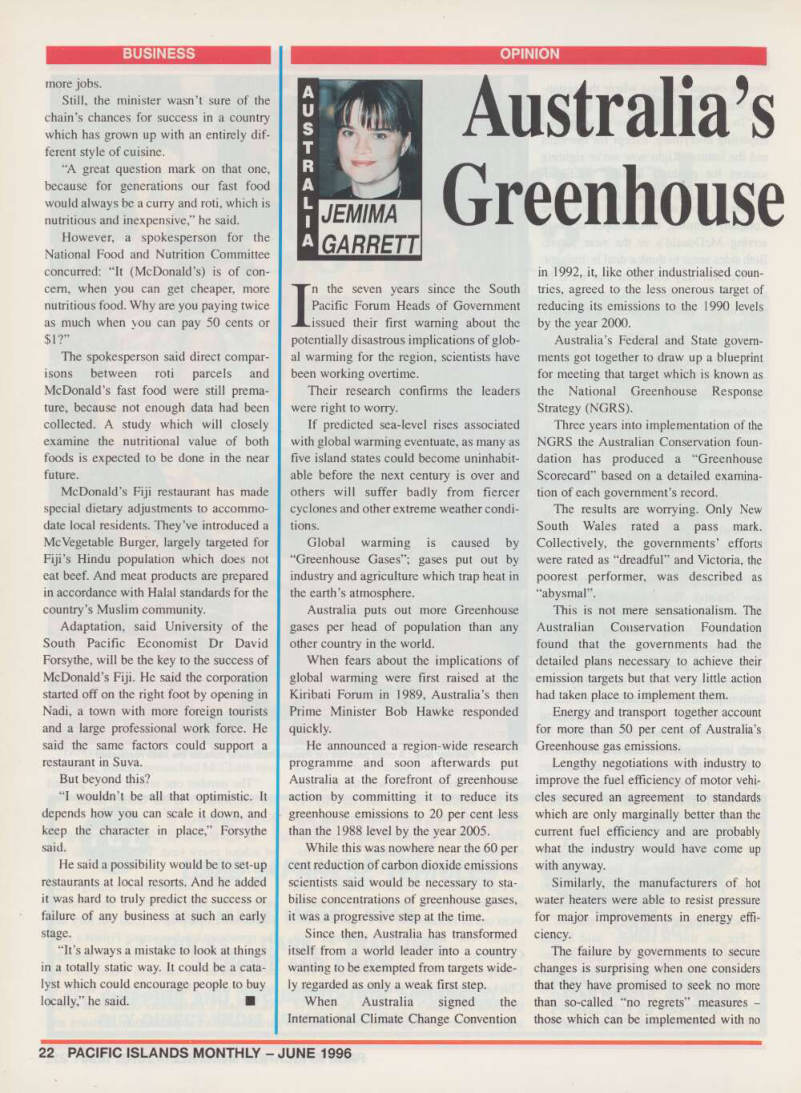
Australia
Jemima
Garrett
overall cost. One electricity distribution company. Energy Australia, has announced a market trial which will give consumers the option of buying all, a half, or a quarter of their energy from clean sources which do not release damaging gases.
The scheme will penalise Victoria’s dirty brown coal stations which at the moment sell almost SFI2O million worth of power to New South Wales each year.
Even with measures of this sort, it is clear Australia will fall short of its Greenhouse targets. Estimates suggest the NGRS will reduce emission levels from 14 per cent over the 1990 levels (which they would have been had no measures been implemented) to seven per cent above target. If new steps announced in March 1995 in the Federal government’s Greenhouse 21C package are put into place, emissions are likely to be reduced to three per cent over the 1990 levels.
Rather than pursue “no regrets” mea sures more vigorously, the Federal gov ernment has embarked on an internation al strategy which relies on special plead ing to explain its failure to meet emission targets and opposes moves to add a proto col to the Climate Convention which would make the targets binding.
That will place it on a collision course with its Pacific Island neighbours who, in line with advice from the prestigious United Nations Inter-govemmental Panel on Climate Change, are advocating much stricter and binding emission targets.
Australia, with its large distances,
growing population, heavy reliance on
coal-fired power stations and energy intensive industries, will find it more dif ficult than other industrialised nations to meet Greenhouse targets. That does not justify its being so quick to ask for special treatment. ■