cross-fire
pp. 18-19 · Read in the full issue
Caught in the cross-fire
By Sophie Foster
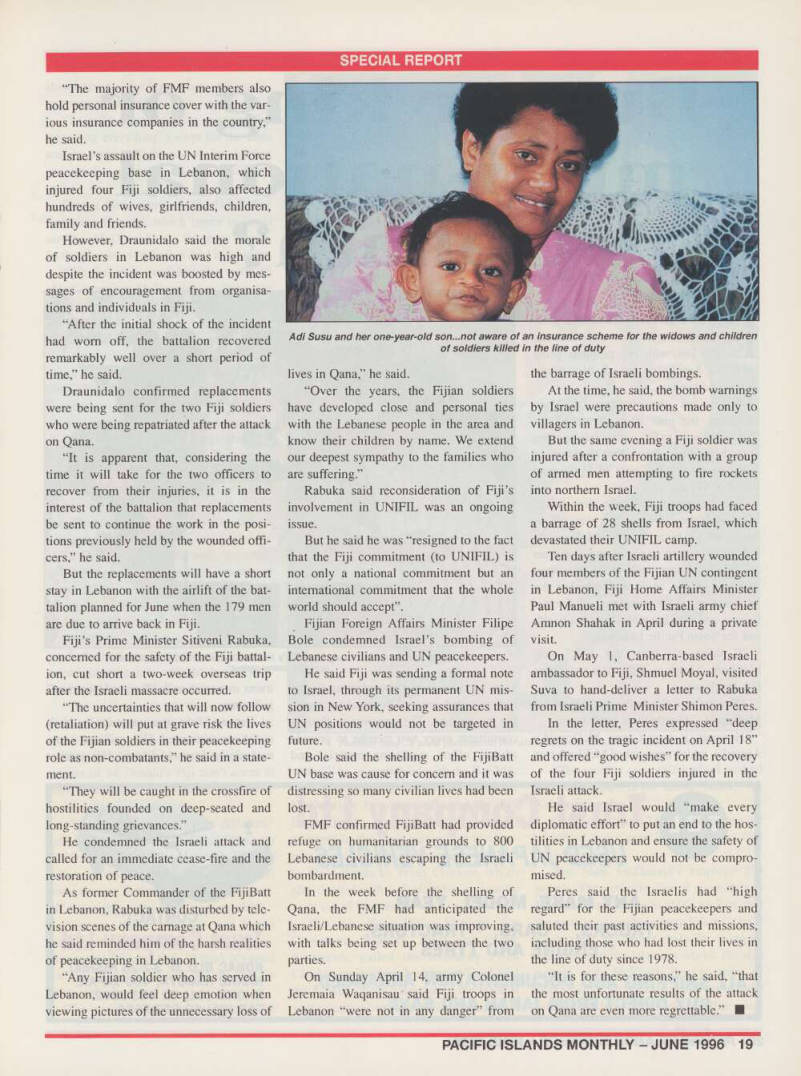
When the green army vehicle pulled up outside her Valelevu home, on the outskirts of Fiji’s capital, the first thought which crossed Adi Susu’s mind was that her husband had been killed in battle.
With tension mounting after the morn ing’s unconfirmed reports of the death of two Fiji soldiers following the April 18 Israeli bombing of their the UN base at Qana in southern Lebanon, the sight of the solemn army officer made Adi Susu weep for the father of her one-year-old baby.
The last time she had seen him was in June 1995, when he left Fiji with his bat talion for peacekeeping duties in the Middle East.
Adi Susu found it hard to believe the officer who reassured her that Lance Corporal George Bakoso was not dead but in a stable condition in a Lebanese hos pital. Bakoso was wounded in the legs and chest during the Israeli attack.
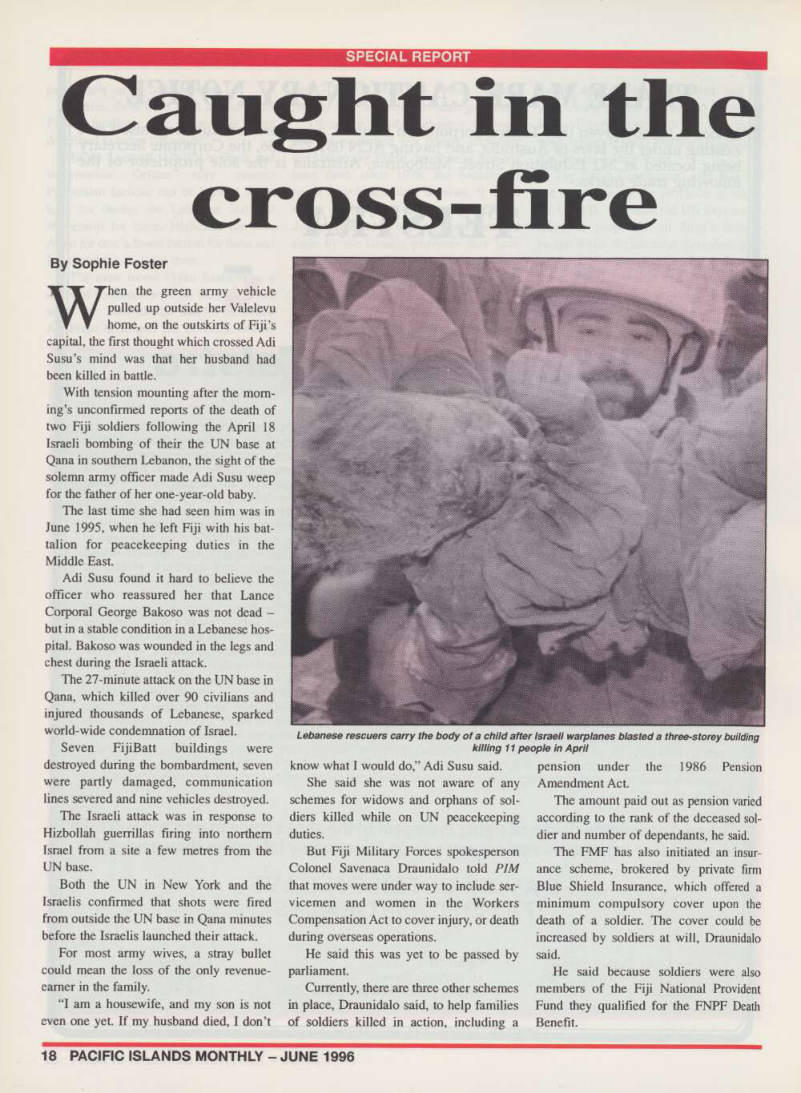
The 27-minute attack on the UN base in Qana, which killed over 90 civilians and injured thousands of Lebanese, sparked world-wide condemnation of Israel.
Seven Fijißatt buildings were
destroyed during the bombardment, seven
were partly damaged, communication
lines severed and nine vehicles destroyed.
The Israeli attack was in response to Hizbollah guerrillas firing into northern Israel from a site a few metres from the UN base.
Both the UN in New York and the Israelis confirmed that shots were fired from outside the UN base in Qana minutes before the Israelis launched their attack.
For most army wives, a stray bullet could mean the loss of the only revenue earner in the family.
“I am a housewife, and my son is not even one yet. If my husband died, I don’t
know what I would do,” Adi Susu said.
She said she was not aware of any schemes for widows and orphans of sol diers killed while on UN peacekeeping duties.
But Fiji Military Forces spokesperson Colonel Savenaca Draunidalo told PIM that moves were under way to include ser vicemen and women in the Workers Compensation Act to cover injury, or death during overseas operations.
He said this was yet to be passed by parliament.
Currently, there are three other schemes in place, Draunidalo said, to help families of soldiers killed in action, including a
pension under the 1986 Pension Amendment Act.
The amount paid out as pension varied according to the rank of the deceased sol dier and number of dependants, he said.
The FMF has also initiated an insur ance scheme, brokered by private firm Blue Shield Insurance, which offered a minimum compulsory cover upon the death of a soldier. The cover could be increased by soldiers at will, Draunidalo said.
He said because soldiers were also members of the Fiji National Provident Fund they qualified for the FNPF Death Benefit.
Lebanese rescuers carry the body of a child after Israeli warplanes blasted a three-storey building killing 11 people in April
“The majority of FMF members also hold personal insurance cover with the var ious insurance companies in the country,” he said.
Israel’s assault on the UN Interim Force peacekeeping base in Lebanon, which injured four Fiji soldiers, also affected hundreds of wives, girlfriends, children, family and friends.
However, Draunidalo said the morale of soldiers in Lebanon was high and despite the incident was boosted by mes sages of encouragement from organisa tions and individuals in Fiji.
“After the initial shock of the incident had worn off, the battalion recovered remarkably well over a short period of time,” he said.
Draunidalo confirmed replacements were being sent for the two Fiji soldiers who were being repatriated after the attack on Qana.
“It is apparent that, considering the time it will take for the two officers to recover from their injuries, it is in the interest of the battalion that replacements be sent to continue the work in the posi tions previously held by the wounded offi cers,” he said.
But the replacements will have a short stay in Lebanon with the airlift of the bat talion planned for June when the 179 men are due to arrive back in Fiji.
Fiji’s Prime Minister Sitiveni Rabuka, concerned for the safety of the Fiji battal ion, cut short a two-week overseas trip after the Israeli massacre occurred.
“The uncertainties that will now follow (retaliation) will put at grave risk the lives of the Fijian soldiers in their peacekeeping role as non-combatants,” he said in a state ment.
“They will be caught in the crossfire of hostilities founded on deep-seated and
long-standing grievances.”
He condemned the Israeli attack and called for an immediate cease-fire and the restoration of peace.
As former Commander of the Fijißatt in Lebanon, Rabuka was disturbed by tele vision scenes of the carnage at Qana which he said reminded him of the harsh realities of peacekeeping in Lebanon.
“Any Fijian soldier who has served in Lebanon, would feel deep emotion when viewing pictures of the unnecessary loss of
lives in Qana,” he said.
“Over the years, the Fijian soldiers have developed close and personal ties with the Lebanese people in the area and know their children by name. We extend our deepest sympathy to the families who
are suffering.”
Rabuka said reconsideration of Fiji’s involvement in UNIFIL was an ongoing issue.
But he said he was “resigned to the fact that the Fiji commitment (to UNIFIL) is not only a national commitment but an international commitment that the whole world should accept”.
Fijian Foreign Affairs Minister Filipe
Bole condemned Israel’s bombing of Lebanese civilians and UN peacekeepers.
He said Fiji was sending a formal note to Israel, through its permanent UN mis sion in New York, seeking assurances that UN positions would not be targeted in future.
Bole said the shelling of the Fijißatt UN base was cause for concern and it was distressing so many civilian lives had been lost.
FMF confirmed Fijißatt had provided refuge on humanitarian grounds to 800 Lebanese civilians escaping the Israeli bombardment.
In the week before the shelling of Qana, the FMF had anticipated the Israeli/Lebanese situation was improving, with talks being set up between the two
parties.
On Sunday April 14, army Colonel Jeremaia Waqanisau said Fiji troops in Lebanon “were not in any danger” from
the barrage of Israeli bombings.
At the time, he said, the bomb warnings by Israel were precautions made only to villagers in Lebanon.
But the same evening a Fiji soldier was injured after a confrontation with a group of armed men attempting to fire rockets into northern Israel.
Within the week, Fiji troops had faced a barrage of 28 shells from Israel, which devastated their UNIFIL camp.
Ten days after Israeli artillery wounded four members of the Fijian UN contingent in Lebanon, Fiji Home Affairs Minister Paul Manueli met with Israeli army chief Amnon Shahak in April during a private visit.
On May 1, Canberra-based Israeli ambassador to Fiji, Shmuel Moyal, visited Suva to hand-deliver a letter to Rabuka from Israeli Prime Minister Shimon Peres.
In the letter, Peres expressed “deep regrets on the tragic incident on April 18” and offered “good wishes” for the recovery of the four Fiji soldiers injured in the Israeli attack.
He said Israel would “make every diplomatic effort” to put an end to the hos tilities in Lebanon and ensure the safety of UN peacekeepers would not be compro mised.
Peres said the Israelis had “high
regard” for the Fijian peacekeepers and
saluted their past activities and missions, including those who had lost their lives in the line of duty since 1978.
“It is for these reasons,” he said, “that the most unfortunate results of the attack on Qana are even more regrettable.” ■
Adi Susu and her one-year-old son...not aware of an insurance scheme for the widows and children of soldiers killed in the line of duty