Tears, pain, death
pp. 14-16 · Read in the full issue
Special Report
Tears, pain, death But Fiji sits on the fence over UNIFL attack
By lan Williams
Fiji abstained from voting at the United Nations when a resolution condemning Israel was discussed at the UN General Assembly.
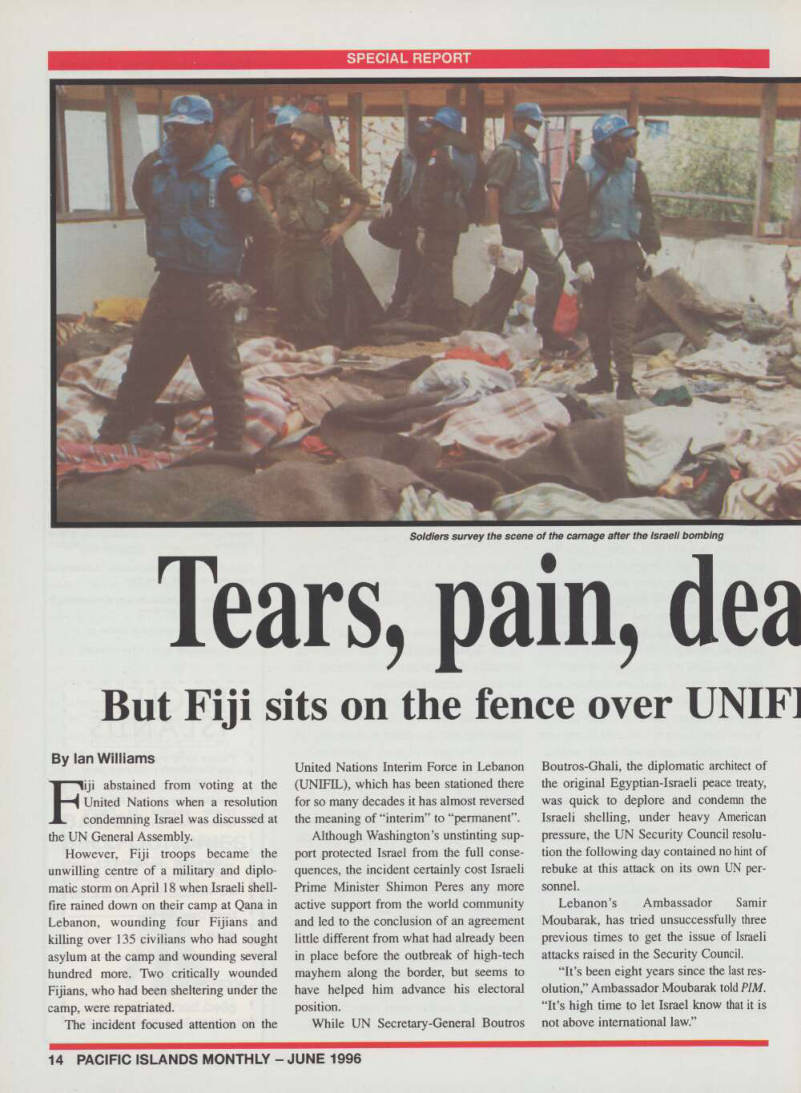
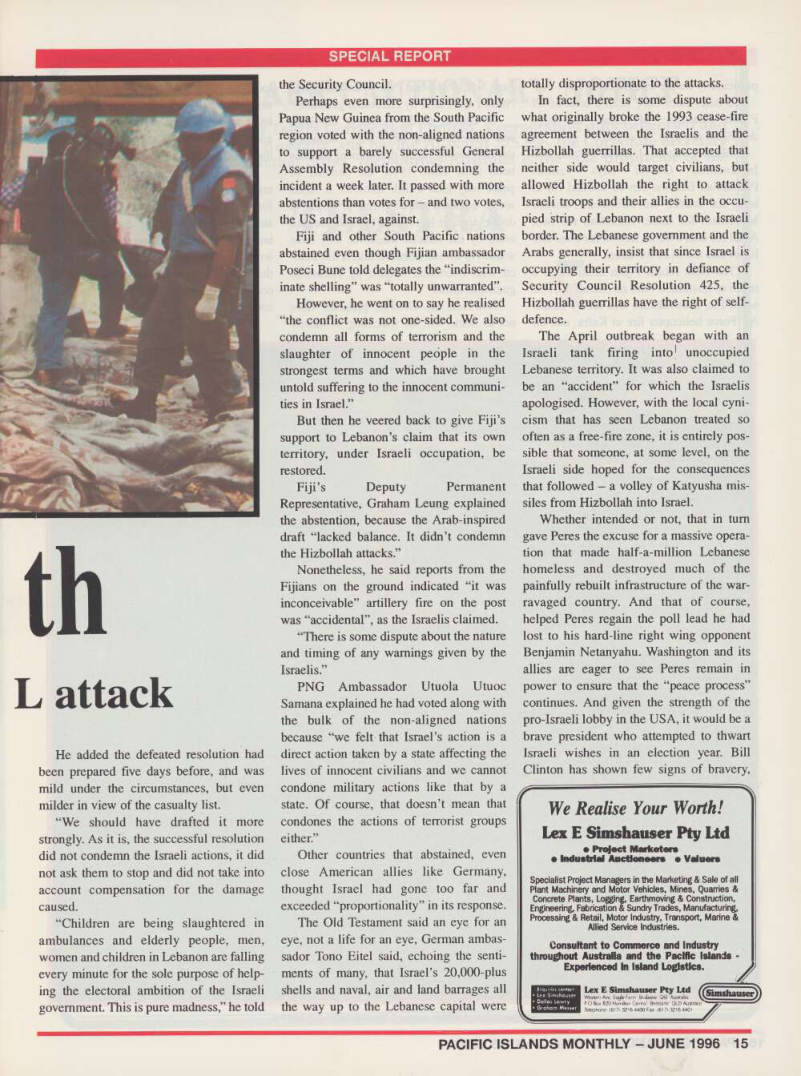
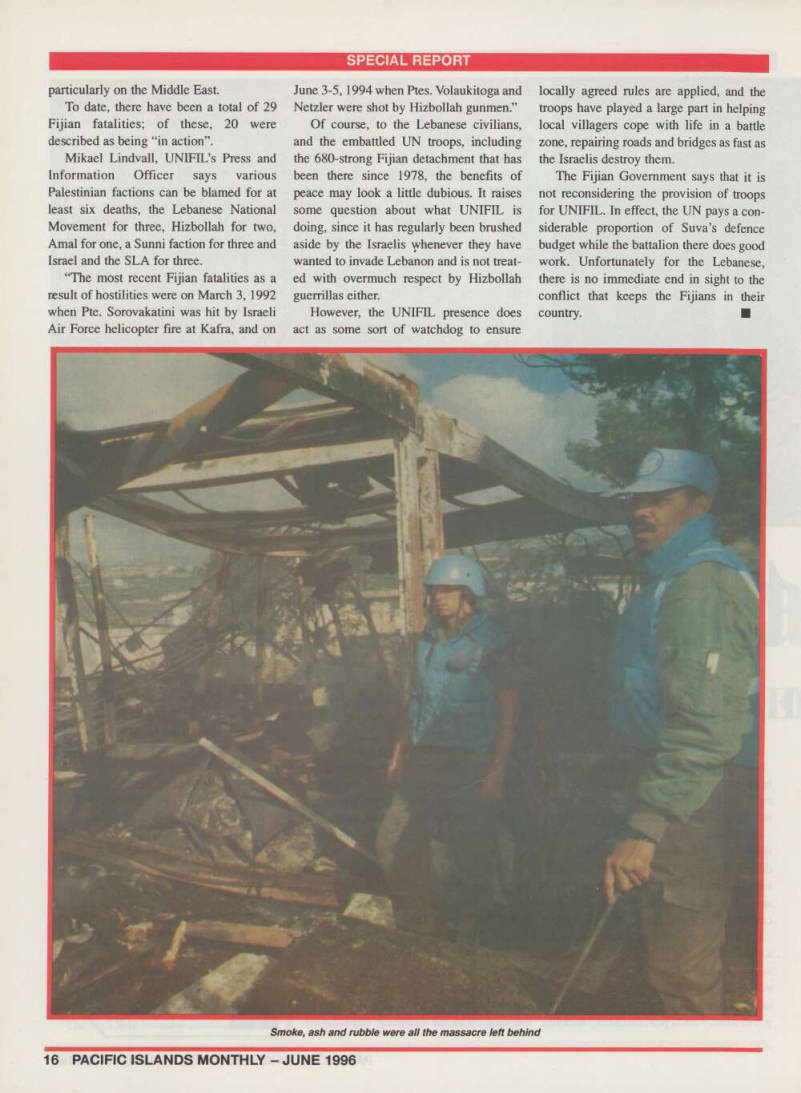
However, Fiji troops became the unwilling centre of a military and diplo matic storm on April 18 when Israeli shell fire rained down on their camp at Qana in Lebanon, wounding four Fijians and killing over 135 civilians who had sought asylum at the camp and wounding several hundred more. Two critically wounded Fijians, who had been sheltering under the camp, were repatriated.
The incident focused attention on the
United Nations Interim Force in Lebanon (UNIFIL), which has been stationed there for so many decades it has almost reversed the meaning of “interim” to “permanent”.
Although Washington’s unstinting sup port protected Israel from the full conse quences, the incident certainly cost Israeli Prime Minister Shimon Peres any more active support from the world community and led to the conclusion of an agreement little different from what had already been in place before the outbreak of high-tech mayhem along the border, but seems to have helped him advance his electoral position.
While UN Secretary-General Boutros
Boutros-Ghali, the diplomatic architect of the original Egyptian-Israeli peace treaty, was quick to deplore and condemn the Israeli shelling, under heavy American pressure, the UN Security Council resolu tion the following day contained no hint of rebuke at this attack on its own UN per sonnel.
Lebanon’s Ambassador Samir Moubarak, has tried unsuccessfully three previous times to get the issue of Israeli attacks raised in the Security Council.
“It’s been eight years since the last res olution,” Ambassador Moubarak told PIM.
“It’s high time to let Israel know that it is not above international law.”
Soldiers survey the scene of the carnage after the Israeli bombing
He added the defeated resolution had been prepared five days before, and was mild under the circumstances, but even milder in view of the casualty list.
“We should have drafted it more strongly. As it is, the successful resolution did not condemn the Israeli actions, it did not ask them to stop and did not take into account compensation for the damage caused.
“Children are being slaughtered in ambulances and elderly people, men, women and children in Lebanon are falling every minute for the sole purpose of help ing the electoral ambition of the Israeli government. This is pure madness,” he told
the Security Council.
Perhaps even more surprisingly, only Papua New Guinea from the South Pacific region voted with the non-aligned nations to support a barely successful General
Assembly Resolution condemning the
incident a week later. It passed with more abstentions than votes for - and two votes, the US and Israel, against.
Fiji and other South Pacific nations abstained even though Fijian ambassador Poseci Bune told delegates the “indiscrim inate shelling” was “totally unwarranted”.
However, he went on to say he realised “the conflict was not one-sided. We also condemn all forms of terrorism and the slaughter of innocent people in the strongest terms and which have brought untold suffering to the innocent communi ties in Israel.”
But then he veered back to give Fiji’s support to Lebanon’s claim that its own territory, under Israeli occupation, be restored.
Fiji’s Deputy Permanent
Representative, Graham Leung explained
the abstention, because the Arab-inspired draft “lacked balance. It didn’t condemn the Hizbollah attacks.”
Nonetheless, he said reports from the Fijians on the ground indicated “it was inconceivable” artillery fire on the post was “accidental”, as the Israelis claimed.
“There is some dispute about the nature and timing of any warnings given by the Israelis.”
PNG Ambassador Utuola Utuoc Samana explained he had voted along with the bulk of the non-aligned nations because “we felt that Israel’s action is a direct action taken by a state affecting the lives of innocent civilians and we cannot condone military actions like that by a state. Of course, that doesn’t mean that condones the actions of terrorist groups either.”
Other countries that abstained, even close American allies like Germany, thought Israel had gone too far and exceeded “proportionality” in its response.
The Old Testament said an eye for an eye, not a life for an eye, German ambas sador Tono Eitel said, echoing the senti ments of many, that Israel’s 20,000-plus shells and naval, air and land barrages all the way up to the Lebanese capital were
totally disproportionate to the attacks.
In fact, there is some dispute about what originally broke the 1993 cease-fire agreement between the Israelis and the Hizbollah guerrillas. That accepted that neither side would target civilians, but allowed Hizbollah the right to attack Israeli troops and their allies in the occu pied strip of Lebanon next to the Israeli border. The Lebanese government and the Arabs generally, insist that since Israel is occupying their territory in defiance of Security Council Resolution 425, the Hizbollah guerrillas have the right of self defence.
The April outbreak began with an Israeli tank firing into unoccupied Lebanese territory. It was also claimed to be an “accident” for which the Israelis apologised. However, with the local cyni cism that has seen Lebanon treated so often as a free-fire zone, it is entirely pos sible that someone, at some level, on the Israeli side hoped for the consequences that followed - a volley of Katyusha mis siles from Hizbollah into Israel.
Whether intended or not, that in turn gave Peres the excuse for a massive opera tion that made half-a-million Lebanese homeless and destroyed much of the painfully rebuilt infrastructure of the war ravaged country. And that of course, helped Peres regain the poll lead he had lost to his hard-line right wing opponent Benjamin Netanyahu. Washington and its allies are eager to see Peres remain in power to ensure that the “peace process” continues. And given the strength of the pro-Israeli lobby in the USA, it would be a brave president who attempted to thwart Israeli wishes in an election year. Bill Clinton has shown few signs of bravery.
particularly on the Middle East.
To date, there have been a total of 29 Fijian fatalities; of these, 20 were described as being “in action”.
Mikael Lindvall, UNIFIL’s Press and Information Officer says various Palestinian factions can be blamed for at least six deaths, the Lebanese National Movement for three, Hizbollah for two, Amal for one, a Sunni faction for three and Israel and the SLA for three.
“The most recent Fijian fatalities as a result of hostilities were on March 3, 1992 when Pte. Sorovakatini was hit by Israeli Air Force helicopter fire at Kafra, and on
June 3-5,1994 when Ptes. Volaukitoga and Netzler were shot by Hizbollah gunmen.”
Of course, to the Lebanese civilians, and the embattled UN troops, including the 680-strong Fijian detachment that has been there since 1978, the benefits of peace may look a little dubious. It raises some question about what UNIFIL is doing, since it has regularly been brushed aside by the Israelis whenever they have wanted to invade Lebanon and is not treat ed with overmuch respect by Hizbollah guerrillas either.
However, the UNIFIL presence does act as some sort of watchdog to ensure
locally agreed rules are applied, and the troops have played a large part in helping local villagers cope with life in a battle zone, repairing roads and bridges as fast as the Israelis destroy them.
The Fijian Government says that it is not reconsidering the provision of troops for UNIFIL. In effect, the UN pays a con siderable proportion of Suva’s defence budget while the battalion there does good work. Unfortunately for the Lebanese, there is no immediate end in sight to the conflict that keeps the Fijians in their country. ■
Smoke, ash and rubble were all the massacre left behind