A crisis
pp. 12-13 · Read in the full issue
situation
By Sophie Foster
A Senate Select Committee report into the Fiji Police Force has called for a national emergency to be declared to stem the Force’s rapid dete rioration.
And in the face of the country’s rising crime rate, it has said the police depart ment should be given “urgent priority” over others of the civil service.
The report, released in April, found widespread dissatisfaction and disillusion ment amongst the force’s ranks particular ly with current employment, working and living conditions.
It said morale in the force was low because of the enormous public pressure placed on the “frontline men and women expected to combat crime” and the low priority given to it by Government.
“The Committee was informed with some force of argument that police matters were usually given lesser priority consid eration than army matters. Therefore, it is no surprise that the police should appear to be the most demoralised department of Government,” it said.
The report is highly critical of Government and its “hollow” assurances that the problems highlighted in it would
be dealt with.
It has found the organisational struc ture, legislation and administration of the Force has sometimes resulted in police being “lamentably inter-twined in a web comprised of unlawful or irregular imple mentation of decisions lacking in fore
sight”.
And it said there is a “clear lack of con sideration for the welfare of men and women who are clearly seen to be just car rying on under the obvious addiction of call of duty, afraid to raise their griev ances”.
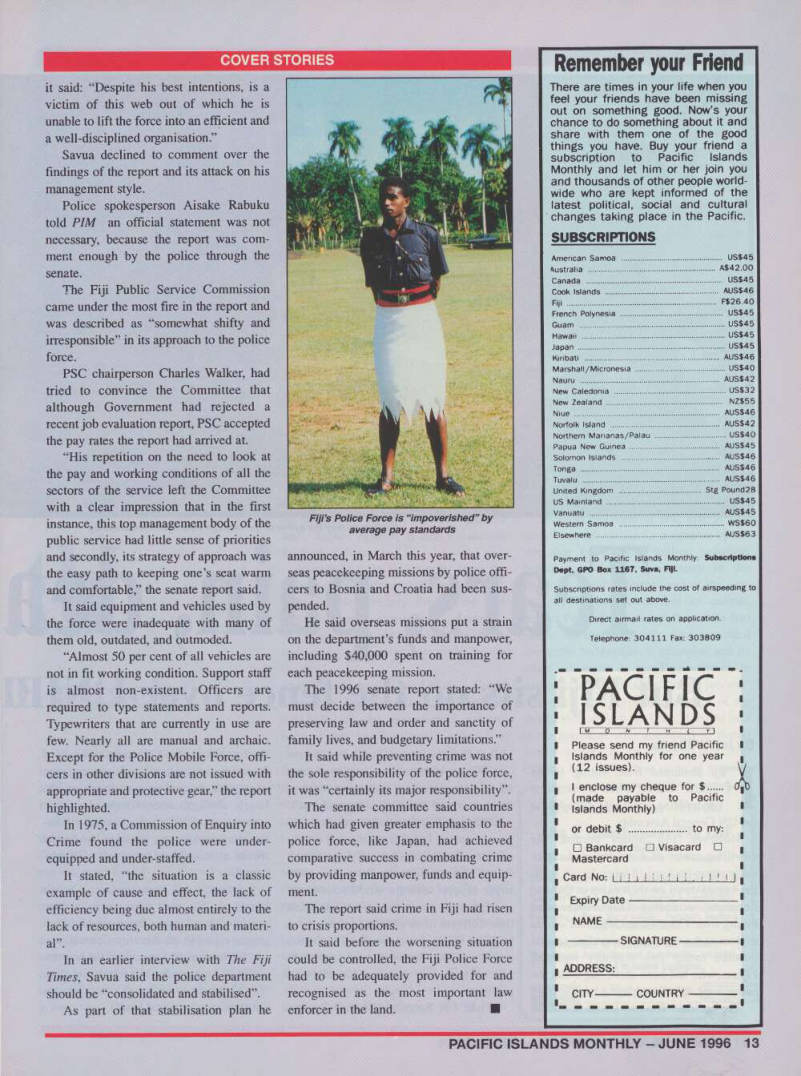
By average pay standards, the Fiji Police Force, is “impoverished”, and its members are overworked and ill-equipped, the report stated.
“Some squatters in and around the city of Suva are seen to be living in better hous ing conditions than many of the junior members of the police force,” it said.
“The current salary structure of the force has the Commissioner of Police on
$F53,900, with the lowest person paid $F5153, a figure on Fiji’s poverty line.”
“The Fiji police force’s downgraded parity suffers from the historical Native Constabulary syndrome. The salary struc ture of the police force is unjustly based,” the report said.
And with sufficient housing for only 40 per cent of married officers, the report said 60 per cent have to find their own place to live in a market of high rentals and unsuit able housing.
“Officers are forced to live a long way from their place of work and in doing so incur more expenses in travel costs,” the senate committee reported.
“High rental costs have also forced offi cers to accept substandard houses, the quality of which would compare with those in squatter settlements. The housing allowance is insufficient to meet costs of water, electricity and sanitation fees.”
The Committee is also critical of Commissioner of Police Isikia Savua who.
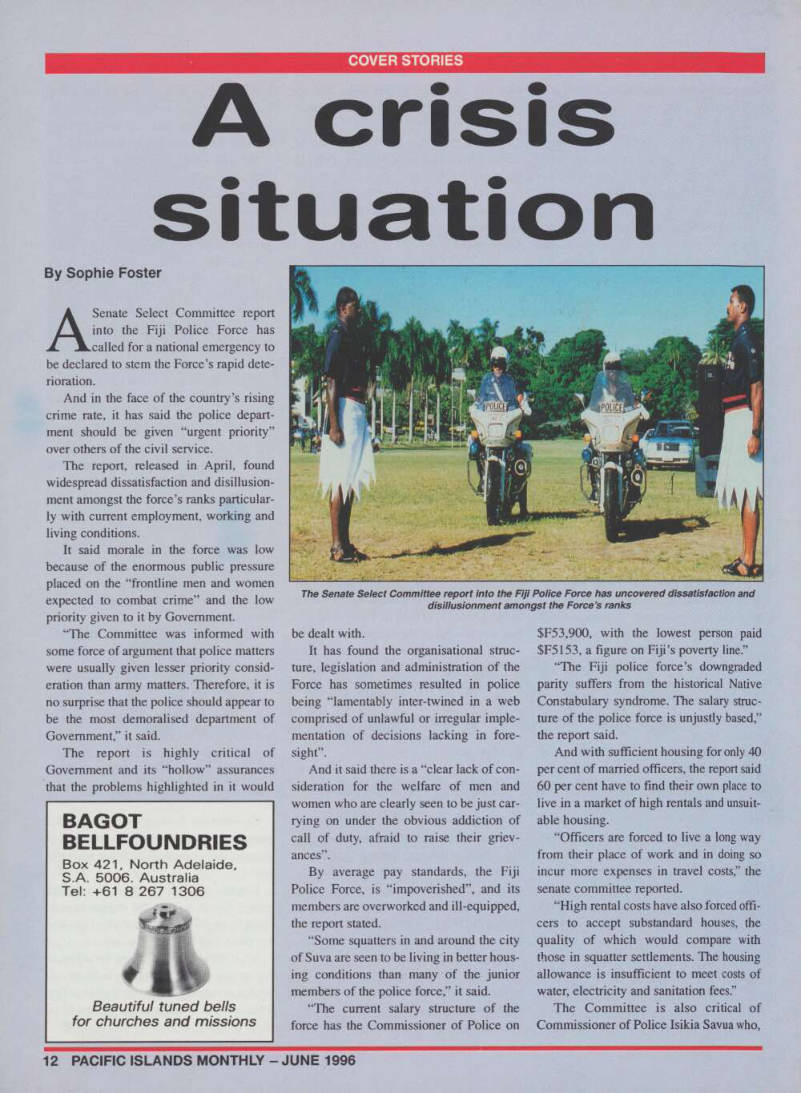
The Senate Select Committee report into the Fiji Police Force has uncovered dissatisfaction and disillusionment amongst the Force’s ranks
it said: “Despite his best intentions, is a victim of this web out of which he is unable to lift the force into an efficient and a well-disciplined organisation.”
Savua declined to comment over the findings of the report and its attack on his management style.
Police spokesperson Aisake Rabuku told PIM an official statement was not necessary, because the report was com ment enough by the police through the senate.
The Fiji Public Service Commission came under the most fire in the report and was described as “somewhat shifty and irresponsible” in its approach to the police force.
PSC chairperson Charles Walker, had tried to convince the Committee that although Government had rejected a recent job evaluation report, PSC accepted the pay rates the report had arrived at.
“His repetition on the need to look at the pay and working conditions of all the sectors of the service left the Committee with a clear impression that in the first instance, this top management body of the public service had little sense of priorities and secondly, its strategy of approach was the easy path to keeping one’s seat warm and comfortable,” the senate report said.
It said equipment and vehicles used by the force were inadequate with many of them old, outdated, and outmoded.
“Almost 50 per cent of all vehicles are not in fit working condition. Support staff is almost non-existent. Officers are required to type statements and reports.
Typewriters that are currently in use are few. Nearly all are manual and archaic.
Except for the Police Mobile Force, offi cers in other divisions are not issued with appropriate and protective gear,” the report highlighted.
In 1975, a Commission of Enquiry into Crime found the police were under equipped and under-staffed.
It stated, “the situation is a classic example of cause and effect, the lack of efficiency being due almost entirely to the lack of resources, both human and materi al”.
In an earlier interview with The Fiji Times, Savua said the police department should be “consolidated and stabilised”.
As part of that stabilisation plan he
announced, in March this year, that over seas peacekeeping missions by police offi cers to Bosnia and Croatia had been sus pended.
He said overseas missions put a strain on the department’s funds and manpower, including $40,000 spent on training for each peacekeeping mission.
The 1996 senate report stated: “We must decide between the importance of preserving law and order and sanctity of family lives, and budgetary limitations.”
It said while preventing crime was not the sole responsibility of the police force, it was “certainly its major responsibility”.
The senate committee said countries which had given greater emphasis to the police force, like Japan, had achieved comparative success in combating crime by providing manpower, funds and equip ment.
The report said crime in Fiji had risen to crisis proportions.
It said before the worsening situation could be controlled, the Fiji Police Force had to be adequately provided for and recognised as the most important law enforcer in the land. ■
Fiji’s Police Force is “impoverished” by average pay standards