On the inside
pp. 10-11 · Read in the full issue
Cover Stories
Dare Fiji’s prisoners hope for reform?
SOPHIE FOSTER reports
What does a recently-released prisoner have to look forward to? The answer for many ex prisoners is bleak. All they have now is a society which refuses to acknowledge their existence and discriminates against them at almost every turn.
And with the police department’s cur rent limited resources, many would be happy to lock criminals up, throw away the key and forget about them.
But is society justified in adopting such
a stance?
In Fiji, a rehabilitation programme for current and ex-prisoners is virtually non existent. The “official” reason being a lack of funds.
But could the situation be better described as a lack of commitment to facil itate changes necessary to make ex-prison ers law-abiding members of the communi ty?
Judging by the number of repeat offenders and rampant discriminatory
policies which encourage a cycle of crime, it is clear a safety net for those who fall by the wayside is non-existent.
It is also clear the justice system in Fiji, which covers the police, courts and pris ons, has failed to address the ever-increas ing crime rate and over-populated prisons.
Fiji’s Crime Prevention and Control Seminar in March highlighted income inequalities, unemployment and poverty as being at the root of the problem.
The seminar recommended changes to
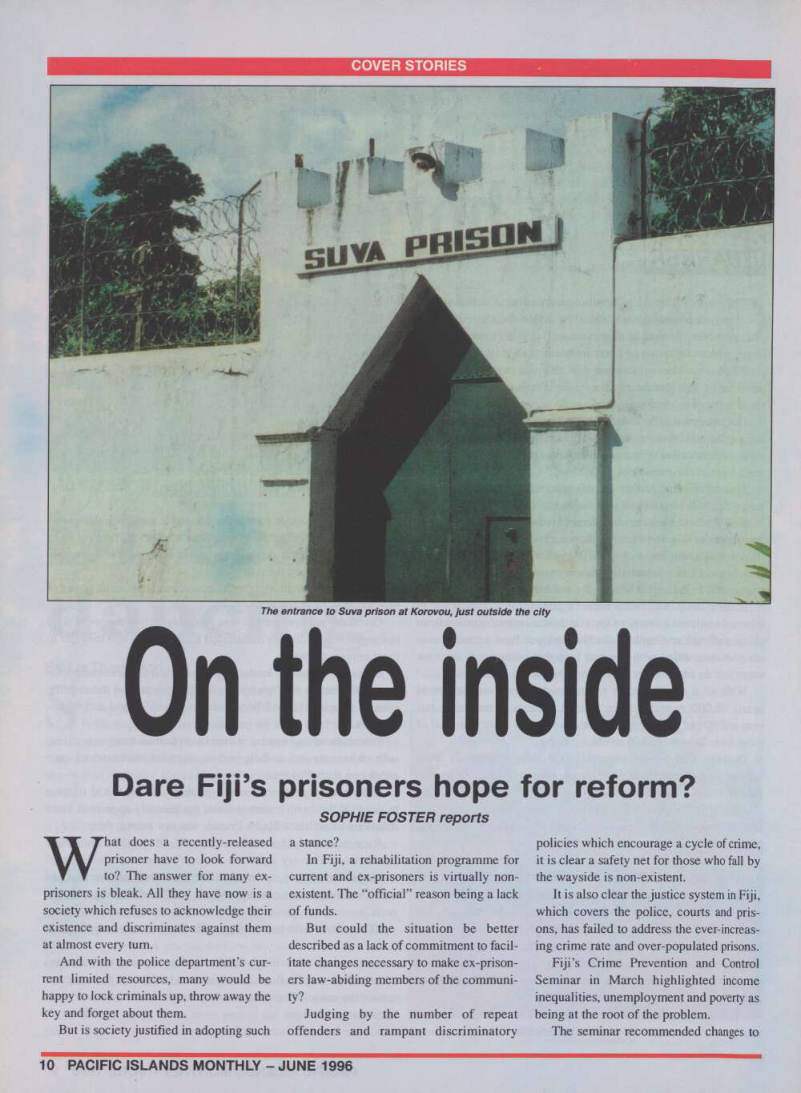
The entrance to Suva prison at Korovou, just outside the city
national planning policies, education and legislation to curb crime rates.
But while national workshops on crime prevention may provide excellent forums for dialogue amongst all parties involved, without commitment, follow-up action and implementation, such gatherings could become a waste of time and effort.
Police, magistrates, prison officials, ex prisoners, and unemployed youth, all agree on one thing - changes are needed immediately if attempts to halt the surging crime rate are to be effective.
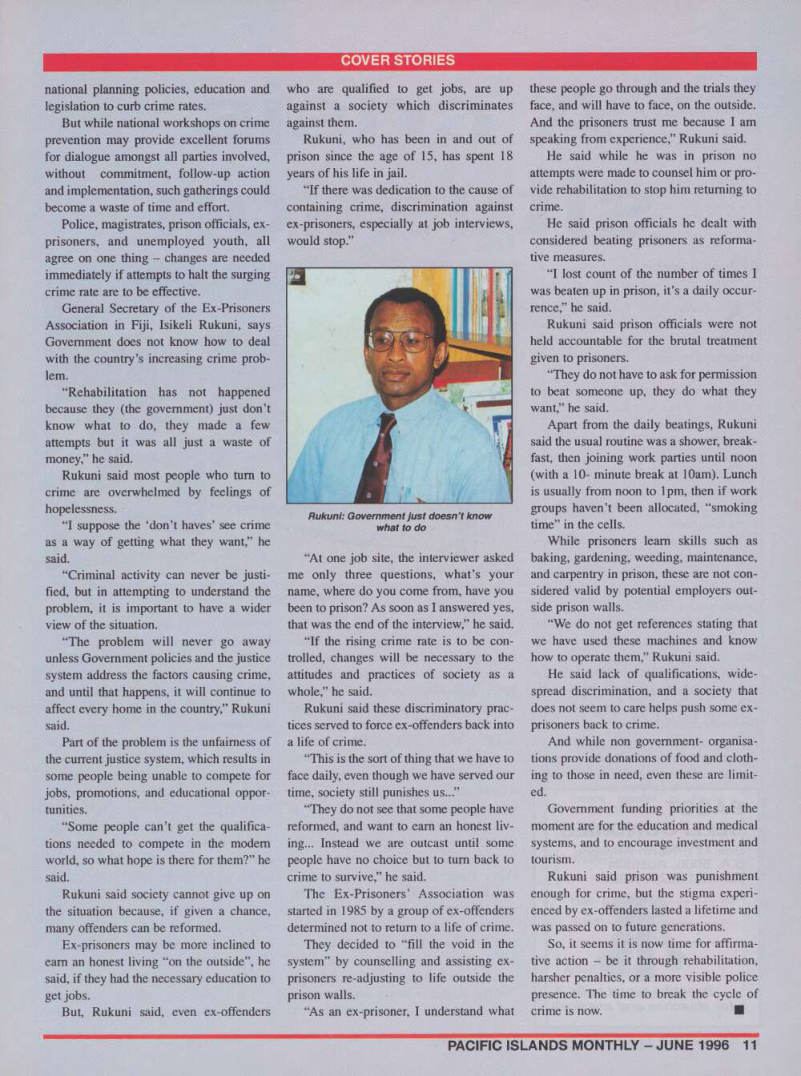
General Secretary of the Ex-Prisoners Association in Fiji, Isikeli Rukuni, says Government does not know how to deal with the country’s increasing crime prob lem.
“Rehabilitation has not happened because they (the government) just don’t know what to do, they made a few attempts but it was all just a waste of money,” he said.
Rukuni said most people who turn to crime are overwhelmed by feelings of hopelessness.
“I suppose the ‘don’t haves’ see crime as a way of getting what they want,” he said.
“Criminal activity can never be justi fied, but in attempting to understand the problem, it is important to have a wider view of the situation.
“The problem will never go away unless Government policies and the justice system address the factors causing crime, and until that happens, it will continue to affect every home in the country,” Rukuni said.
Part of the problem is the unfairness of the current justice system, which results in some people being unable to compete for jobs, promotions, and educational oppor tunities.
“Some people can’t get the qualifica tions needed to compete in the modem world, so what hope is there for them?” he said.
Rukuni said society cannot give up on the situation because, if given a chance, many offenders can be reformed.
Ex-prisoners may be more inclined to earn an honest living “on the outside”, he said, if they had the necessary education to get jobs.
But, Rukuni said, even ex-offenders
who are qualified to get jobs, are up against a society which discriminates against them.
Rukuni, who has been in and out of prison since the age of 15, has spent 18 years of his life in jail.
“If there was dedication to the cause of containing crime, discrimination against ex-prisoners, especially at job interviews, would stop.”
“At one job site, the interviewer asked me only three questions, what’s your name, where do you come from, have you been to prison? As soon as I answered yes, that was the end of the interview,” he said.
“If the rising crime rate is to be con trolled, changes will be necessary to the attitudes and practices of society as a whole,” he said.
Rukuni said these discriminatory prac tices served to force ex-offenders back into a life of crime.
“This is the sort of thing that we have to face daily, even though we have served our time, society still punishes u 5...”
“They do not see that some people have reformed, and want to earn an honest liv ing... Instead we are outcast until some people have no choice but to turn back to crime to survive,” he said.
The Ex-Prisoners’ Association was started in 1985 by a group of ex-offenders determined not to return to a life of crime.
They decided to “fill the void in the system” by counselling and assisting ex prisoners re-adjusting to life outside the
prison walls.
“As an ex-prisoner, I understand what
these people go through and the trials they face, and will have to face, on the outside.
And the prisoners trust me because I am speaking from experience,” Rukuni said.
He said while he was in prison no attempts were made to counsel him or pro vide rehabilitation to stop him returning to crime.
He said prison officials he dealt with considered beating prisoners as reforma tive measures.
“I lost count of the number of times I was beaten up in prison, it’s a daily occur rence,” he said.
Rukuni said prison officials were not held accountable for the brutal treatment
given to prisoners.
“They do not have to ask for permission to beat someone up, they do what they want,” he said.
Apart from the daily beatings, Rukuni
said the usual routine was a shower, break fast, then joining work parties until noon (with a 10- minute break at 10am). Lunch is usually from noon to 1 pm, then if work groups haven’t been allocated, “smoking time” in the cells.
While prisoners learn skills such as
baking, gardening, weeding, maintenance,
and carpentry in prison, these are not con
sidered valid by potential employers out
side prison walls.
“We do not get references stating that we have used these machines and know how to operate them,” Rukuni said.
He said lack of qualifications, wide spread discrimination, and a society that does not seem to care helps push some ex prisoners back to crime.
And while non government- organisa tions provide donations of food and cloth ing to those in need, even these are limit ed.
Government funding priorities at the moment are for the education and medical systems, and to encourage investment and tourism.
Rukuni said prison was punishment enough for crime, but the stigma experi enced by ex-offenders lasted a lifetime and was passed on to future generations.
So, it seems it is now time for affirma tive action - be it through rehabilitation, harsher penalties, or a more visible police presence. The time to break the cycle of crime is now. ■
Rukuni: Government Just doesn’t know what to do