Carlot’s
pp. 32-33 · Read in the full issue
Politics
Carlot’s comeback
The struggle for power in Vanuatu has turned again in favour of Maxime Carlot, who on February 23 returned as Prime Minister to replace his rival Serge Vohor.
Vohor, who had resigned a fortnight before, had been PM for less than two months.
By Patrick Decloitre
In a stormy parliamentary session on February 23, Carlot was elected Prime Minister by a majority consisting of a group of eight dissident members of par liament from the Union of Moderate Parties (UMP, of which Vohor is President) led by MP Amos Andeng, and Donald
Kalpoka’s Unity Front.
A few minutes before the vote took place, the 11 MPs faithful to Vohor’s UMP and Walter Lini’s National United Party left the chamber, saying they could no longer participate because there was “too much confusion”.
On February 8, Prime Minister Serge Vohor, who was elected on December 21, resigned to avoid facing a motion of no confidence due to have been debated the
same day.
The motion was filed by an alliance of
opposition Donald Kalpoka’s Unity Front
and eight dissident MPs from Vohor’s own UMP, but was withdrawn on February 12 after Vohor’s resignation. After last November’s general elections, UF, which won 22 seats, was at the time excluded from power.
On February 23, Vanuatu’s second
extraordinary parliamentary session began
in a confusing manner: the first deputy speaker John Tari (NUP), had attempted to sit in the Speaker’s chair. The Vohor-Lini
alliance argued that it was he who, in the absence of a speaker, should head the debates until a new speaker was elected.
On the morning of February 23, police were deployed in numbers rarely seen in Vanuatu. Prior to the debates beginning, they invited John Tari to leave the speak er’s chair, which he eventually did.
The Kalpokas-Andeng group, citing
parliament’s standing orders, said it was the most senior MP’s role to preside over the debates pending a new speaker’s elec tion. In this case, the most senior MP was
Amos Andeng.
A few days before, parliament speaker Maxime Carlot had announced his resig nation, a move seen here as clearly indi cating he was paving the way for a come back.
Later, Vanuatu’s only woman MP, Hilda Lini (NUP), Walter Lini’s sister, was removed from the house by police, by order of Amos Andeng, who was presiding over the sitting.
After refusing to sit down at the injunc tions of Andeng, Hilda Lini, who had questioned the fact that he should preside to the election of a new speaker, was dragged out of the house by police.
Three of them were injured in the
process,. as they dragged the screaming
Hilda Lini out of the chamber. One police man ended up with a ball point pen stuck on his upper lip.
A new speaker of parliament, Edward Natapei (from Donald Kalpokas Unity Front), was later elected by the 31 remain ing MPs.
Minutes after, Maxime Carlot, the only candidate brought forward by the MPs attending, was unanimously elected Prime Minister of Vanuatu by 30 votes (the speaker does not vote).
He then announced the composition of his government, naming Kalpokas as his deputy and minister of education.
Carlot, a personal friend of French President Jacques Chirac, was Vanuatu’s Prime Minister from 1991 until last December. During his term he was seen as the key element of normalisation of rela tions with France, a major aid donor to Vanuatu.
Amid opposition to last year’s French nuclear testing campaign, he was the most moderate voice in the Pacific, calling the French decision a “sovereign” one.
His return at the head of the island state’s government marks a persona! victo ry in an internal UMP power struggle against his rival Serge Vohor, who only remained PM from last December 21 to February 8, 1996.
“The former Prime Minister tries to continue to talk and mislead people (on national radio). We’ll see that it stops,”
Carlot told national radio hours after his election in a nation-wide broadcast inter
view.
Vohor and Lini challenged parliament’s decision in the Supreme Court on February 23, calling the sitting “null and void” because standing orders of parliament and the national Constitution had been violat ed. They also argued that Vohor, on February 12, had “revoked” his resigna tion. Vohor had earlier explained that there were no provisions in the island state’s Constitution, nor in parliament’s standing orders, that said he could not do it. He added his resignation had not been endorsed by parliament and that the motion which he wanted to avoid facing by resigning was not in order.
The matter was heard in the Supreme Court, which gave its ruling one week later: Vanuatu’s Chief Justice ruled Maxime Carlot had been duly elected Prime Minister of Vanuatu by parliament on February 23.
The Chief justice pointed out Vohor’s resignation had been read out and endorsed in parliament on February 12, and that it had later been gazetted.
“There was no breach of the Constitution or infringements to anyone’s rights,” Charles Vaudin d’lmecourt said.
DTmecourt dismissed all five claims by the applicants before declaring Carlot duly elected and ordering the applicants not to take action or make statements inconsis tent with his decision.
The applicants were also ordered to sur render all government properties (such as vehicles and houses) to the new govern ment.
Lawyer Roger de Robillard, said he intended to appeal against the decision, but d’lmecourt indicated a Court of Appeal
(which must consist of three foreign judges) could not be convened before next October.
Then on March 12, Vanuatu’s council of ministers declared Roger de Robillard and a Mauritian judge, Jean-Claude Bibi,
“undesirable immigrants” in Vanuatu.
The government accused de Robillard, an Australian lawyer of Mauritian origin, of “leading a delegation of former Prime Minister Serge Vohor into parliament to order and harass parliament staff about government properties”.
“This shows interference from those lawyers in Vanuatu’s political internal affairs,” a statement said.
But de Robillard said from his Sydney office: “If they try to exclude me from (Vanuatu), it is to prevent me from defend ing my clients and if they did this, this is
because they now realise, after seeing the grounds of my appeal, that we will win our case in the court of appeal before three
neutral judges.”
Bibi, who was due to be sworn in as a judge in the Vanuatu Supreme Court, is a Mauritian lawyer. Like de Robillard, he is bi-lingual speaking both French and English, Vanuatu’s two official lan guages.
Both de Robillard and Bibi left Vanuatu on March 2, the former for Australia, the latter for Mauritius.
The Vanuatu parliament, which con vened for its first ordinary session of 1996, has started discussing bills includ ing its main one: the island state’s budget for this year, totalling some $59 million.
It also passed a motion suspending Hilda Lini, John Tari and Robert Karie, all NUP MPs, for “endangering respect and confidence” in the house.
The motion, moved by Louis Carlot (from UMP’s breakaway faction now in the majority and PM Maxime’s nephew), suspended the three members for one to three parliamentary sessions.
Louis Carlot added Tari, who was then first deputy speaker, had “demeaned his high office.”
Lini, he said, had “deliberately set out to bring about disorder and violence in (the) chamber”, when she refused to sit down and was eventually removed from
the house by police.
Karie, according to Carlot, “co-operat ed with (Lini) to wilfully obstruct the busi ness of parliament”.
Opposition leader Willie Jimmy said the motion was an “abuse of power” by the
parliament majority. ■
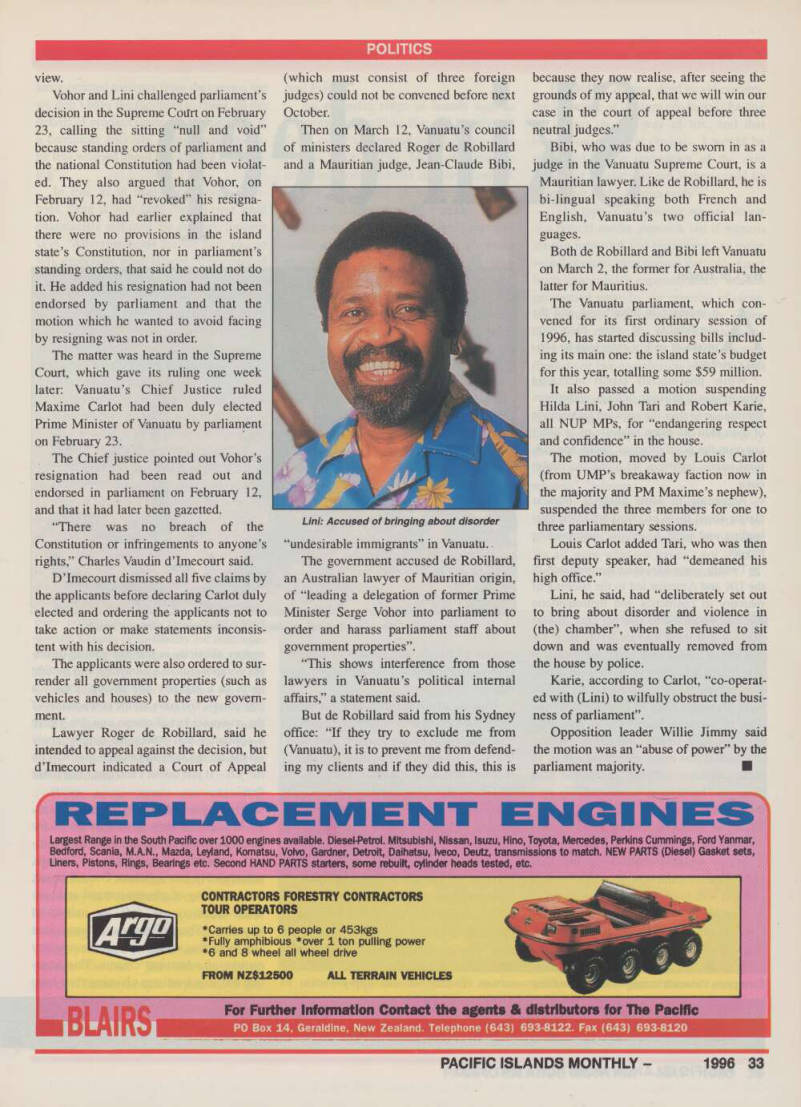
Lini: Accused of bringing about disorder