Skin deep
pp. 34-35 · Read in the full issue
Health
By UN Tuwai
An increase in advertising and the
availability of skin bleaching
products in Fiji may lead to seri ous concerns.
While pharmacists report increased sales in skin-lightening creams, consumers attempting to alter the outward appearance of their skin are often unaware of or don’t question the psychological, social and cul tural issues involved, let alone the health risks.
According to some analysts, miracle claims about these products are often mis leading and work to delude unsuspecting
buyers.
Twenty years ago, intensive research in the UK and America led to the banning of mercury in cosmetics and hydroquinone use was restricted to two per cent. It was decided that there was no justification for the use of dangerous toxic chemicals in skin bleaching products. Both these chem ical substances are active agents which were popularly used to inhibit the forma tion of melanin (pigment) in the skin, resulting in a lighter appearance. It was discovered that many women of colour in these countries suffered irreversible skin damage. The damage to the melanin pro ducing cells made the skin susceptible to ultraviolet radiation making these women predisposed to cancer.
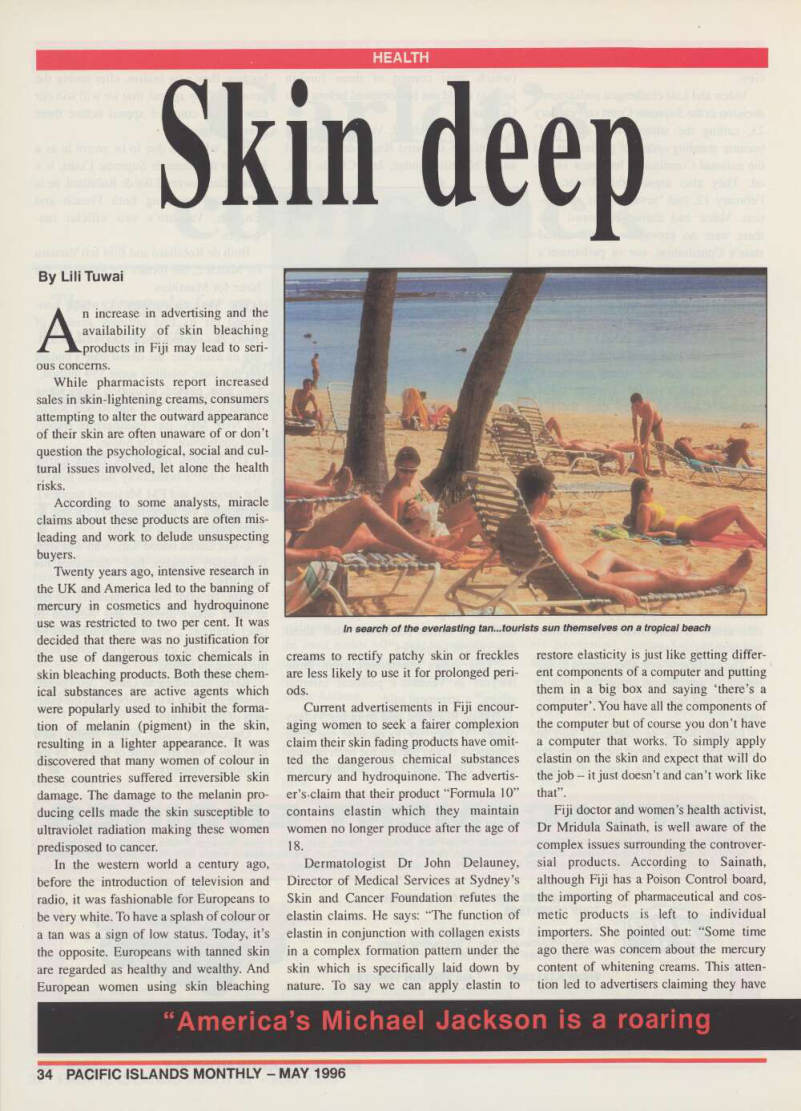
In the western world a century ago, before the introduction of television and radio, it was fashionable for Europeans to be very white. To have a splash of colour or a tan was a sign of low status. Today, it’s the opposite. Europeans with tanned skin are regarded as healthy and wealthy. And European women using skin bleaching
creams to rectify patchy skin or freckles are less likely to use it for prolonged peri ods.
Current advertisements in Fiji encour aging women to seek a fairer complexion claim their skin fading products have omit ted the dangerous chemical substances mercury and hydroquinone. The advertis er’s claim that their product “Formula 10” contains elastin which they maintain women no longer produce after the age of 18.
Dermatologist Dr John Delauney, Director of Medical Services at Sydney’s Skin and Cancer Foundation refutes the elastin claims. He says; “The function of elastin in conjunction with collagen exists in a complex formation pattern under the skin which is specifically laid down by nature. To say we can apply elastin to
restore elasticity is just like getting differ ent components of a computer and putting them in a big box and saying ‘there’s a computer’. You have all the components of the computer but of course you don’t have a computer that works. To simply apply elastin on the skin and expect that will do the job - it just doesn’t and can’t work like that”.
Fiji doctor and women’s health activist.
Dr Mridula Sainath, is well aware of the complex issues surrounding the controver sial products. According to Sainath, although Fiji has a Poison Control board, the importing of pharmaceutical and cos metic products is left to individual importers. She pointed out: “Some time ago there was concern about the mercury content of whitening creams. This atten tion led to advertisers claiming they have
“America’s Michael Jackson is a roaring
In search of the everlasting tan...tourists sun themselves on a tropical beach
since omitted mercury from the creams but we don’t have the facilities to check all the details of product contents. Unless there is a consumer concern, people here tend to be less worried about this kind of advertis
ing”.
In Fiji, as in many developing coun tries, there is very little control over what pharmacists sell over the counter, Sainath says. “Advertisements are the best way to sell, especially when almost 50 per cent of the population is of Indian origin, and for these women on the marriage market the issue of complexion is a major one. It’s a cultural thing - never mind that a man might be dark, the issue is that they expect to marry a woman who is fair, especially if it is an arranged marriage”.
In the nineties, notions of skin colour continue to play a central role in the way a woman is related to or what she imagines herself to be. In Japan, past fascination with the rice-powdered face of the geishas with their porcelain complexion was a symbol of beauty. Throughout the western world it is the blond, blue-eyed look-alikes of Marilyn Monroe, Twiggy, Princess Diana, and Claudia Schiffer who are pro jected by the media to be “desirable” women.
Analysts say in many developing coun tries colouration has long determined women’s status or suitability for marriage.
Preference for lightness may not be explic itly stated, but for many women of colour around the globe skin bleaching plays an important role in their beauty regime and is often used as a way of becoming more socially acceptable. The media is more likely to portray fair skinned women in advertisements.
While some women use whitening creams to erase patchy darker pigment or unwanted hair from their face and body, others use the creams in an attempt to lighten or whiten their appearance. A Dispensary Assistant at Makkans Pharmacy in Fiji disclosed that it is most ly Indian women who purchase their bleaching creams but said indigenous Fijians purchases of the cream was on the increase. She said: “The ratio would be 60 per cent Indian women buyers to 40 per
cent Fijians”.
An extensive range of brands such as Formula 10, Fair Plus, Fair and Lovely and Too Lovely are among popular bleaching creams used in Fiji. Most of these are imported from Australia and New Zealand.
The creams are in big demand with Makkans selling about 30 a week.
Sainath pointed to Afro-American musician Michael Jackson, “as a roaring example of what people can do with creams.
But ask some young women why they use skin bleaching products and reasons differ. One Fijian woman replied: “It is because I want to look more European, but I only use Formula 10 because it is cheap er, I can’t use the more sophisticated prod ucts that many of my friends use because I can’t afford it”.
Another young Indian woman said: “I don’t use bleaching creams to be whiter, I just use them to be lighter in complexion”.
Inia Wele, Environmental Health Officer for the Ministry of Health in Fiji expressed that while he wasn’t aware of any health concern connected to skin bleaching products he recognised Fiji’s changing experiences with regard to other imported products.
He said; “Like any third world country, the influence of western products is having an impact on our way of life, and that impact on health is obvious. I would be interested in the toxicology of the skin bleaching products to see if they could be damaging to the human body”.
“The type of advertising we are seeing is a typical media gimmick but if women are not informed and empowered to make
sound choices, they remain gullible. Apart
from unnecessary expense, many women get carried away by the promise of clear ing blemishes and becoming fairer. Often they don’t realise the model’s picture has been airbrushed to give her that smooth, flawless or fair complexion look,” Sainath said.
“While skin bleaching is a topical prob lem among the Indian population in Fiji, there are a group of people who easily develop pigmented areas on their skin after injuries and sometimes for no apparent reasons”, Delauney.
He continued: “It’s funny isn’t it?
White people want to get tanned and a lot of the Indian population want to be paler.
We all want what we haven’t got - that’s the funny thing about human nature”. ■
example of what people can do with creams.”
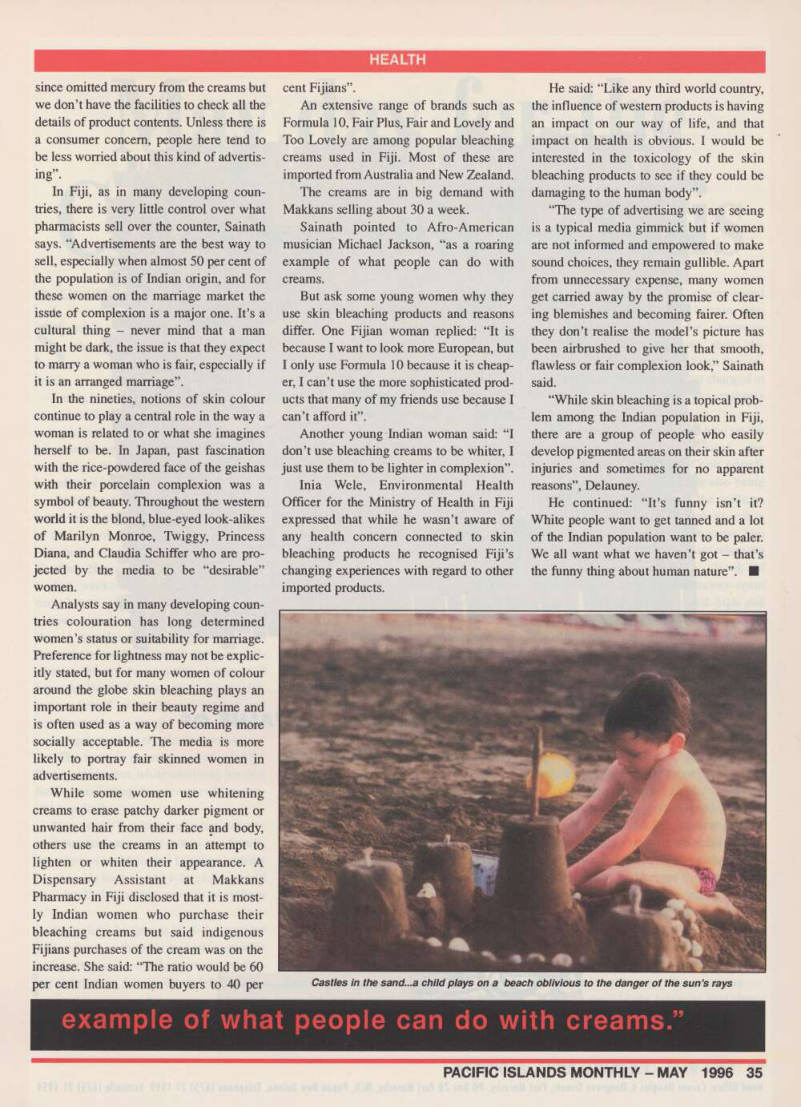
Castles in the sand...a child plays on a beach oblivious to the danger of the sun’s rays