uncertainty
p. 29 · Read in the full issue
Region
Beti’s trail of uncertainty
By Patrick Decloitre
Tropical cyclone Beti, which hit Vanuatu and New Caledonia at the end of March, left a trail of uncer tainty in Vanuatu over the extent of its
damage.
The cyclone, which was moving slowly (about five knots) when it passed over Vanuatu, had winds estimated at its centre at 40 to 45 knots, with gusts to 50 knots.
It hit the northern islands of the archi pelago, including Ambrym, Malekula, Pentecost and Maewo.
Soon after Bed’s passage, reports from affected islands began flowing into Vanuatu’s National Disaster Management Office (NDMO) and, through other chan nels, to the national radio, Radio Vanuatu.
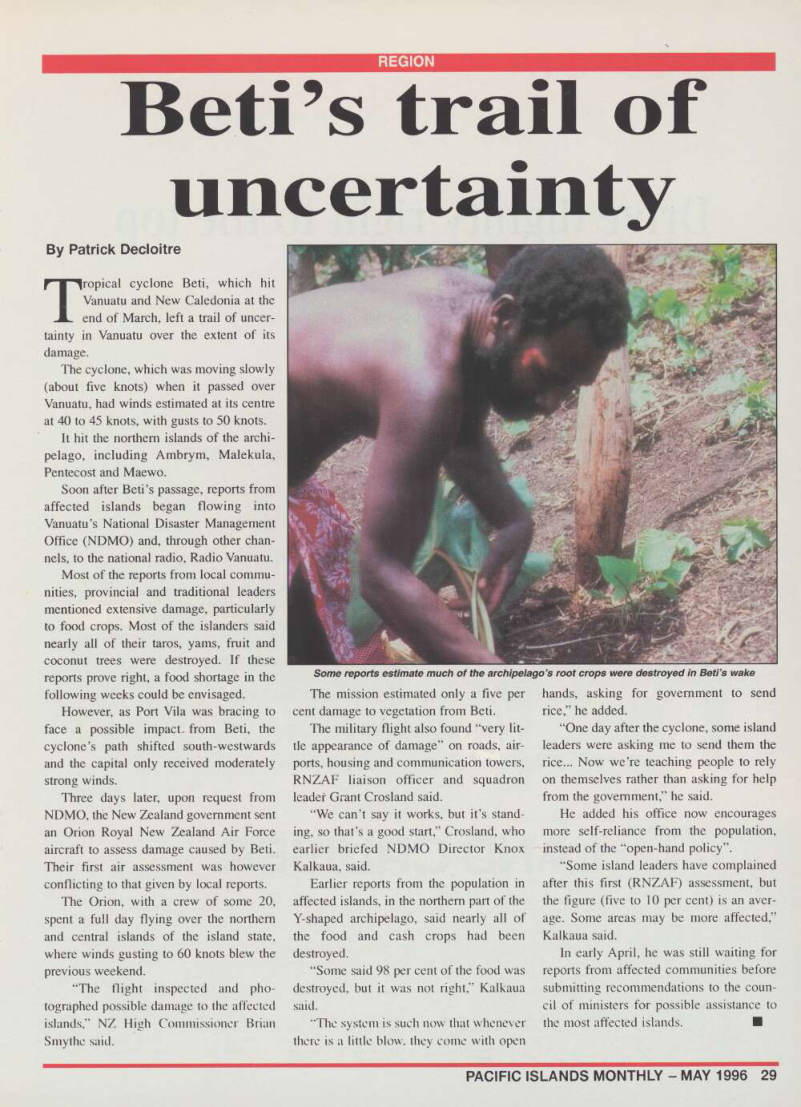
Most of the reports from local commu nities, provincial and traditional leaders mentioned extensive damage, particularly to food crops. Most of the islanders said nearly all of their taros, yams, fruit and coconut trees were destroyed. If these reports prove right, a food shortage in the following weeks could be envisaged.
However, as Port Vila was bracing to face a possible impact- from Beti, the cyclone’s path shifted south-westwards and the capital only received moderately strong winds.
Three days later, upon request from NDMO, the New Zealand government sent an Orion Royal New Zealand Air Force aircraft to assess damage caused by Beti.
Their first air assessment was however conflicting to that given by local reports.
The Orion, with a crew of some 20, spent a full day flying over the northern and central islands of the island state, where winds gusting to 60 knots blew the
previous weekend.
“The flight inspected and pho tographed possible damage to the affected islands,” NZ High Commissioner Brian
Smythe said.
The mission estimated only a five per cent damage to vegetation from Beti.
The military flight also found “very lit tle appearance of damage” on roads, air ports, housing and communication towers, RNZAF liaison officer and squadron leader Grant Crosland said.
“We can’t say it works, but it’s stand ing, so that’s a good start,” Crosland, who earlier briefed NDMO Director Knox Kalkaua, said.
Earlier reports from the population in affected islands, in the northern part of the Y-shaped archipelago, said nearly all of the food and cash crops had been destroyed.
“Some said 98 per cent of the food was destroyed, but it was not right," Kalkaua said.
"The system is such now that whenever there is a little blow, they come with open
hands, asking for government to send rice,” he added.
“One day after the cyclone, some island leaders were asking me to send them the rice... Now we’re teaching people to rely on themselves rather than asking for help from the government,” he said.
He added his office now encourages more self-reliance from the population, instead of the “open-hand policy”.
“Some island leaders have complained after this first (RNZAF) assessment, but the figure (five to 10 per cent) is an aver age. Some areas may be more affected,”
Kalkaua said.
In early April, he was still waiting for reports from affected communities before submitting recommendations to the coun cil of ministers for possible assistance to the most affected islands. ■
Some reports estimate much of the archipelago’s root crops were destroyed in Bed’s wake