future
pp. 10-11 · Read in the full issue
Opinion
Franc future
The signing by Britain, France and
the United States of the protocols of the South Pacific Nuclear Free Zone Treaty is not just a victory for the region but another signal that the much sought permanent and world-wide ban on nuclear tests is now a real possibility.
The Comprehensive Test Ban Treaty (CTBT) has been on the international drawing board since the end of World War 11.
At that time it was feared that by the 1990’s there would be somewhere between 30 and 50 nuclear armed countries.
As it is, there are the big five - the United States, Russia, France, Britain and China - who acknowledge their weapons; the threshold nuclear powers - Israel, India, and Pakistan - which do not, and others such as Iraq, Libya and North Korea which are actively moving to join the nuclear club.
During the Cold War any real progress towards a ban on nuclear tests was out of the question. The first breakthrough came in 1993 when Australia, New Zealand and Mexico sponsored a consensus resolution calling for the negotiation of a Comprehensive Test Ban Treaty. The fol lowing year they won co-sponsorship for their resolution from the five nuclear weapons states.
While the support of the nuclear weapons states was crucial if the Treaty was to have any hope of becoming a reali ty there were still widely divergent views on what such a treaty should include - in particular, the nuclear weapons states wanted to retain the right to conduct small explosions - a stance which many saw as undermining the comprehensive nature of the treaty and its aim to prevent the devel opment of new generations of nuclear weapons.
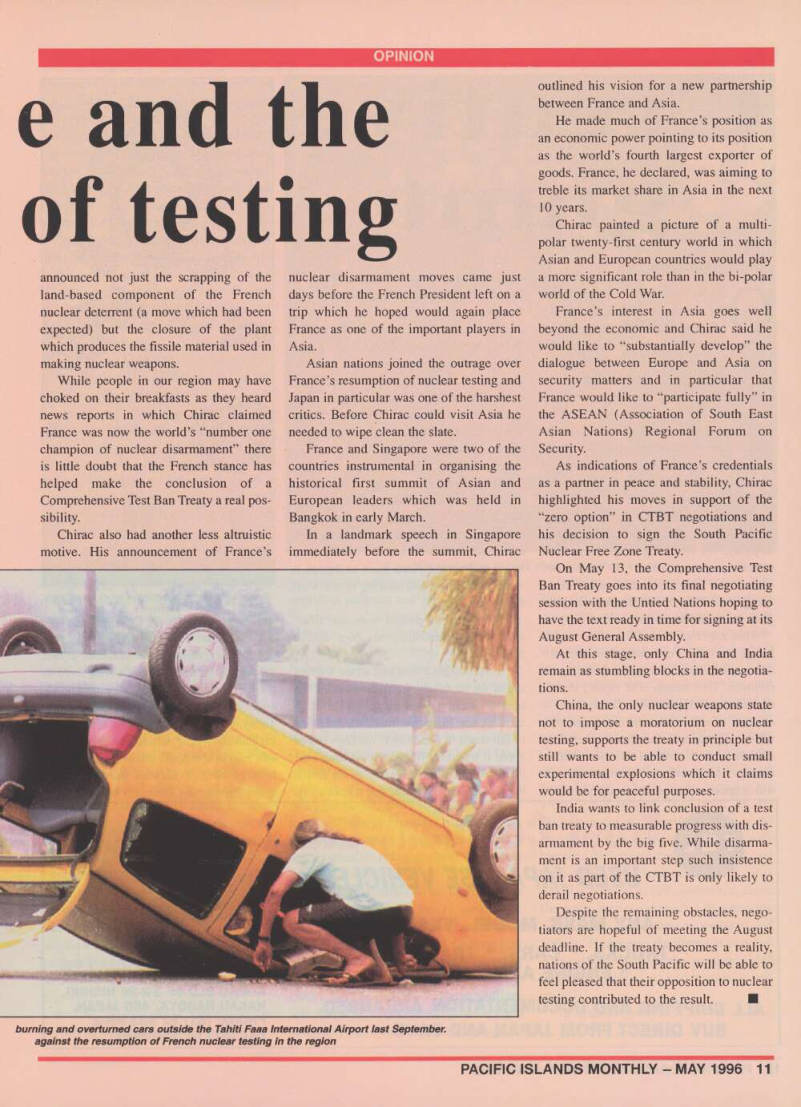
The huge protests which resulted from France’s decision to conduct a final series of tests at Mururoa Atoll helped break the log-jam. French President Jacques Chirac responded by announcing that France would back the so-called “zero option” or no tests at all under the CTBT.
Things moved rapidly and the United Nations set August 1996 as deadline for the treaty text to be ready for signing.
As France continued to suffer under protests against its tests at Mururoa, President Chirac quietly mapped out a strategy aimed at restoring his battered nation’s international image. That plan involved a nuclear about-face.
Once the tests were finished Chirac
Australia
Jemima
Garrett
A hooded demonstrator walks away fro[?] The protests wer
announced not just the scrapping of the land-based component of the French nuclear deterrent (a move which had been expected) but the closure of the plant which produces the fissile material used in making nuclear weapons.
While people in our region may have choked on their breakfasts as they heard news reports in which Chirac claimed France was now the world’s “number one champion of nuclear disarmament” there is little doubt that the French stance has helped make the conclusion of a Comprehensive Test Ban Treaty a real pos
sibility.
Chirac also had another less altruistic motive. His announcement of France’s
nuclear disarmament moves came just days before the French President left on a trip which he hoped would again place France as one of the important players in Asia.
Asian nations joined the outrage over France’s resumption of nuclear testing and Japan in particular was one of the harshest critics. Before Chirac could visit Asia he needed to wipe clean the slate.
France and Singapore were two of the countries instrumental in organising the historical first summit of Asian and European leaders which was held in
Bangkok in early March.
In a landmark speech in Singapore immediately before the summit, Chirac
outlined his vision for a new partnership between France and Asia.
He made much of France’s position as an economic power pointing to its position as the world’s fourth largest exporter of goods. France, he declared, was aiming to treble its market share in Asia in the next 10 years.
Chirac painted a picture of a multi polar twenty-first century world in which Asian and European countries would play a more significant role than in the bi-polar world of the Cold War.
France’s interest in Asia goes well beyond the economic and Chirac said he would like to “substantially develop” the dialogue between Europe and Asia on security matters and in particular that France would like to “participate fully” in the ASEAN (Association of South East Asian Nations) Regional Forum on
Security.
As indications of France’s credentials as a partner in peace and stability, Chirac highlighted his moves in support of the “zero option” in CTBT negotiations and his decision to sign the South Pacific Nuclear Free Zone Treaty.
On May 13, the Comprehensive Test Ban Treaty goes into its final negotiating session with the Untied Nations hoping to have the text ready in time for signing at its August General Assembly.
At this stage, only China and India remain as stumbling blocks in the negotia tions.
China, the only nuclear weapons state not to impose a moratorium on nuclear testing, supports the treaty in principle but still wants to be able to conduct small experimental explosions which it claims would be for peaceful purposes.
India wants to link conclusion of a test ban treaty to measurable progress with dis armament by the big five. While disarma ment is an important step such insistence on it as part of the CTBT is only likely to
derail negotiations.
Despite the remaining obstacles, nego tiators are hopeful of meeting the August deadline. If the treaty becomes a reality, nations of the South Pacific will be able to feel pleased that their opposition to nuclear testing contributed to the result. ■
burning and overturned cars outside the Tahiti Faaa International Airport last September, against the resumption of French nuclear testing in the region