An epic mom
pp. 6-9 · Read in the full issue
Cover Story
The governments of France, the United States and the United Kingdom signed the protocols to the South Pacific Nuclear Free Zone Treaty or Rarotonga Treaty, in March. But a Comprehensive Test Ban Treaty is still being negotiated by the world’s superpowers.
What does the Suva signing mean in light of the CTBT and how comprehensive will the CTBT be? Will it cover right of passage?
And will it ban the manufacture of nuclear arsenal via physical and computer-simulated means?
By Sophie Foster
Amid pomp and ceremony, France, the United States and the United Kingdom signed the three proto cols to the South Pacific Nuclear Free Zone (SPNFZ) Treaty at the headquarters
of the Suva-based Forum Secretariat on March 25.
But what does this mean for the Pacific? Is the signing of the treaty just a partial fulfilment of the promise of a nuclear free Pacific?
South Pacific Forum chairperson and
Papua New Guinea prime minister Sir Julius Chan said a more comprehensive agreement would have been preferred .
“We would have preferred an agree ment that does more to limit the risks nuclear-related activities pose to our region, and indeed to the world.
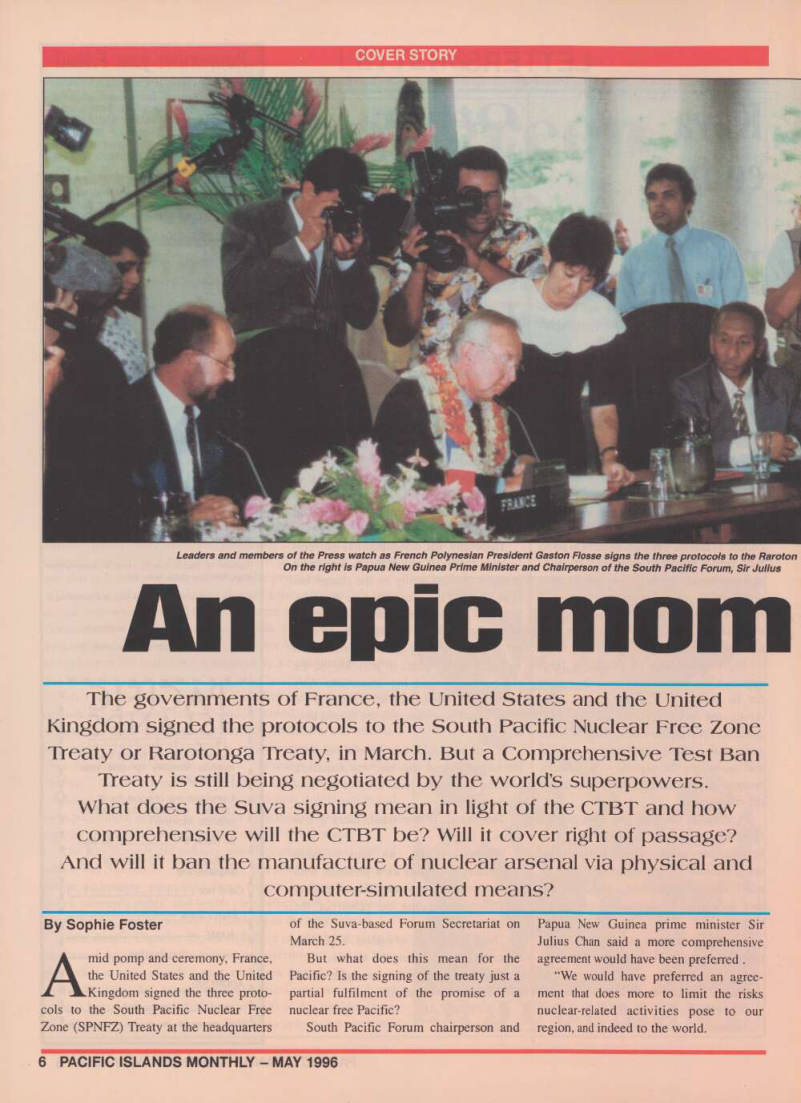
Leaders and members of the Press watch as French Polynesian President Gaston Flosse signs the three protocols to the Raroton On the right is Papua New Guinea Prime Minister and Chairperson of the South Pacific Forum, Sir Julius
“The export of uranium, the presence and transit of nuclear-powered vessels, the testing of delivery vehicles, and inade quately protected nuclear power genera tion - these dangers may not be accompa nied by a mushroom cloud but they are nonetheless very real,” he said.
The South Pacific Nuclear Free Zone treaty, or the Rarotonga Treaty as it is com monly known, has now been signed by all the nations in the South Pacific region, except for Tonga.
As yet, there is no official reason why Tonga has not ratified the treaty.
According to the Forum Secretariat, the decision to sign is the prerogative of indi vidual governments, and the right of sov ereign nations to decide whether or not to
sign.
The provisions of the treaty include the
prevention of the stationing of nuclear explosive devices within the SPNFZ, “renunciation” of nuclear explosive devices, prevention of dumping of nuclear wastes and the prevention of testing of nuclear explosive devices in the region.
Under Article Three (a) of the treaty, which covers the Renunciation of Nuclear Explosive Devices, each party has agreed “not to manufacture or acquire, possess or have control over any nuclear explosive device by any means anywhere inside or outside the South Pacific Nuclear Free Zone”.
But the signatories to the treaty, the US, France and the UK each have nuclear war heads in their stockpiles.
The treaty’s three protocols state: that France, UK and the US apply the provi sions of the treaty to their territories in the South Pacific; it bans the use or threat of use of nuclear explosive devices against any party to the treaty and bans nuclear testing in the zone.
The world’s five nuclear powers, including Russia and China have now signed protocols toward a nuclear free South Pacific.
However despite China’s signing of the two protocols pertaining to it in the SPNFZ, it remains to be seen if it will sup port a North Pacific Nuclear Free Zone (NPNFZ) which hinges on China signing the Comprehensive Test Ban Treaty
(Ctbt).
And as has been found from France’s insistence on completing its series of tests, world opinion means little to a nuclear power unless it is satisfied that its nuclear programme will not be compromised by an end to testing.
France will continue its nuclear pro gramme through computer-simulated tests which means despite an end to the Cold War, it will continue to make sophisticated nuclear weaponry.
Greenpeace Pacific spokesperson
Dennis Rounds says the three nuclear powers who signed the Rarotonga Treaty protocols should now place pressure on China to agree to a CTBT by the end of the year.
“France, the US and Britain should exercise leadership by ensuring that China comes to the table,” he says.
“Chinese Premier Peng must hear from
the international community in the same way that France did, that continued testing is unacceptable, and is jeopardising the conclusion of a test ban treaty.”
At the signing ceremony, Julius Chan said the signing of the protocols strength ened prospects for lasting peace but stressed the need to eliminate all forms of testing in the South Pacific or on a nuclear power’s home soil.
Chan stressed that the signing, while giving some comfort to Forum members, means that the region can now proceed with realising the Forum’s vision of main taining security, improving living stan dards, and ensuring sustainable develop ment.
Chan said what happened in the past would continue to impact directly on many
people’s lives through “environmental,
social and economic after-shocks”.
The occasion, while not one for smug ness, he said, was a milestone on the way to addressing a much wider range of nuclear and security-related issues.
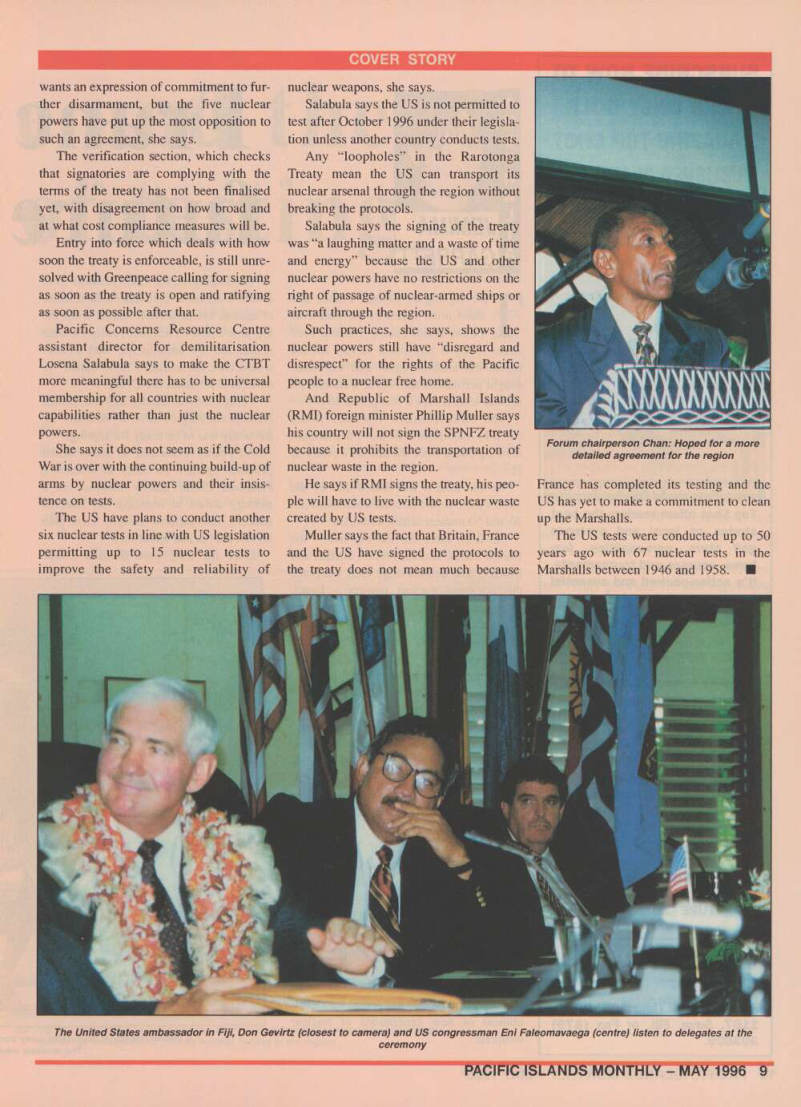
American ambassador to Fiji, Don Gevirtz, who signed the treaty on behalf of the United States, says it was a partial ful filment of the objective of non-prolifera tion and arms control.
He said the US was fully committed to achieving a “zero-yield” CTBT conference this year.
He called the Rarotonga Treaty a great tribute to the collective efforts of Forum members towards safeguarding “for all time the extraordinary beauty and natural wealth of the region from the threat of nuclear war and the destructive effects of nuclear contamination”.
But despite this call, the US has not put an end to its testing programme.
Last November 3, the US announced its plan to conduct a series of six nuclear weapons tests through this year and 1997.
The US says the tests will be conducted so they are stopped short of a nuclear chain reaction, resulting in “zero yield” nuclear weapons tests.
Fiji’s prime minister Sitiveni Rabuka says the treaty is by no means the end of the struggle.
“Let us hope and pray the commit ments made give impetus and strength to the global movement towards halting the spread of nuclear weapons,” he said.
ga Treaty in Suva in March.
Chan
British ambassador Michael Peart says the Treaty of Rarotonga demonstrates a group of countries, acting in unison, can achieve more than is possible for any one country to achieve alone.
“We hope that the endeavour used to bring about this Treaty can also be applied in a wider context, since security is not just a matter of treaties and promises.
Economic development and free, open and just societies are also fundamental to regional security and stability,” he said.
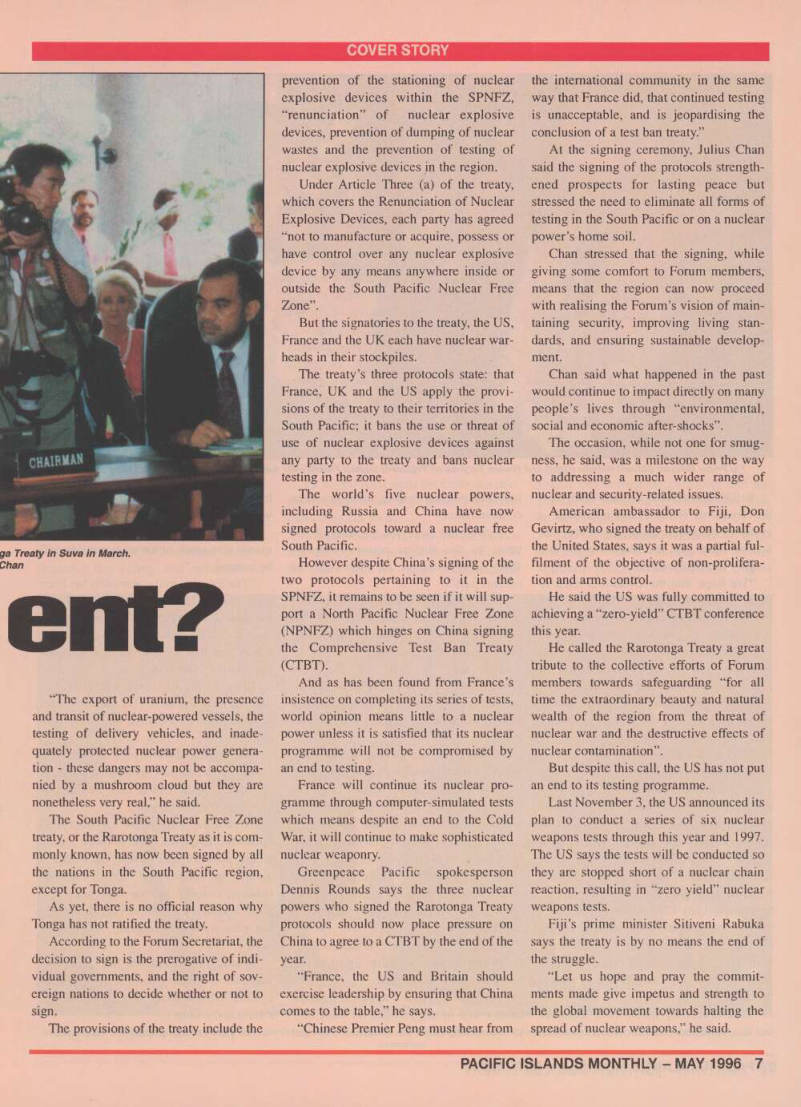
French Polynesian president Gaston Flosse said it was the first time in history that the South Pacific had been given “careful consideration at the highest level of responsibility” in France.
Flosse denied Mururoa was dangerous and said, “ I myself have made frequent visits to Mururoa at least a dozen or so times, the last being in September (1995).
I have swum in the lagoon, I have eaten fish out of there, I have drunk the coconut water and despite my advancing age, I have not felt any after-effects of this”.
The comment has come under fire from Greenpeace Pacific’s Bunny McDiarmid, who says, “even state-of-the-art nuclear weapons storage facilities - which Mururoa isn’t - will eventually leak”.
“One lesson we should have leamt in our nuclear history is that wherever there
has been nuclear testing there has been contamination.”
McDiarmid says the signing of the treaty by the nuclear powers “certainly shuts tightly one of the doors of our
nuclear past”.
And although questions have been raised about the enforcement of the Rarotonga Treaty, McDiarmid says it does carry weight internationally.
She says as part of the Non Proliferation Treaty, the nuclear powers had committed support to the development of nuclear free zones as a key disarmament effort.
According to annex four of the treaty, which outlines the Complaints Procedure, the best that the South Pacific Forum can do if any of the signatories breaches its obligations is “call a meeting”.
But action against the party in breach of its obligations is not outlined.
It is also unclear whether the Forum would have the power to impose penalties on any government, especially signatories to the protocols.
The heavy dependence on nuclear pow ers to uphold their word and signatures on treaties is made very clear.
McDiarmid says it is apparent from the latest round of negotiations for the CTBT in the Conference on Disarmament that
there is still a long way to go especially with disagreement on a “zero yield” treaty.
A zero yield means all nuclear tests no matter how small or for what purpose will be banned.
“The international community has been promised a CTBT for 25 years and that is the key disarmament challenge for this year. If it is not achieved this year there is a real fear that we will have missed the opportunity,” she says.
Some of the key areas where there is disagreement for the CTBT are the scope, its preamble, verification, and entry into force.
The biggest obstacle for a CTBT at the moment, McDiarmid says, is the scope of the treaty, with China and Russia not agreeing to a “zero yield”.
“If nuclear explosions for so called “peaceful purposes” are allowed - this would leave a major flaw in the treaty. It would be impossible to distinguish between peaceful nuclear explosions and those conducted for improving or design ing new nuclear weapons,” McDiarmid says.
“Furthermore, whether for “peaceful” purposes or military purposes, the impact on the environment and disarmament efforts is the same.”
As part of the preamble, Greenpeace
Fiji Prime Minister Sitiveni Rabuka (right) and French Polynesian President Gaston Flosse after the signing of the Rarotonga Treaty in Suva
wants an expression of commitment to fur ther disarmament, but the five nuclear powers have put up the most opposition to such an agreement, she says.
The verification section, which checks that signatories are complying with the terms of the treaty has not been finalised yet, with disagreement on how broad and at what cost compliance measures will be.
Entry into force which deals with how soon the treaty is enforceable, is still unre solved with Greenpeace calling for signing as soon as the treaty is open and ratifying as soon as possible after that.
Pacific Concerns Resource Centre assistant director for demilitarisation Losena Salabula says to make the CTBT more meaningful there has to be universal membership for all countries with nuclear capabilities rather than just the nuclear powers.
She says it does not seem as if the Cold War is over with the continuing build-up of arms by nuclear powers and their insis tence on tests.
The US have plans to conduct another six nuclear tests in line with US legislation permitting up to 15 nuclear tests to
improve the safety and reliability of
nuclear weapons, she says.
Salabula says the US is not permitted to test after October 1996 under their legisla tion unless another country conducts tests.
Any “loopholes” in the Rarotonga Treaty mean the US can transport its nuclear arsenal through the region without
breaking the protocols.
Salabula says the signing of the treaty was “a laughing matter and a waste of time and energy” because the US and other nuclear powers have no restrictions on the right of passage of nuclear-armed ships or aircraft through the region.
Such practices, she says, shows the nuclear powers still have “disregard and disrespect” for the rights of the Pacific people to a nuclear free home.
And Republic of Marshall Islands (RMI) foreign minister Phillip Muller says his country will not sign the SPNFZ treaty because it prohibits the transportation of nuclear waste in the region.
He says if RMI signs the treaty, his peo ple will have to live with the nuclear waste created by US tests.
Muller says the fact that Britain, France and the US have signed the protocols to the treaty does not mean much because
France has completed its testing and the US has yet to make a commitment to clean up the Marshalls.
The US tests were conducted up to 50 years ago with 67 nuclear tests in the Marshalls between 1946 and 1958. ■
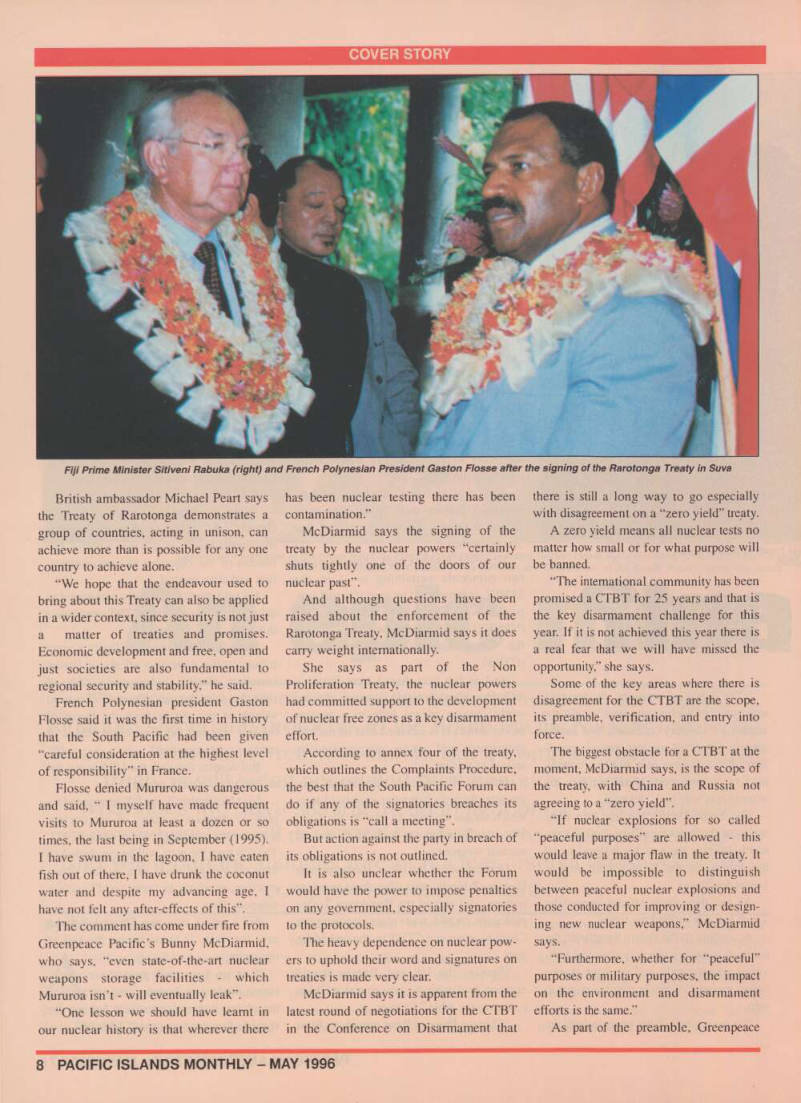
Forum chairperson Chan: Hoped for a more detailed agreement for the region
The United States ambassador in Fiji, Don Gevirtz (closest to camera) and US congressman Eni Faleomavaega (centre) listen to delegates at the ceremony