giant
pp. 12-13 · Read in the full issue
The Arts
Creative giant
By Liz Thompson
Outside the Islander Travelodge in Port Moresby, Matias Kuage sits talking with friends. Stretched out in front of the hotel’s entrance are his paintings, some on canvas, some on paper.
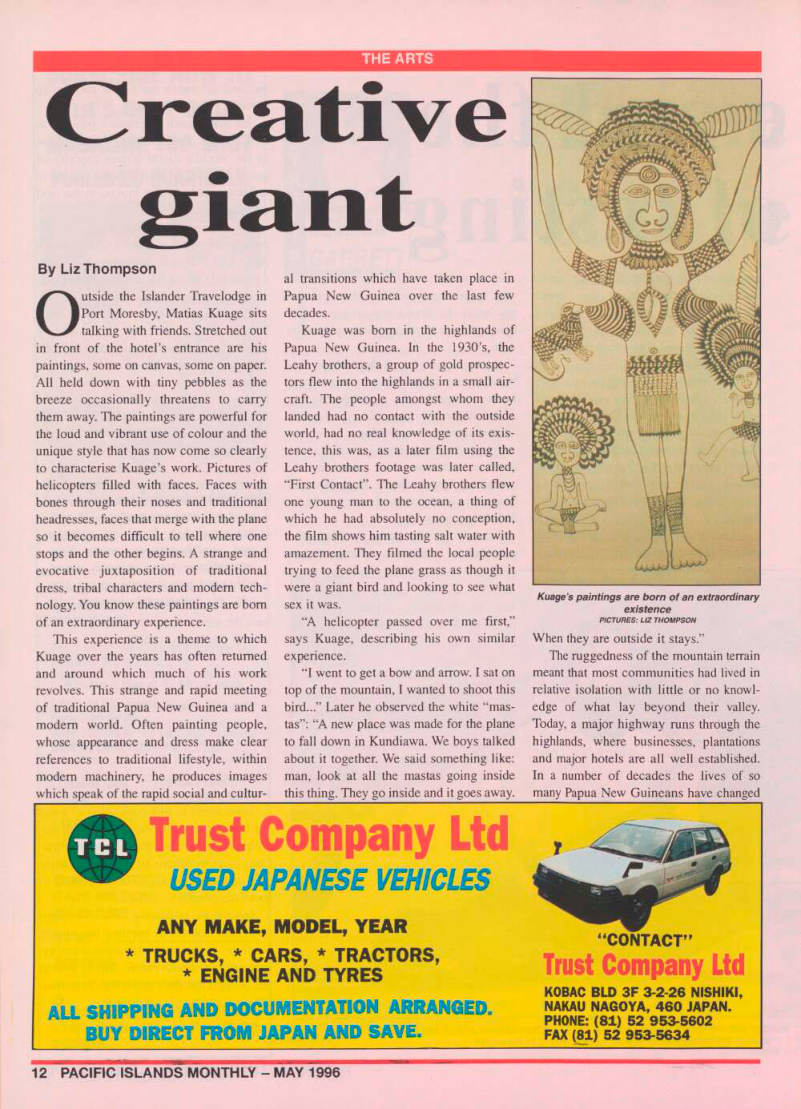
All held down with tiny pebbles as the breeze occasionally threatens to carry them away. The paintings are powerful for the loud and vibrant use of colour and the unique style that has now come so clearly to characterise Kuage’s work. Pictures of helicopters fdled with faces. Faces with bones through their noses and traditional headresses, faces that merge with the plane so it becomes difficult to tell where one stops and the other begins. A strange and evocative juxtaposition of traditional dress, tribal characters and modem tech nology. You know these paintings are bom
of an extraordinary experience.
This experience is a theme to which Kuage over the years has often returned and around which much of his work revolves. This strange and rapid meeting of traditional Papua New Guinea and a modem world. Often painting people, whose appearance and dress make clear references to traditional lifestyle, within modem machinery, he produces images which speak of the rapid social and cultur
al transitions which have taken place in Papua New Guinea over the last few decades.
Kuage was bom in the highlands of Papua New Guinea. In the 1930’5, the Leahy brothers, a group of gold prospec tors flew into the highlands in a small air craft. The people amongst whom they landed had no contact with the outside world, had no real knowledge of its exis tence, this was, as a later film using the Leahy brothers footage was later called, “First Contact”. The Leahy brothers flew one young man to the ocean, a thing of which he had absolutely no conception, the film shows him tasting salt water with amazement. They filmed the local people trying to feed the plane grass as though it were a giant bird and looking to see what sex it was.
“A helicopter passed over me first,” says Kuage, describing his own similar experience.
“I went to get a bow and arrow. I sat on top of the mountain, I wanted to shoot this bird...” Later he observed the white “mas tas”: “A new place was made for the plane to fall down in Kundiawa. We boys talked about it together. We said something like: man, look at all the mastas going inside this thing. They go inside and it goes away.
When they are outside it stays.”
The ruggedness of the mountain terrain meant that most communities had lived in relative isolation with little or no knowl edge of what lay beyond their valley.
Today, a major highway runs through the
highlands, where businesses, plantations
and major hotels are all well established.
In a number of decades the lives of so many Papua New Guineans have changed
Kuage’s paintings are born of an extraordinary existence
Pictures: Liz Thompson
dramatically and Kuage’s work explores with great candour his own relationship to
these changes.
Kuage himself was bom in Chimbu Province in the Highlands of Papua New Guinea. In 1968, he moved from the Highlands to Port Moresby and was employed as a cleaner at what later became the University of Papua New Guinea. Soon afterwards he met Georgina Beier. A painter herself, both she and her husband Ulli Beier were committed to supporting artists in Papua New Guinea and they began to organise exhibitions and sales. There was a corresponding energy and excitement in the work produced throughout this period.
This period saw the emergence of the first distinct wave of contemporary art in Papua New Guinea and today remains some of the strongest yet produced. A col lection of extremely talented and innova tive artists used new techniques such as
etching, lithography, silk screen, acrylics
and canvas and even welded metal sculp ture to explore their experiences and those of their community. This experience of transition, common to them all, appears in various forms in much of the work pro duced throughout this time. Whilst using modem techniques, much of the imagery drew on and incorporated traditional sym bols and designs. Up until this time art in Papua New Guinea had been produced essentially for ritual or decorative purpos es, it was only in relatively recent years that the concept of art produced for sale was introduced.
Over time this work slowly gained international recognition, with Papua New Guinea artists beginning to exhibit over seas. Kuage is still painting and has trav elled around the world to attend his own exhibitions. Last year, he went to visit the Beiers’ in Germany where he took part in a massive street art project. He painted a number of large concrete columns, turning them into joyous, vibrantly coloured art works which stand out as a celebration in otherwise ordinary streets. In Berlin he painted a Mercedes bus for a gallery which had exhibited a series of his screen prints.
He painted he says, “lovely ladies all over it”.
In 1987, he was one of four winners in the prestigious annual Blake Prize for reli-
gious art in Sydney, Australia. He is repre sented in galleries and museums in West Germany, California, the Glasgow Museum of Contemporary Art, the University of Queensland, the Australian National University and the Australian Museum. His work sells for enormously
variable prices.
Kuage points out that there is not a sub stantial market for his work in Papua New Guinea. The country does not have a large number of tourists and often those who are there are not aware of the work that is being produced, given it receives no pro motion. Three of four days a week he sits outside the Islander Travelodge and makes sales, usually pricing work depending upon his current needs.
The international market however, is a different story. From the 12 acrylic-on canvas paintings in Kuage’s first London show at the Rebecca Hossack Gallery, four were bought by the Glasgow Museum of Modem Art for more than 10,000 pounds ($A21,700). In fact, one of these paintings was also sought by the Australian Museum in Sydney but they weren’t fast enough.
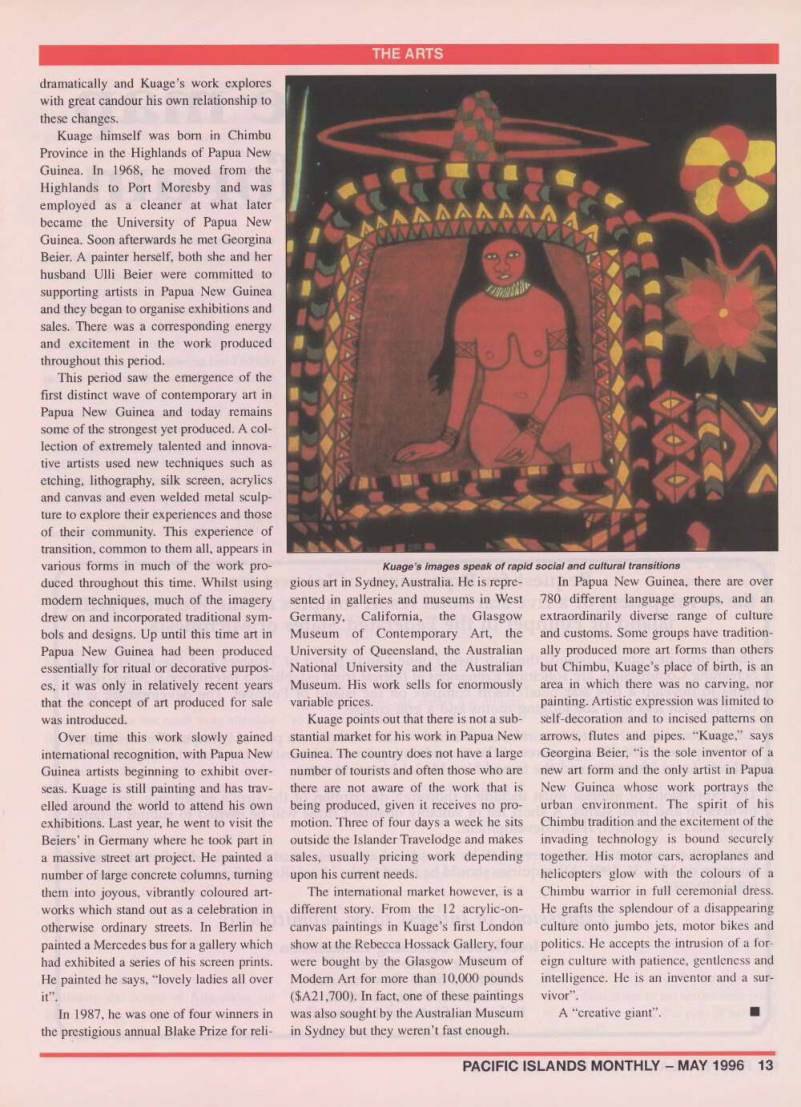
In Papua New Guinea, there are over 780 different language groups, and an extraordinarily diverse range of culture and customs. Some groups have tradition ally produced more art forms than others but Chimbu, Kuage’s place of birth, is an area in which there was no carving, nor painting. Artistic expression was limited to self-decoration and to incised patterns on arrows, flutes and pipes. “Kuage,” says Georgina Beier, “is the sole inventor of a new art form and the only artist in Papua New Guinea whose work portrays the urban environment. The spirit of his Chimbu tradition and the excitement of the invading technology is bound securely together. His motor cars, aeroplanes and helicopters glow with the colours of a Chimbu warrior in full ceremonial dress.
He grafts the splendour of a disappearing culture onto jumbo jets, motor bikes and politics. He accepts the intrusion of a for eign culture with patience, gentleness and intelligence. He is an inventor and a sur vivor”.
A “creative giant”. ■
Kuage’s images speak of rapid social and cultural transitions