promises plenty
pp. 54-56 · Read in the full issue

Pan Pacific series promises plenty
By Atama Raganivatu
The Pan Pacific rugby series, due to commence its inaugural season on April 27, promises an exciting new era for the Tongan, Fijian and Western Samoan national rugby union selections and their supporters.
The series involves the three Pacific Island nations, along with Argentina, Canada, Hong Kong, Japan and USA., who oppose each other once during the first stage. The leading four at the end of this round robin phase will then play off, with the top side meeting the fourth and the third facing the runners up in the semi finals. The final is to be staged on the weekend of July 27-28. The highest placed featured team in each of the play off games will act as hosts.
Manu Samoa coach Bryan Williams has been appointed chairman of the Pan Pacific Series Company, which will run the competition. The eight participating unions are the company’s sole sharehold ers.
Williams is in no doubt about the series’ value. “The northern hemisphere has the Five Nations Tournament, the southern hemisphere the Tri Series and now the Pan Pacific has created a mean ingful competition for the rugby union nations of the Pacific, Asia and the Americas,” he said.
“Our establishment proves that rugby union is a truly global sport.” The nations involved in the Pan Pacific Series will now have control over their own destinies, rather than having to rely upon feeding on the scraps of other rugby playing coun tries. The series will strengthen rugby considerably in the Pacific rim region and that has to be beneficial for rugby world wide.”
The setting up of the series denotes a
considerable achievement for the organi sation that stitched it all together, Carnegie Sports International. Carnegie is a sub sidiary of Murray International, the sports marketing company created by the incom parable David Murray.
Scotsman Murray ranks amongst the most admired of international entrepre
neurs, having built a huge world-wide con glomerate despite being a paraplegic. His greatest claim to fame, though, is as chair man of universally famous soccer club Glasgow Rangers.
Carnegie have rendered operable what would seem, at face value, a totally envi able concept - a competition involving far
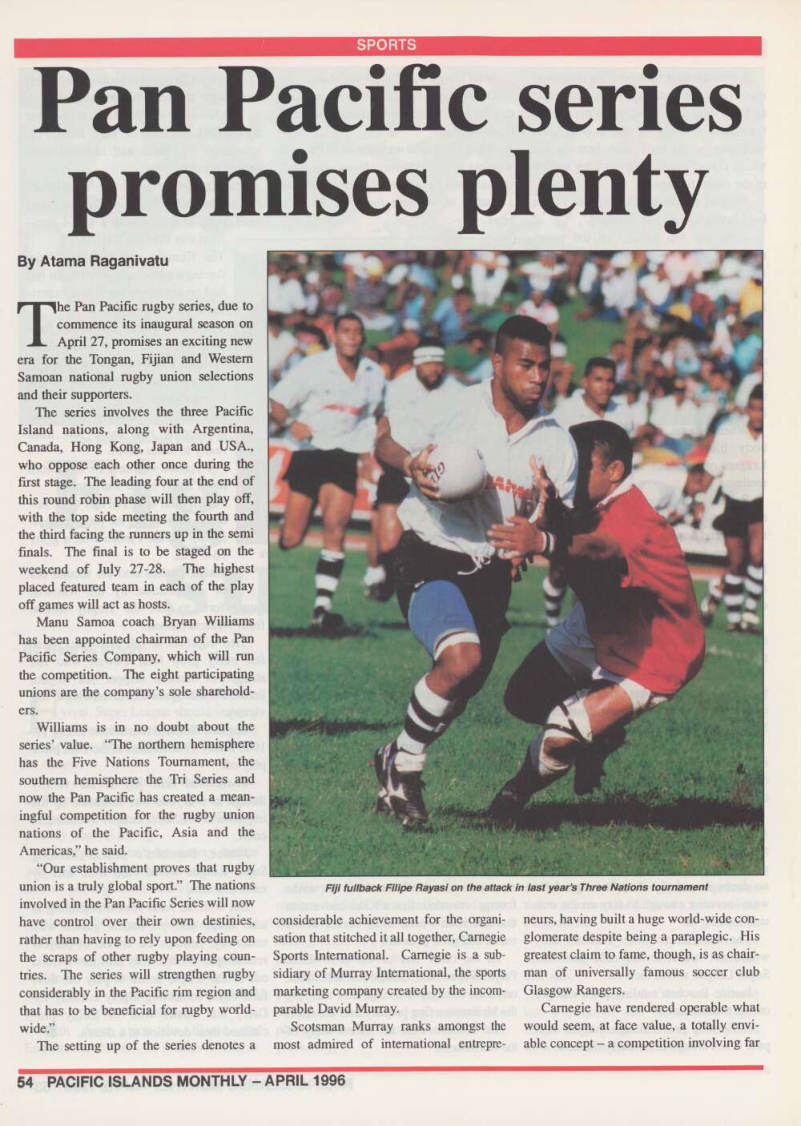
Fiji fullback Filipe Rayasi on the attack in last year’s Three Nations tournament
flung national unions from the second ech elon of world rugby; all of whom have lim ited financial resources.
Carnegie’s acumen in securing sponsor ship and negotiating television rights has been crucial in getting the series off the ground. It remains to be seen whether or not their expertise will generate the money Fiji, Tonga and Western Samoa need to compete successfully in the new profes sional rugby environment. The defections, through financial considerations, of lead ing players to New Zealand and Australia is a major concern for the Pacific trio.
Only time will tell if revenues from the series can stem the “Brawn Drain”.
Thankfully, a recent International Rugby Board rul ing has given the Pan Pacific series precedence over the Super Twelve competition, which fea tures leading New Zealand, Australian and South African professional combinations and overlaps the series for four weeks.
This means that, in theory, Pan Pacific teams will have access to players contracted with Super Twelve sides. However, as Australian and New Zealand soccer officials can testify, extreme difficulties often arise
when trying to obtain releases form over seas outfits (in those cases, European pro fessional clubs) and our players may well be pressurised clubs) and our players may well be pressurised into remaining avail able for Super Twelve duty.
Should they be able to field a best pos sible line up (including their five Super Twelve stars), Western Samoa will proba bly commence the tournament as favourites. A tour to England and Scotland late last year roved that Manu Samoa are still competitive at the very highest level; reproducing the form which carried them through to the World Cup quarter finals.
The draw has also been kind to the Samoans. Four of their seven round robin fixtures will be played at home against, on paper, the Series’ weakest teams. A clean sweep of these games would almost ensure them of a semi final berth.
Fiji’s prospects depend largely upon
which side of their enigmatic personality is displayed. If playing like the team so des perately unlucky to be defeated by Wales last year, they will do very well. If per forming as badly as they did against Ireland shortly afterwards, then a lean time is in prospect. The Fijians have three home matches and four away in 1996 (this will be reversed next year), however they will be confident of winning in Hong Kong, Tonga and the United States while on the road (“in the air” would be a more accurate term) and it could easily be the holne encounters with Western Samoa and
Canada which determine the fate of Fiji’s season.
Tongan rugby union entered 1996 in turmoil. Several New Zealand based play ers walked out on the national team whose revival they had primarily been responsible for, complaining of inept administration.
At the time of writing, the emigrants were not appeased and the likelihood is that the Kingdom will contest the series with a young and inexperienced team.
They commence their programme with four away games within 21 days and, unless Tonga return to Nuku’alofa with a least one success (and only the USA game on May 11 offers an obvious possibility of achieving it), the chance of qualifying for the semi finals will have all but disap peared.
Of the competing teams from outside our region, Argentina promise to present the biggest danger. However, all is not
well with rugby on the Pampas. The Argentina Rugby Union are badly split over the question of whether or not to recall exiles for test match duty. Amongst the many Argentineans playing abroad are members of the front row who were so impressive in South Africa last year.
Argentina have always been a formida ble proposition in Buenos Aires and, irre spective of their team’s composition, will inevitably continue to be so.
Unfortunately, Tonga, Western Samoa and Fiji are each required to travel to South America. Both Fiji and Western Samoa
have recorded memorable World Cup victories pver the Pumas on neutral territory, but may find the Argentineans’ home advantage too great a handicap to over come. It must be hoped that Argentina’s traditionally woeful away from persists in the round robin phase and none of our sides are required to make a return journey for the semi finals or final.
In contrast to Argentina, Canada have never had any qualms about calling upon overseas domiciled players for international duty, despite they being scattered across Europe and South Africa.
Assembling these individuals and moulding them into an effec
tive combination always presents huge problems, both financial and logistical.
Recent events; particularly the first loss to USA on home soil for 19 years and the huge winning margins clocked up by the touring Australian Barbarians (domestic champions Ontario were beaten 112-121), suggests that Canadian rugby has declined significantly since their team performed resolutely at the World Cup. Several prominent players have retired in the inter im and Fiji can be confident of avenging the loss sustained last year, when they meet again on July 6 in what looms as a crucial match for both sides.
The Fijians will also be seeking vengeance for their surprise defeat by Japan two years ago. The Japanese are reported to still be in shock over their 145- 17 hammering by New Zealand at the World Cup and local rugby has struggled to counter the admirable progress being
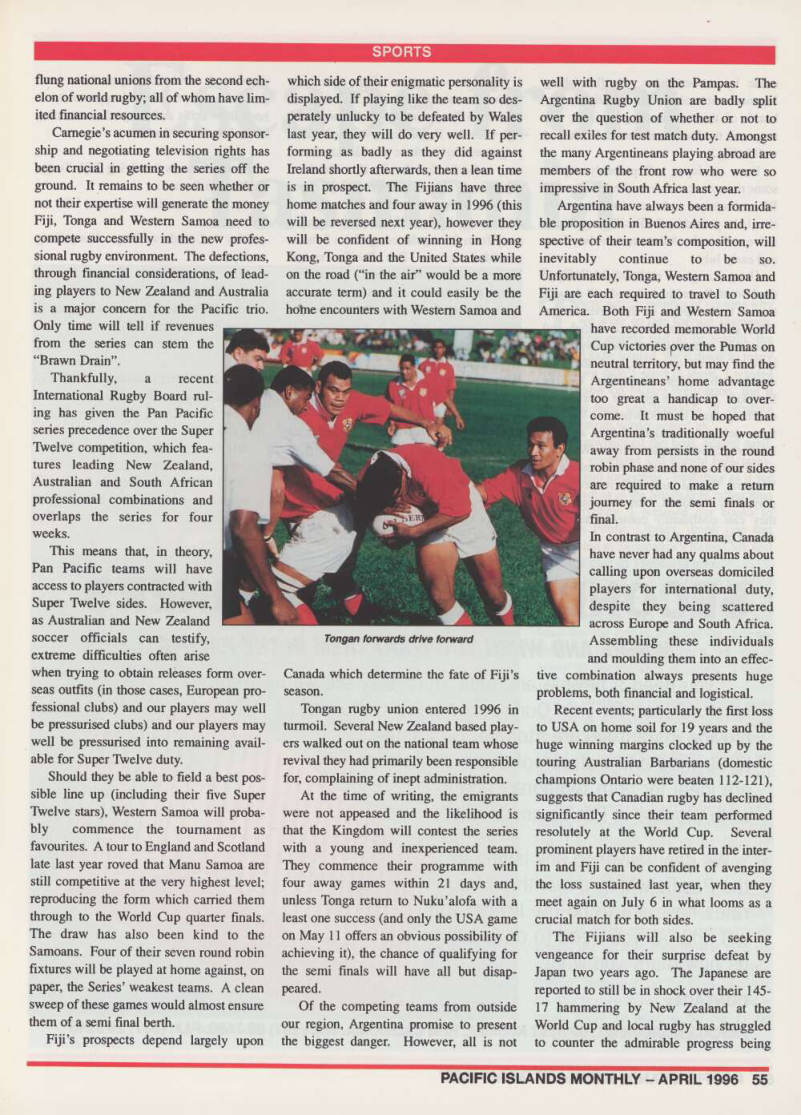
Tongan forwards drive forward
made by soccer there. A flourishing Japanese national team is essential for the health of their domestic game and, one suspects, the Pan Pacific series’ financial well being.
Even so, Japan will probably require some time to recover from the Massacre of Bloemfontein and maximum points should be gained by the Pacific’s represen tatives when the Asians tour in late June aiyl early July.
Hong Kong are ranked behind Japan (and South Korea) in Asia and will do well to avid bottom place on the Series ladder.
Their side consists solely of British and Australian expatriates, who achieved little in their home countries, and they are coached by New Zealander George Simpkin. Simpkin’s greatest moment in coaching came in 1980 when his Waikato team defeated Auckland 7-3 in an epic Ranfurly Shield battle. Bryan Williams and Brad Johnston, now the mentors of Western Samoa and Fiji respectively, played for Auckland. Now, 16 years later, they can confidently contemplate intro ducing professionalism.
With the exception of the win over Canada, results for them in recent years have been disappointing. Both Tonga and Fiji visit the Eagles early in their cam paigns and losses there would be momen tous setbacks for the Pacific islanders’ aspirations. Lack of international expo sure has always been the USA’s greatest dilemma and they will be a major benefi ciary from the regular competitive fixtures provided by the Pan Pacific series.
However, several seasons may be required before that benefit becomes apparent.
Predicting the results of a tournament over a month before it commences is always a thankless (and, possibly, stupid) undertaking, yet even at this juncture both Western Samoa and Fiji can be forgiven if being reasonably optimistic about appear ing in the semi finals while Tonga will probably have to be content that the series offers them an invaluable opportunity to effect their rebuilding programme.
What can be forecast with much greater certainty is that Pacific rugby fans can look forward to the finest feast of competitive rugby they have ever experi
enced and our local players have been granted an unprecedented opportunity to hone their skills and gauge their standing in the international area.
Series fixtures involving Fiji, Tonga & Western Samoa: April 27: Argentina vs Tonga; USA vs Fiji; May 4: Canada vs Tonga; Hong Kong vs Fiji; May 11: USA vs Tonga; Fiji vs Western Samoa; May 18: Western Samoa vs Tonga; June 8: Argentina vs Fiji June 15: Western Samoa vs Hong Kong; June 22: Western Samoa vs USA; Fiji vs Japan; Tonga vs Hong Kong June 29: Western Samoa vs Japan; Tonga vs Fiji; July 6; Argentina vs Western Samoa; Fiji vs Canada; Tonga vs Japan; July 13: Canada vs Western Samoa (Home teams named first in all instances). ■