Fighting for
pp. 52-53 · Read in the full issue
Sports
Fighting for survival
By Gabriel Singh
Fighting on arrival, fighting for sur vival. Super League should serious ly consider adopting the opening lines of Bob Marley’s Buffalo Soldier as its anthem.
Who could have thought the mega-dol lar Super League would be fighting for its very survival a day after its grand debut in a sunny tropical setting.
But rugby league’s breakaway faction was dealt two body blows as over $ 15 mil lion in playing talent assembled in Suva for the birth of a new era.
Nothing like the World Nines had hit Fiji before.
In came Mai Meninga and the star studded Laurie Daley-captained Australians - Super League’s standard bearers - to a hero’s welcome.
With them came the Kiwis, the English, the Welsh - 16 nations of league
power for the baptism of a new era.
Apart from the oppressing humidity of the Fijian capital, the players may well have felt they were still in Canberra, Brisbane, Sydney, Auckland, London or Leeds.
Daley, a hero in Fiji because of Fiji’s greatest rugby league export Noa Nadruku, plays with Canberra, summed it up by saying, “We can’t wait for it to hap pen” after having sat out a season in the war between Rupert Murdoch’s Super league and the Australian Rugby League.
Daley’s Canberra Raiders and new comers Adelaide Rams had created great interest in the World Nines with an enter taining tussle two Saturday’s earlier in a pre-season match in Suva.
The stars - players, referees and sup port crew - marched through Suva with throngs of locals keyed-up to watch peo ple only seen on television screens here previously.
Everything was ready. The teams were in, ticket sales were beginning to snowball and Suva’s national sports complex was in resplendent form.
It had been a long wait and Super League was desperate for a glorious start.
But the Gods and the law were not about to allow a free-flowing weekend of relentless action.
The first ominous omen appeared on the morning of the games - Thursday, February 24.
A trough of low pressure edged closer and closer to Fiji, bringing a depression that was to turn the birth of a new era into a nightmare.
That first day saw 60 millimetres of rain being dumped on the National Stadium.
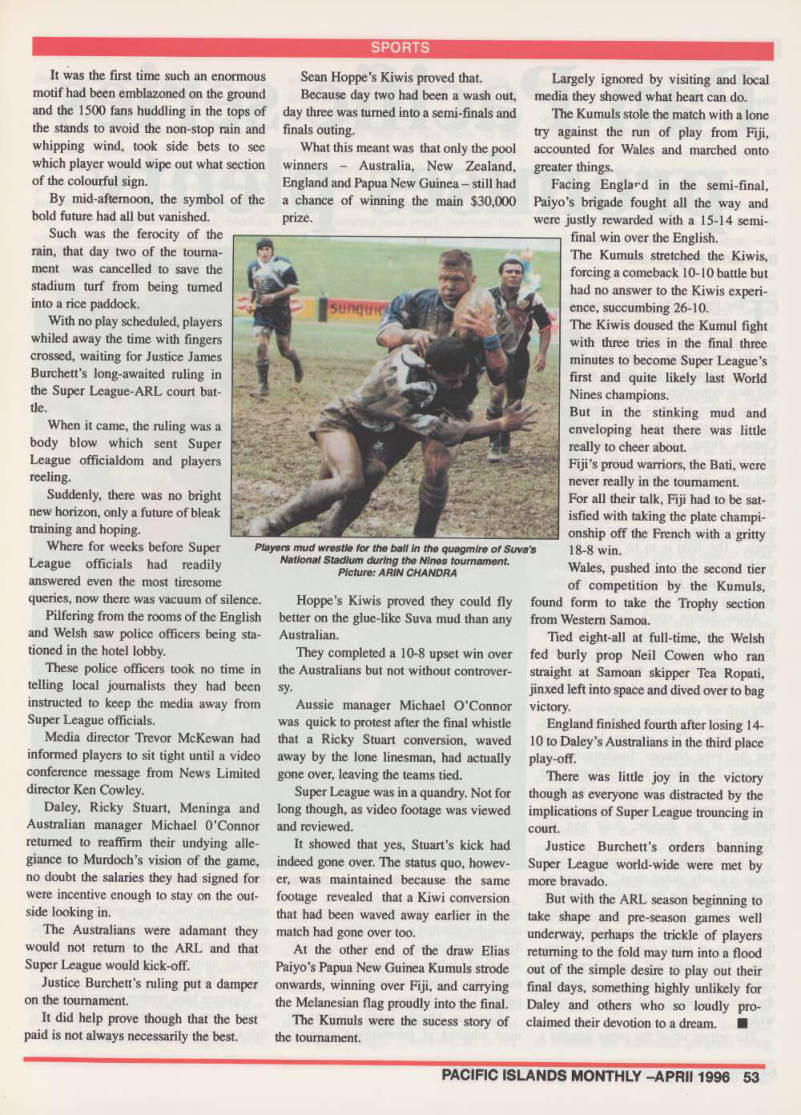
Within an hour, the turf was churned into a quagmire and the massive Super League logo painted on it in centre field soon became a brown smudge.
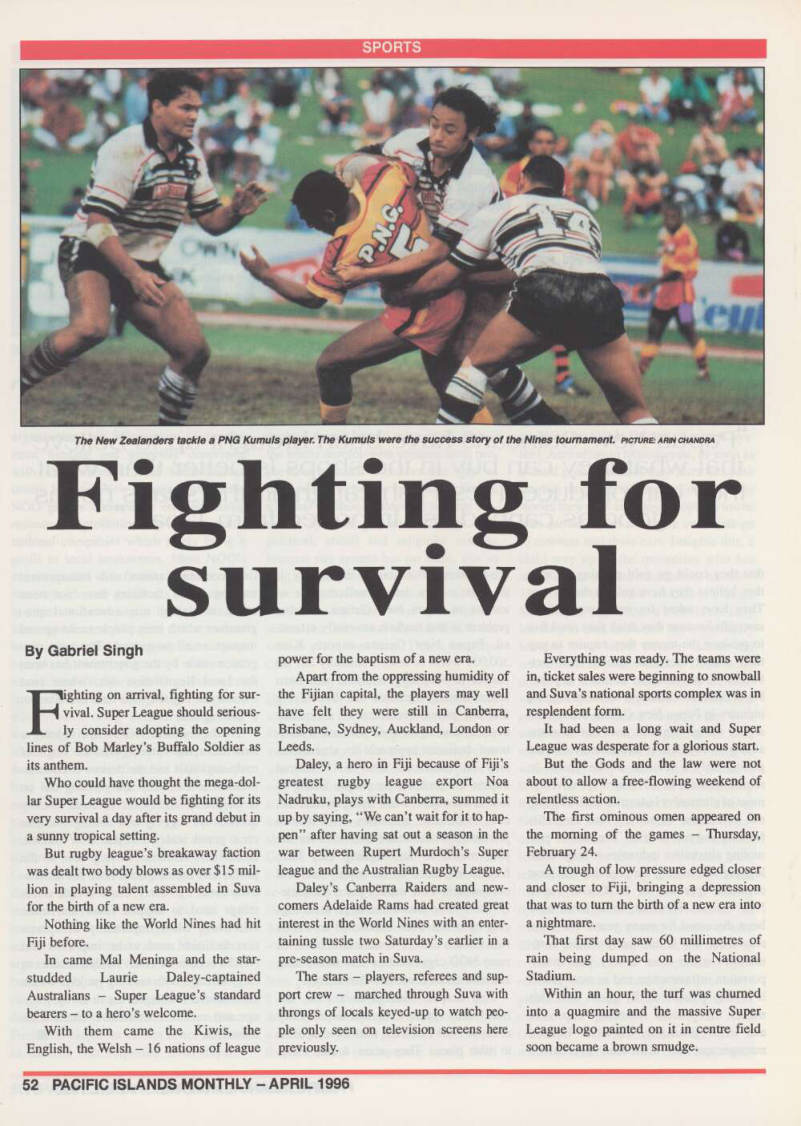
The New Zealanders tackle a PNG Kumuls player. The Kumuls were the success story of the Nines tournament, pICTRE: ARIN CHANDRA
It was the first time such an enormous motif had been emblazoned on the ground and the 1500 fans huddling in the tops of the stands to avoid the non-stop rain and whipping wind, took side bets to see which player would wipe out what section of the colourful sign.
By mid-afternoon, the symbol of the bold future had all but vanished.
Such was the ferocity of the rain, that day two of the tourna ment was cancelled to save the stadium turf from being turned into a rice paddock.
With no play scheduled, players whiled away the time with fingers crossed, waiting for Justice James Burchett’s long-awaited ruling in the Super League-ARL court bat tle.
When it came, the ruling was a body blow which sent Super League officialdom and players reeling.
Suddenly, there was no bright new horizon, only a future of bleak training and hoping.
Where for weeks before Super League officials had readily answered even the most tiresome
queries, now there was vacuum of silence.
Pilfering from the rooms of the English and Welsh saw police officers being stationed in the hotel lobby.
These police officers took no time in telling local journalists they had been instructed to keep the media away from Super League officials.
Media director Trevor McKewan had informed players to sit tight until a video conference message from News Limited director Ken Cowley.
Daley, Ricky Stuart, Meninga and Australian manager Michael O’Connor returned to reaffirm their undying allegiance to Murdoch’s vision of the game, no doubt the salaries they had signed for were incentive enough to stay on the outside looking in.
The Australians were adamant they would not return to the ARL and that Super League would kick-off, Justice Burchett’s ruling put a damper on the tournament.
It did help prove though that the best paid is not always necessarily the best.
Sean Hoppe’s Kiwis proved that.
Because day two had been a wash out, day three was turned into a semi-finals and finals outing.
What this meant was that only the pool winners - Australia, New Zealand, England and Papua New Guinea - still had a chance of winning the main $30,000 prize.
Hoppe’s Kiwis proved they could fly better on the glue-like Suva mud than any Australian.
They completed a 10-8 upset win over the Australians but not without controver sy.
Aussie manager Michael O’Connor was quick to protest after the final whistle that a Ricky Stuart conversion, waved away by the lone linesman, had actually gone over, leaving the teams tied.
Super League was in a quandry. Not for long though, as video footage was viewed and reviewed.
It showed that yes, Stuart’s kick had indeed gone over. The status quo, howev er, was maintained because the same footage revealed that a Kiwi conversion that had been waved away earlier in the match had gone over too.
At the other end of the draw Elias Paiyo’s Papua New Guinea Kumuls strode onwards, winning over Fiji, and carrying the Melanesian flag proudly into the final.
The Kumuls were the sucess story of the tournament.
Largely ignored by visiting and local media they showed what heart can do.
The Kumuls stole the match with a lone try against the run of play from Fiji, accounted for Wales and marched onto greater things.
Facing England in the semi-final, Paiyo’s brigade fought all the way and were justly rewarded with a 15-14 semi
final win over the English.
The Kumuls stretched the Kiwis, forcing a comeback 10-10 battle but had no answer to the Kiwis experi ence, succumbing 26-10.
The Kiwis doused the Kumul fight with three tries in the final three minutes to become Super League’s first and quite likely last World Nines champions.
But in the stinking mud and enveloping heat there was little really to cheer about.
Fiji’s proud warriors, the Bati, were never really in the tournament.
For all their talk, Fiji had to be sat isfied with taking the plate champi onship off the French with a gritty 18-8 win.
Wales, pushed into the second tier of competition by the Kumuls,
found form to take the Trophy section from Western Samoa.
Tied eight-all at full-time, the Welsh fed burly prop Neil Cowen who ran straight at Samoan skipper Tea Ropati, jinxed left into space and dived over to bag victory.
England finished fourth after losing 14- 10 to Daley’s Australians in the third place play-off.
There was little joy in the victory though as everyone was distracted by the implications of Super League trouncing in court.
Justice Burchett’s orders banning Super League world-wide were met by more bravado.
But with the ARL season beginning to take shape and pre-season games well underway, perhaps the trickle of players returning to the fold may turn into a flood out of the simple desire to play out their final days, something highly unlikely for Daley and others who so loudly pro claimed their devotion to a dream. ■
Players mud wrestle for the ball In the quagmire of Suva's National Stadium during the Nines tournament.
Picture: ARIN CHANDRA