Escape from Tasmania
pp. 57-58 · Read in the full issue
Tasmania
By Sally Andrew
There were a number of reasons why we were so late leaving Tasmania.
The engine had |to be rebuilt, the boat had to be hauled. We’d made so many friends we didn’t want to leave, I wanted to see snow on Mount Wellington. But it was mid-June and thoughts of crossing Bass Strait in winter scared us.
We provisioned the boat, posted mail, said our goodbyes and bought balaclavas, mittens and longjohns - outfitting as if we were heading to the South Pole rather than sunny Sydney. I returned our books to Hobart’s Public Library, drank one last cappuccino at Salamanca’s Retro Cafe and bought a case of Tigerhead beer.
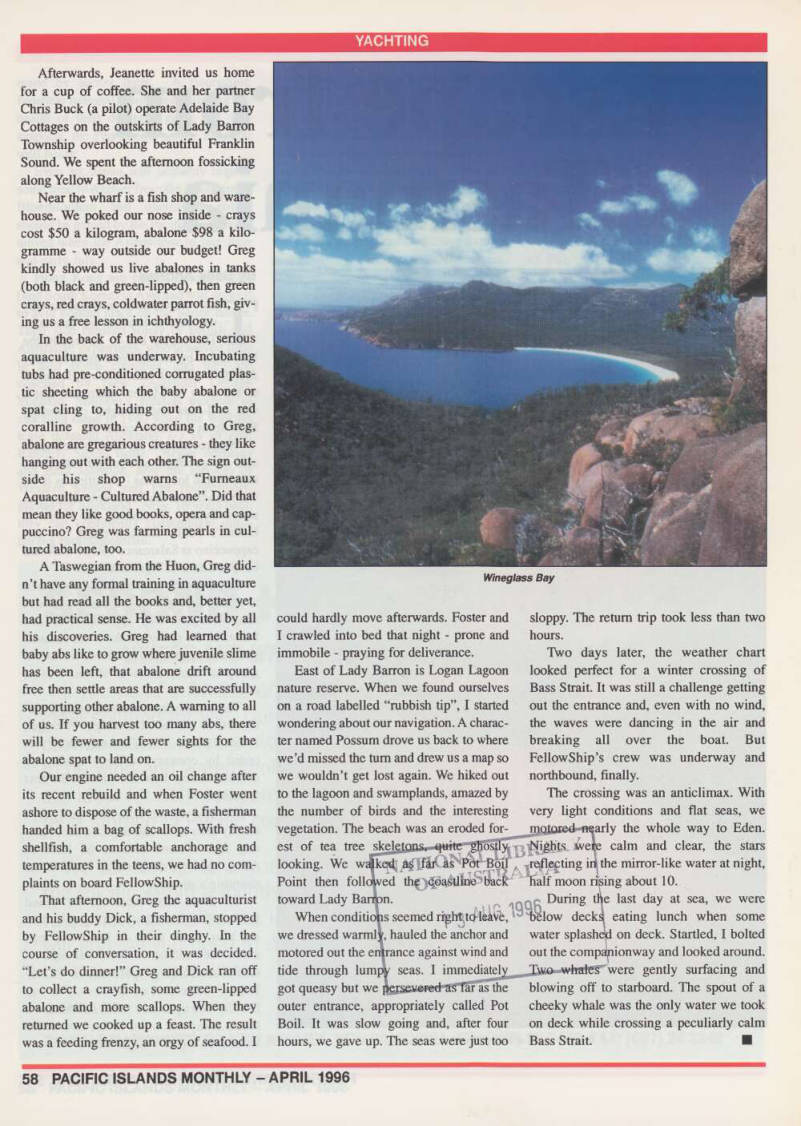
Day-hopping up the coast, we motored in drizzle and quiet fog. Despite a lack of sun. Wineglass Bay appeared blue and beautiful, the granite peaks of the Hazards pink and spectacular. Ashore, we met a group of backpackers in shorts, T-shirts and barefeet.
The weatherfax promised benign con ditions, so we sailed overnight to rugged Flinders Island. With a low on its way, pre ceded by contrary northerly winds, we decided to stop there and wait for the next opening.
We tied up to Lady Barron’s dock shortly after noon and inquired about get ting fuel. Noreen sold us 63 litres of diesel, then we anchored in front of the township’s slipway.
On shore next morning, we found Jeanette Gowans busy working on a fish ing boat. Paint brush in hand and rope around her middle, Jeanette was high on some scaffolding, painting a “Lady Barron” home port on the stem. She was literally tied up in her work, but needed a break. Away we went, in her car, to the lookout on top of Vinegar Hill.
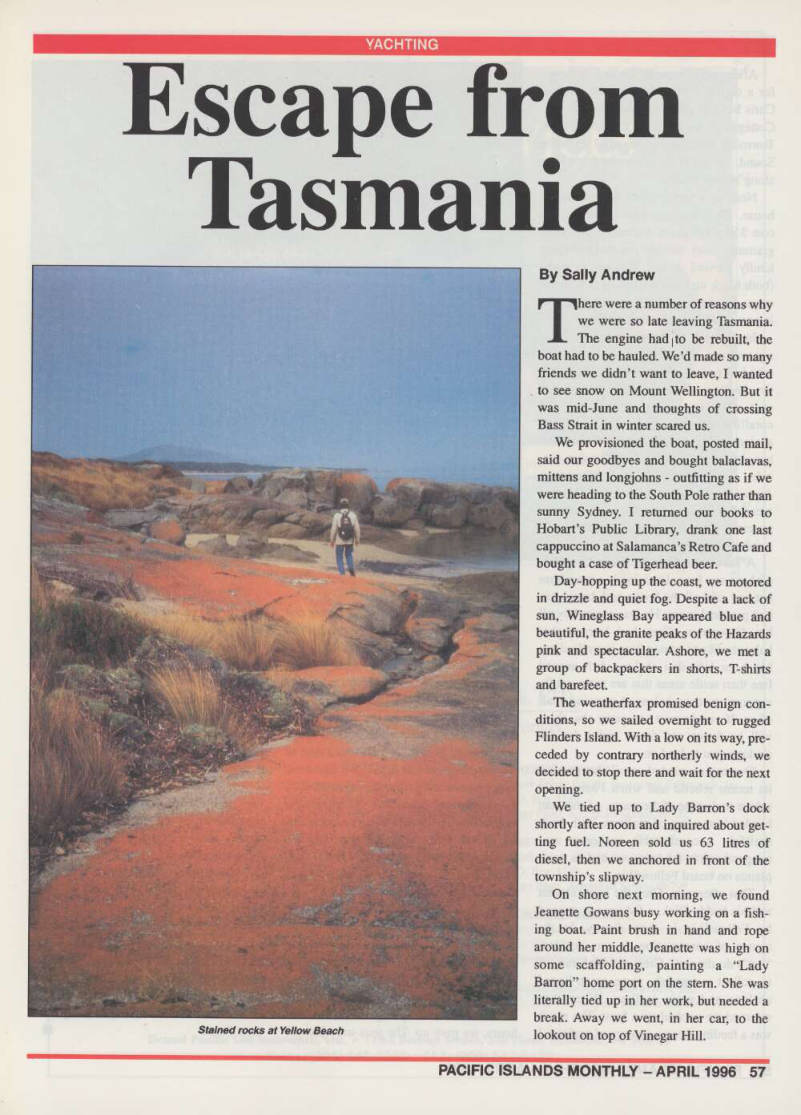
Stained rocks at Yellow Beach
Afterwards, Jeanette invited us home for a cup of coffee. She and her partner Chris Buck (a pilot) operate Adelaide Bay Cottages on the outskirts of Lady Barron Township overlooking beautiful Franklin Sound. We spent the afternoon fossicking along Yellow Beach.
Near the wharf is a fish shop and ware house. We poked our nose inside - crays cost $5O a kilogram, abalone $9B a kilo gramme - way outside our budget! Greg kindly showed us live abalones in tanks (both black and green-lipped), then green crays, red crays, coldwater parrot fish, giv ing us a free lesson in ichthyology.
In the back of the warehouse, serious aquaculture was underway. Incubating tubs had pre-conditioned corrugated plas tic sheeting which the baby abalone or spat cling to, hiding out on the red coralline growth. According to Greg, abalone are gregarious creatures - they like hanging out with each other. The sign out side his shop warns “Fumeaux Aquaculture - Cultured Abalone”. Did that mean they like good books, opera and cap puccino? Greg was farming pearls in cul tured abalone, too.
A Taswegian from the Huon, Greg did n’t have any formal training in aquaculture but had read all the books and, better yet, had practical sense. He was excited by all his discoveries. Greg had learned that baby abs like to grow where juvenile slime has been left, that abalone drift around free then settle areas that are successfully supporting other abalone. A warning to all of us. If you harvest too many abs, there will be fewer and fewer sights for the abalone spat to land on.
Our engine needed an oil change after its recent rebuild and when Foster went ashore to dispose of the waste, a fisherman handed him a bag of scallops. With fresh shellfish, a comfortable anchorage and temperatures in the teens, we had no com plaints on board Fellowship.
That afternoon, Greg the aquaculturist and his buddy Dick, a fisherman, stopped by Fellowship in their dinghy. In the course of conversation, it was decided.
“Let’s do dinner!” Greg and Dick ran off to collect a crayfish, some green-lipped abalone and more scallops. When they returned we cooked up a feast. The result was a feeding frenzy, an orgy of seafood. I
could hardly move afterwards. Foster and I crawled into bed that night - prone and immobile - praying for deliverance.
East of Lady Barron is Logan Lagoon nature reserve. When we found ourselves on a road labelled “rubbish tip”, I started wondering about our navigation. A charac ter named Possum drove us back to where we’d missed the turn and drew us a map so we wouldn’t get lost again. We hiked out to the lagoon and swamplands, amazed by the number of birds and the interesting vegetation. The beach was an eroded for est of tea tree skeletons, quite looking. We walke^ Point then followed tho^o^ldin'e" J back toward Lady Barron. /■ if; 1 When conditions seemed right tcf leave, we dressed warmly, hauled the anchor and motored out the entrance against wind and tide through lumpy seas. I immediately got queasy but we persevered as far as the outer entrance, appropriately called Pot Boil. It was slow going and, after four hours, we gave up. The seas were just too
sloppy. The return trip took less than two hours.
Two days later, the weather chart looked perfect for a winter crossing of Bass Strait. It was still a challenge getting out the entrance and, even with no wind, the waves were dancing in the air and breaking all over the boat. But Fellowship’s crew was underway and northbound, finally.
The crossing was an anticlimax. With very light conditions and flat seas, we mQ|OEed»fl©arly the whole way to Eden.
Nights. ive|e calm and clear, the stars reflecting in the mirror-like water at night, naif moon rising about 10.
During the last day at sea, we were o&low decks[ eating lunch when some water splashed on deck. Startled, I bolted out the compapionway and looked around.
Two whales were gently surfacing and blowing off to starboard. The spout of a cheeky whale was the only water we took on deck while crossing a peculiarly calm Bass Strait. ■
Wineglass Bay