Fidel’s Cuba:
pp. 26-27 · Read in the full issue
Region
Fidel’s Cuba: Island on the brink
By lan Williams
Cuba is the largest member of the Alliance of Small Island States, but it shares many of the problems of smaller members, even if the cold winds of the New World Order are eroding its own unique solution. Perhaps few island states have paid such a price for maintaining political and economic independence. Now, 37 years after Fidel Castro, Che Guevara and their bearded comrades rode into Havana, there is a gradual, indeed desperate, opening up to new solutions. Several senior government officials told me that now, for the first time the coun try was independent. Colonised by the Spanish, the Americans and then the Russians, they were now able to find their own way.
It will not be an easy road, however. The fall of the Soviet Union left the Cuban economy in ruins while the American blockade made it so much more difficult to rebuild. When I was there in 1993, almost all road transport had stopped, Havana was subject to eighteen hour power cuts, and almost every factory or work place was closed. Although Cuba is just 90 miles from the United States, for economic purposes it may as well be in the middle of the Pacific, since the years of American embargo have distorted and extended its shipping lines across thousands of miles. While Soviet style “colonialism provided a deeply flawed model, it did provide massive amounts of cheap oil and consumer goods in return for the island’s sugar. However; that reinforced the prob lems of the colonial heritage it shared with many other tropical islands, that left them overwhelmingly dependent on one crop for foreign exchange. Like Fiji, that was sugar cane. Combined with the economic inefficiencies of Soviet style socialism, that led to shortages of food on a lush and fertile island. Ironically, some dis sidents feel that the continuing US embargo has provided Castro with a ready-made excuse for inefficiencies in a state sector mod elled after the Soviets - with significant changes forced by the Cubans’ admirable temperament. Like many other tropical islands, Cuba has embraced another means of raising foreign exchange, and at similar cost to the social structure. Tourism has brought in hundreds of thousands of visitors who are allowed only to spend dollars. That has led to a double economy, in which if you have dollars almost anything is available, but, if like most people you are paid in pesos, you have access only to the barest necessities. So, in the hotels, what tourists pay for a beer is the equivalent of month’s salary for a teacher. A dollar tip for waiter rewards him with more money than a cane-worker for a full day at harvest in the fields. The hotels and dollar restaurants provide more protein in one meal than a Cuban family, restricted to rice, beans and plantains on the official peso rations, will see in three
months. It is hardly surprising that there is a sort of latter-day Cargo Cult growing up. Cubans expect visitors they meet to bring in or pay for all the goods that are unavailable in the peso stores.
Many of the hotels are surrounded by young women looking for the type of good time that only a dollar holder can deliver.
Perhaps there would be even more dissatisfaction if it were not for the strength of the extended family that ensures that any dollars earned are spread around.
However, for all its faults, tourism has kick-started the econo my and the government has been quite effective at building new trade links. Last month, there was so much traffic back on the roads that the traffic lights in Havana were switched on for the first time in five years. That is not all good news. The ageing engines and poor fuel leave Havana under a pall of pollution that is no better for the Greenhouse effect than it is for the lungs. The cyclists who the government encouraged so assiduously for the last five years, now all wear masks as they ride along the dedicat ed cycle lanes. Although local oil production has risen to meet some of the demand, the energy shortage is the biggest economic problem. Five years ago, the Russians pulled out on completing a massive nuclear power station in the South East of the island. The
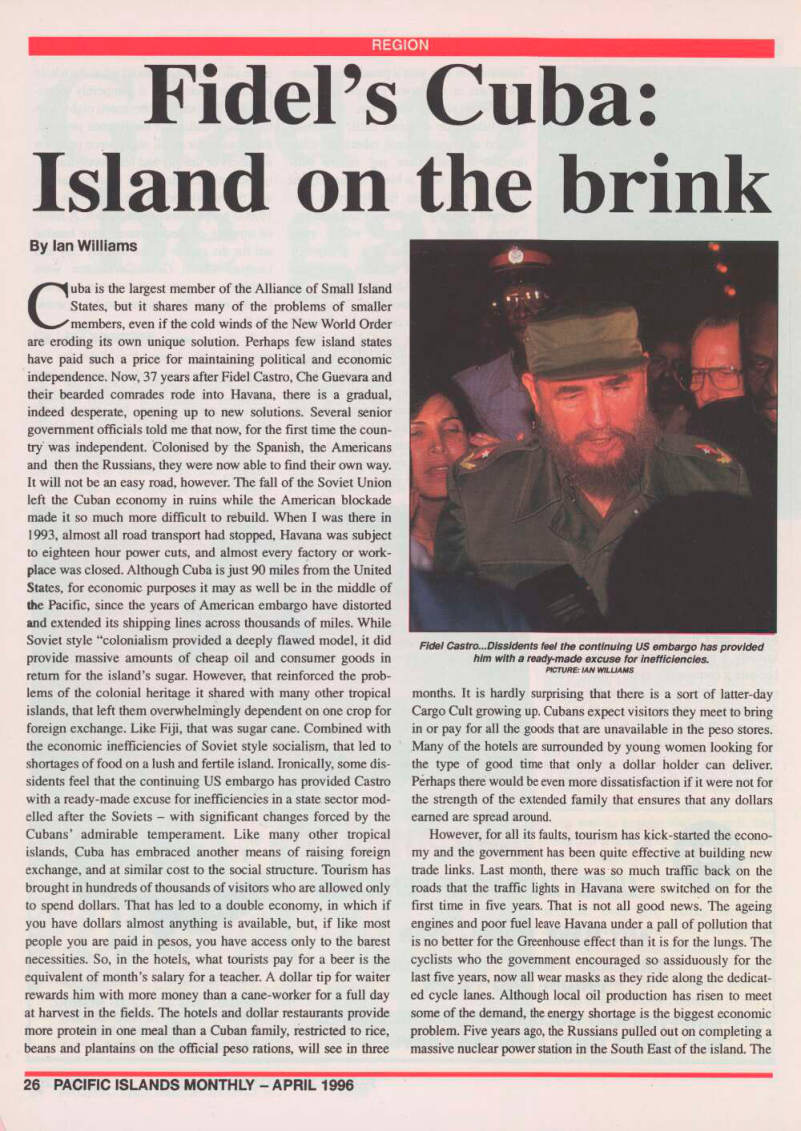
Fidel Castro...Dissidents feel the continuing US embargo has provided him with a ready-made excuse for inefficiencies.
Picture: [?]An Williams
“Last month, there was so much traffic back on the roads that the traffic lights in Havana were switched on for the first time in five years.”
government is now inviting them back in a strictly commercial venture to complete the job. Needless to say, the Americans are not ecstatic at having what they see as a Chemobyl-style reactor a few hours’ wind-blow away from Florida, but there is little that they can do about it. Not even the most demented anti-Castro ele ment in Washington has suggested that Cuba has any intention of developing nuclear weapons. The corrosive effects of the foreign exchange shortage have caused deep damage to the economy.
Cuba owes $6 billion to the Paris club of foreign debtors who have not agreed terms for repayment. While the tourist industry was rapidly developed with foreign investors who expected an equally rapid payback, the old staple of sugar suffered. There was no for eign exchange for fertilisers, machinery parts, or for oil. Even irri gation suffered and the transport breakdowns led to huge losses.
Sugar production was almost halved by last year, as was the pro portion of foreign exchange it produced. This year, Castro’s gov ernment bet the shop with a SUS3OO million short term credit ded icated to boosting the harvest with fertilisers and machinery. It has worked, up to a point, but the country’s credit rating is so low that it has to repay a usurious $350 million with interest. It takes more than money to grow sugar however. It takes hard and motivated work, and that was difficult to get out of people who knew that a tourist in Havana was paying the equivalent of a week of their wages for a cigar. So in 1993 the government handed over the land to the producers to form co-operatives. That has almost doubled their earnings - but they still have to sell their crop to the govem
merit which gets the dollars it earns. To motivate the sugar work ers, they now get coupons that allow them to use pesos to buy hard currency goods at shops run by the sugar mills.
And although Cuban officials and planners are now thinking of radical new Cuban routes to Socialism - and even of the succes sion to Fidel Castro, it is difficult for them as long as he is around.
Vilified as a repressive dictator by Washington, the charismatic Castro is still a hero for many in the Caribbean and Latin America for standing up to Uncle Sam. At the Small Islands Summit in Barbados he was the undoubted star of the show.
But there is indeed repression in Cuba, and strictly limited free dom of speech. However, unlike many other US-supported regimes in the neighbourhood, Cuban dissidents don’t end up dead and mutilated at the roadside, and even opponents who have spent time in prison allow that Castro still has a large degree of support among ordinary Cubans, who respect his achievements in univer sal education and health care. And the Habaneros seem happy with the cheap food and drink available on the streets, and the opportu nity to let their hair (and much of their clothes) down.
But most Cubans have paid a heavy price for those years of dependence on the Soviets. Some of them may well have wished for a better model for Socialism in one island. If, as some planners told me, the eventual aim is a society like Sweden or Finland, then it may well provide a model for other island states. ■
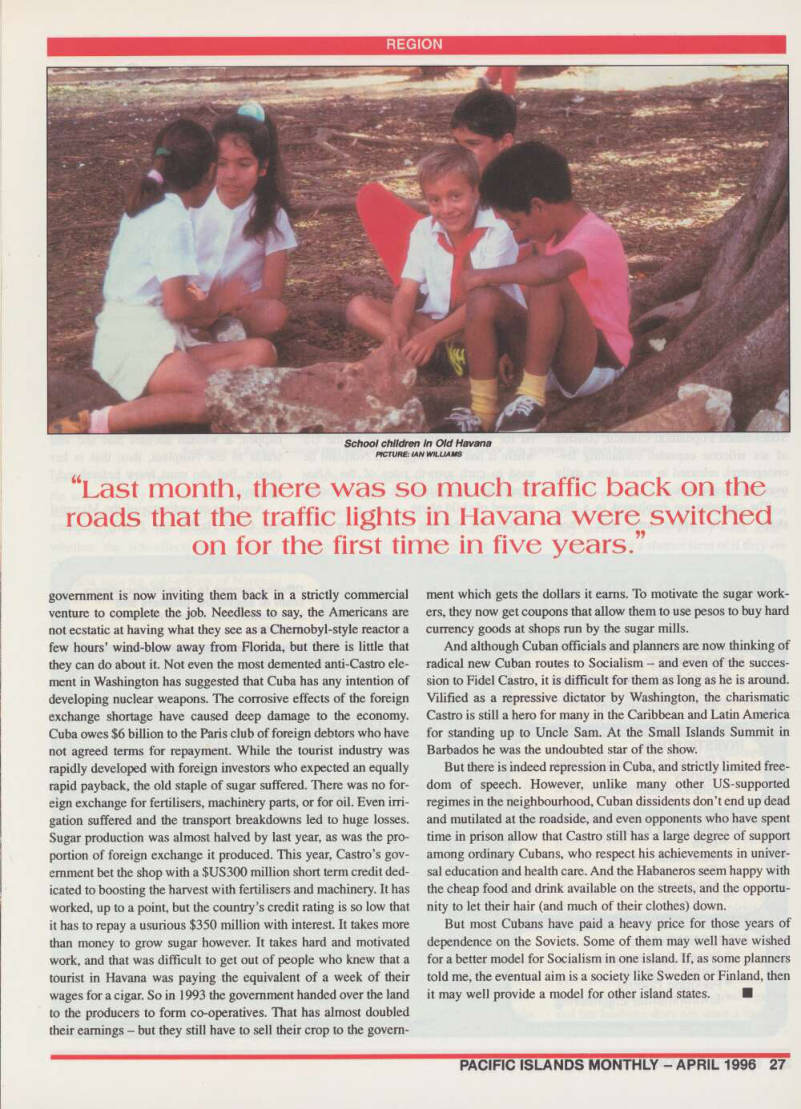
School children in Old Havana