Under her skin
pp. 28-29 · Read in the full issue
Health
By Sophie Foster
The introduction of a foreign idea is usually treated with scepticism and suspicion. And when it comes to the reproductive health of a nation, the issue becomes even more personal.
Pacific women, confronted with a vari ety of introduced and traditional ideas, seem to be increasingly at a loss over what will work best to their advantage.
In Fiji, this has become more clouded with the introduction of the controversial contraceptive Norplant.
Norplant, developed by the United States-based Population Council, consists of six silicone capsules containing lev onorgestrel, released in small doses daily over a five-year period.
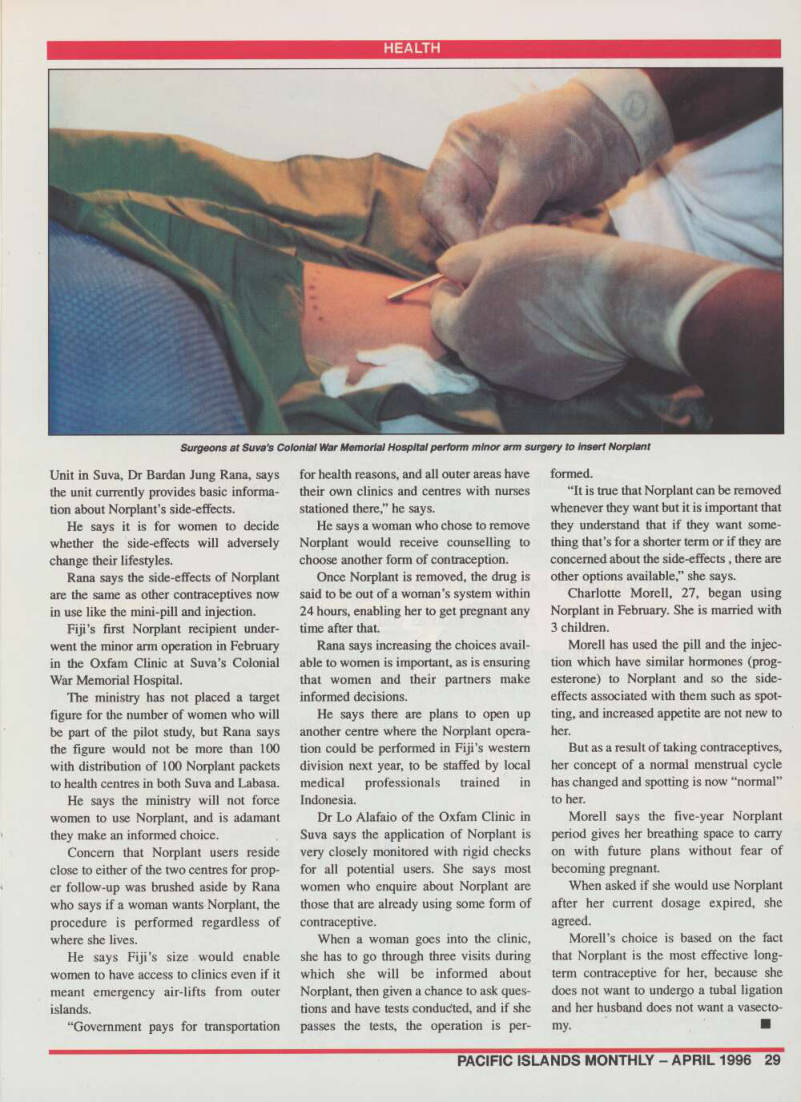
The capsules are implanted in a fan shape in the upper arm, and when
removed, the recipient is said to be as like ly to get pregnant as a woman who has never used Norplant.
But Fiji medical practitioner and human rights activist, Dr Mridula Sainath is not convinced. She says although Norplant has been accepted in 26 coun tries throughout the globe, there are still major concerns over its application in var ious countries and its side-effects.
She says if Norplant is so effective, why has it not been accepted so readily in industrialised countries?
There is also concern that certain seg ments of the population have been target ed for Norplant use, such as in the US where it has been suggested Norplant be used to curb growth rates of the Afro- American population or for a woman accused of child abuse.
But the biggest concern for Fiji,
Sainath says, is the need for proper coun selling and follow-up if Norplant is to be successful.
Fiji’s limited training facilities and lack of medical professionals, is cause for con cern for such a long-term project, she says.
Sainath says the side-effects such as depression, unpredictable bleeding pat terns or spotting between periods, headaches, nervousness, nausea, acne, weight gain, breast tenderness, excessive facial hair growth or loss and loss of libido need to be seriously considered before Norplant is accepted.
“If, knowing that all these things could happen, a woman decides that she still wants to use Norplant, then that is her choice. But she must know beforehand,” she says.
Assistant co-ordinator of the Maternal and Child Health and Family Planning
Unit in Suva, Dr Bardan Jung Rana, says the unit currently provides basic informa tion about Norplant’s side-effects.
He says it is for women to decide whether the side-effects will adversely
change their lifestyles.
Rana says the side-effects of Norplant are the same as other contraceptives now in use like the mini-pill and injection.
Fiji’s first Norplant recipient under
went the minor arm operation in February in the Oxfam Clinic at Suva’s Colonial War Memorial Hospital.
The ministry has not placed a target figure for the number of women who will be part of the pilot study, but Rana says the figure would not be more than 100 with distribution of 100 Norplant packets to health centres in both Suva and Labasa.
He says the ministry will not force women to use Norplant, and is adamant they make an informed choice.
Concern that Norplant users reside close to either of the two centres for prop er follow-up was brushed aside by Rana who says if a woman wants Norplant, the
procedure is performed regardless of
where she lives.
He says Fiji’s size would enable women to have access to clinics even if it meant emergency air-lifts from outer islands.
“Government pays for transportation
for health reasons, and all outer areas have their own clinics and centres with nurses stationed there,” he says.
He says a woman who chose to remove Norplant would receive counselling to choose another form of contraception.
Once Norplant is removed, the drug is said to be out of a woman’s system within 24 hours, enabling her to get pregnant any time after that.
Rana says increasing the choices avail able to women is important, as is ensuring that women and their partners make informed decisions.
He says there are plans to open up another centre where the Norplant opera tion could be performed in Fiji’s western division next year, to be staffed by local medical professionals trained in Indonesia.
Dr Lo Alafaio of the Oxfam Clinic in Suva says the application of Norplant is very closely monitored with rigid checks for all potential users. She says most women who enquire about Norplant are those that are already using some form of contraceptive.
When a woman goes into the clinic, she has to go through three visits during which she will be informed about Norplant, then given a chance to ask ques tions and have tests conducted, and if she passes the tests, the operation is per
formed.
“It is true that Norplant can be removed whenever they want but it is important that they understand that if they want some thing that’s for a shorter term or if they are concerned about the side-effects, there are other options available,” she says.
Charlotte Morell, 27, began using Norplant in February. She is married with 3 children.
Morell has used the pill and the injec tion which have similar hormones (prog esterone) to Norplant and so the side effects associated with them such as spot ting, and increased appetite are not new to her.
But as a result of taking contraceptives, her concept of a normal menstrual cycle has changed and spotting is now “normal” to her.
Morell says the five-year Norplant period gives her breathing space to carry on with future plans without fear of becoming pregnant.
When asked if she would use Norplant after her current dosage expired, she agreed.
Morell’s choice is based on the fact that Norplant is the most effective long term contraceptive for her, because she does not want to undergo a tubal ligation and her husband does not want a vasecto my. ■
Surgeons at Suva’s Colonial War Memorial Hospital perform minor arm surgery to insert Norplant