be gay
pp. 24-25 · Read in the full issue
Event
Glad to be gay
By Liz Thompson
For a week in March, Oxford Street in Sydney is unusually crowded.
The cafe’s and bars are all full, all day, and the pavements are crowded with international and interstate visitors who all arrive for the Sydney Gay and Lesbian Mardi Gras. Hours before it is due to begin the hundreds of people participating start getting ready, converging around the start ing points in the city. As one walks through the crowds there is a palpable sense of excitement and anticipation.
Preparations for the event began almost a year ago and the March night was what thousands of people had waited for.
The Sydney Gay and Lesbian Mardi Gras officially began in 1978 with a
protest march by gay rights activists. The protesters stood outside a police station and began to shout “Stop police attacks on gays, women and blacks.” Although the organisers had been granted a permit, the police responded by reading a statement which declared the permit had been with drawn and the police now had the power to arrest people on sight. A violent confronta tion followed with police repeatedly hit ting many of those who had taken part in the parade, 53 people were arrested and later another 100 who protested against the initial arrests. At this time, homosexuality was illegal in New South Wales although lesbianism was not. Somewhat ironically, this key event was the beginning of what was to become the Sydney Gay and Lesbian Mardi Gras, now the biggest event
of its kind in the world. The dance party that takes place afterwards is the largest in the Southern Hemisphere. In today’s event, parade officials use over 120 walkie talkies, over 2000 barriers are used to con tain the crowds and over 500,000 people come to watch. Today, the Sydney Gay and Lesbian Mardi Gras is not only con doned by the Australian government, but the police now support and work along side the gay community to ensure the smooth running of the event. One of Sydney’s major roads is closed overnight.
Last year, the Australian Broadcasting Commission-televised coverage of the event was so popular that this year they wanted to broadcast the parade live, prime time on Saturday night. The only reason they didn’t was because it clashed with the federal election. This year, the parade attracted over 350 media members, including crews from 40 international radio and television networks and was sponsored by a number of major compa nies including Telstra, Qantas, Smirnoff and the South Sydney Council.
An impact study conducted during the 1993 Sydney Gay and Lesbian Mardi Gras Parade and Festival showed that
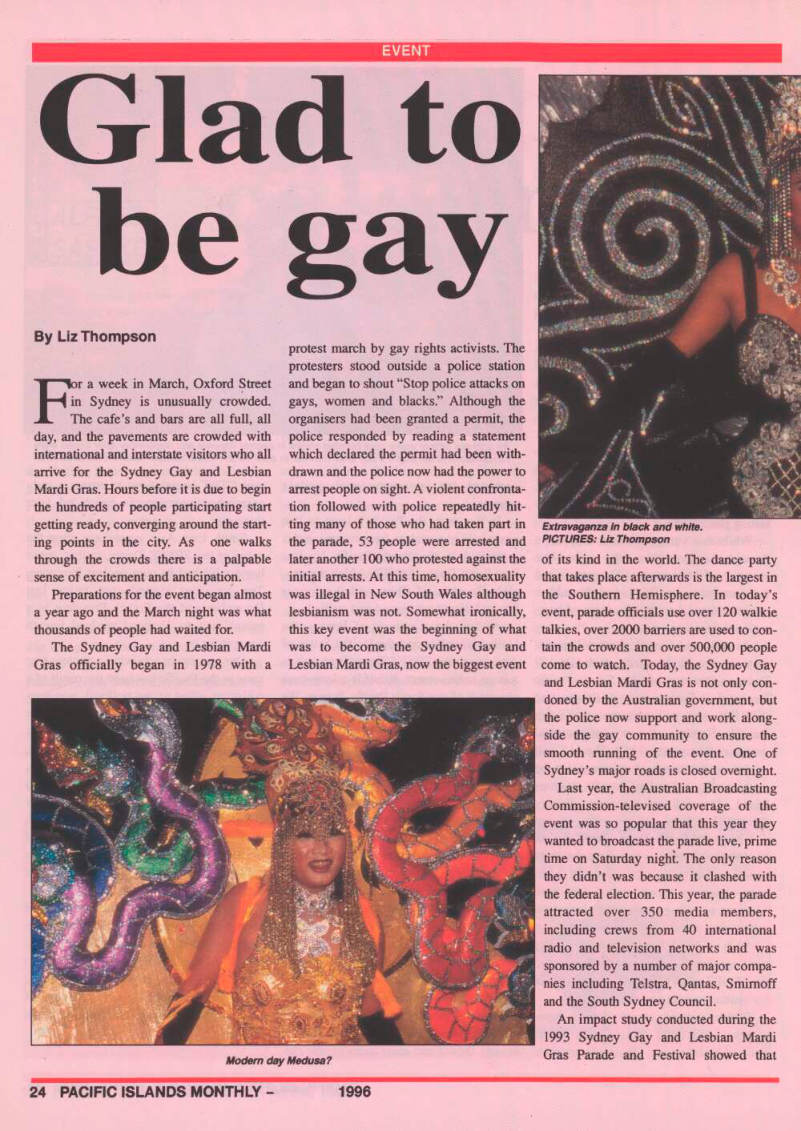
Modern day Medusa?
Extravaganza In black and white.
PICTURES: Liz Thompson
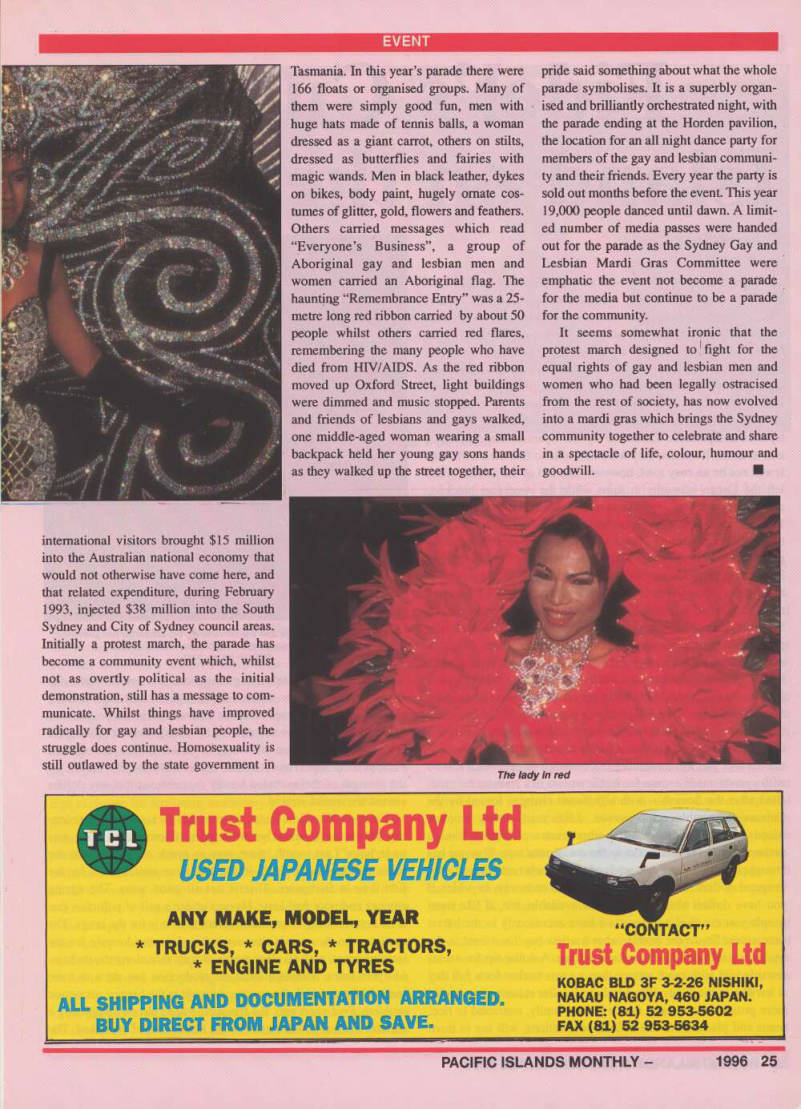
Tasmania. In this year’s parade there were 166 floats or organised groups. Many of them were simply good fun, men with huge hats made of tennis balls, a woman dressed as a giant carrot, others on stilts, dressed as butterflies and fairies with magic wands. Men in black leather, dykes on bikes, body paint, hugely ornate cos tumes of glitter, gold, flowers and feathers.
Others carried messages which read “Everyone’s Business”, a group of Aboriginal gay and lesbian men and women carried an Aboriginal flag. The haunting “Remembrance Entry” was a 25metre long red ribbon carried by about 50 people whilst others carried red flares, remembering the many people who have died from HIV/AIDS. As the red ribbon moved up Oxford Street, light buildings were dimmed and music stopped. Parents and friends of lesbians and gays walked, one middle-aged woman wearing a small backpack held her young gay sons hands as they walked up the street together, their
pride said something about what the whole parade symbolises. It is a superbly organ ised and brilliantly orchestrated night, with the parade ending at the Horden pavilion, the location for an all night dance party for members of the gay and lesbian communi ty and their friends. Every year the party is sold out months before the event. This year 19,000 people danced until dawn. A limit ed number of media passes were handed out for the parade as the Sydney Gay and Lesbian Mardi Gras Committee were emphatic the event not become a parade for the media but continue to be a parade for the community.
It seems somewhat ironic that the protest march designed to'fight for the equal rights of gay and lesbian men and women who had been legally ostracised from the rest of society, has now evolved into a mardi gras which brings the Sydney community together to celebrate and share in a spectacle of life, colour, humour and goodwill. ■
international visitors brought $15 million into the Australian national economy that would not otherwise have come here, and that related expenditure, during February 1993, injected $38 million into the South Sydney and City of Sydney council areas.
Initially a protest march, the parade has become a community event which, whilst not as overtly political as the initial demonstration, still has a message to com municate. Whilst things have improved radically for gay and lesbian people, the struggle does continue. Homosexuality is still outlawed by the state government in
The lady in red