celebrate
pp. 22-23 · Read in the full issue
Opinion
Reason to celebrate
The Pacific peoples and those who stood with them against French nuclear testing in the South Pacific over the past three decades should be proud of a job well done.
France announced on January 29, a “definitive” end to its controversial nuclear testing programme at Mururoa and Fangataufa Atolls.
In consultation with the Americans and the British, Paris announced immediately afterward it was ready to sign the Protocols to the South Pacific Nuclear Free Zone Treaty (SPNFZ), also known as the Rarotonga Treaty.
The Americans and British also con firmed a commitment, announced earlier, that they would jointly sign with the French.
All three major nuclear powers were due to sign the relevant Protocols (1,2 and 3) at a ceremony to be held at the South Pacific Fomm Secretariat headquarters in Suva at a date being finalised.
The signing is historic. It marks a mile stone in almost three decades of a vigorous and an untiring campaign spearheaded by the South Pacific Fomm against nuclear weapons development and, in particular.
the use of the Pacific for testing its weapons of mass destruction.
The anti-nuclear campaign is as old as the South Pacific Forum itself. It was first discussed by the South Pacific Forum’s seven founding members - Australia, the Cook Islands, Fiji, Naum, New Zealand, Tonga and Western Samoa - at their inau gural meeting held in Wellington on August 5-7, 1971.
A communique issued after the meet ing condemned the then prevailing French atmospheric tests at Mururoa and called on Paris to cease the practice immediately.
France did not.
However, support by other nuclear weapons states forced Paris to switch to underground testing that year. The issue has since “graced” the agenda of every subsequent summit of the South Pacific Forum. The anti-nuclear campaign by the South Pacific Forum included letters by successive Fomm Chairs to the major nuclear weapons states such as France, the People’s Republic of China, the former Soviet Union, the United Kingdom and the United States of America, urging them to sign and ratify the South Pacific Nuclear Free Zone Treaty.
In 1992, the South Pacific Fomm was
relieved when France announced a unilat eral moratorium on its nuclear testing pro gramme in the South Pacific.
But the announcement was short-lived.
About three years on, Gaulist President Jacques Chirac reversed the decision, announcing that France would resume testing in a bid to perfect its nuclear arse nal.
Chirac’s announcement to resume nuclear testing in the South Pacific ignited anger and storms of protests worldwide.
Anti-nuclear rallies and rock concerts were organised to drum up support against French testing in the South Pacific. It was a people’s campaign that touched every one far and wide. The world had never been so united in one cause.
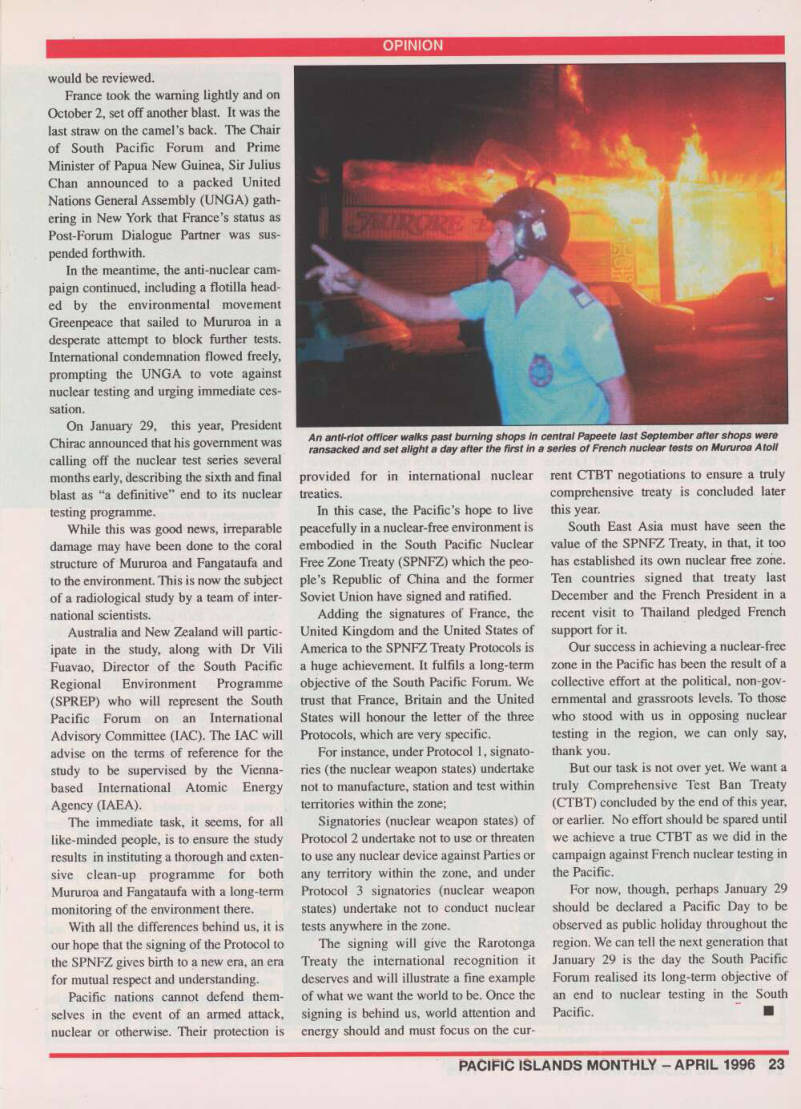
Despite the growing international opposition, the French nuclear test went ahead. The first blast was detonated on Mururoa on September 6, as leaders of the 16-member South Pacific Forum were on their way to Madang, on Papua New Guinea’s northern coast, for their annual summit.
In response, the South Pacific Forum issued a warning that if France did not stop the nuclear test series immediately, its sta tus as a Post-Forum Dialogue Parmer
The Forum
Alfred
Sasako
would be reviewed.
France took the warning lightly and on October 2, set off another blast. It was the last straw on the camel’s back. The Chair of South Pacific Forum and Prime Minister of Papua New Guinea, Sir Julius Chan announced to a packed United Nations General Assembly (UNGA) gath ering in New York that France’s status as Post-Forum Dialogue Partner was sus pended forthwith.
In the meantime, the anti-nuclear cam paign continued, including a flotilla head ed by the environmental movement Greenpeace that sailed to Mururoa in a desperate attempt to block further tests.
International condemnation flowed freely, prompting the UNGA to vote against nuclear testing and urging immediate ces sation.
On January 29, this year, President Chirac announced that his government was calling off the nuclear test series several months early, describing the sixth and final blast as “a definitive” end to its nuclear testing programme.
While this was good news, irreparable damage may have been done to the coral structure of Mururoa and Fangataufa and to the environment. This is now the subject of a radiological study by a team of inter national scientists.
Australia and New Zealand will partic ipate in the study, along with Dr Vili Fuavao, Director of the South Pacific Regional Environment Programme (SPREP) who will represent the South Pacific Forum on an International Advisory Committee (lAC). The lAC will advise on the terms of reference for the study to be supervised by the Vienna based International Atomic Energy Agency (lAEA).
The immediate task, it seems, for all like-minded people, is to ensure the study results in instituting a thorough and exten sive clean-up programme for both Mururoa and Fangataufa with a long-term monitoring of the environment there.
With all the differences behind us, it is our hope that the signing of the Protocol to the SPNFZ gives birth to a new era, an era for mutual respect and understanding.
Pacific nations cannot defend them selves in the event of an armed attack, nuclear or otherwise. Their protection is
provided for in international nuclear treaties.
In this case, the Pacific’s hope to live peacefully in a nuclear-free environment is embodied in the South Pacific Nuclear Free Zone Treaty (SPNFZ) which the peo ple’s Republic of China and the former Soviet Union have signed and ratified.
Adding the signatures of France, the United Kingdom and the United States of America to the SPNFZ Treaty Protocols is a huge achievement. It fulfils a long-term objective of the South Pacific Forum. We trust that France, Britain and the United States will honour the letter of the three Protocols, which are very specific.
For instance, under Protocol 1, signato ries (the nuclear weapon states) undertake not to manufacture, station and test within territories within the zone; Signatories (nuclear weapon states) of Protocol 2 undertake not to use or threaten to use any nuclear device against Parties or any territory within the zone, and under Protocol 3 signatories (nuclear weapon states) undertake not to conduct nuclear tests anywhere in the zone.
The signing will give the Rarotonga Treaty the international recognition it deserves and will illustrate a fine example of what we want the world to be. Once the signing is behind us, world attention and energy should and must focus on the cur
rent CTBT negotiations to ensure a truly comprehensive treaty is concluded later this year.
South East Asia must have seen the value of the SPNFZ Treaty, in that, it too has established its own nuclear free zone.
Ten countries signed that treaty last December and the French President in a recent visit to Thailand pledged French support for it.
Our success in achieving a nuclear-free zone in the Pacific has been the result of a collective effort at the political, non-gov ernmental and grassroots levels. To those who stood with us in opposing nuclear testing in the region, we can only say, thank you.
But our task is not over yet. We want a truly Comprehensive Test Ban Treaty (CTBT) concluded by the end of this year, or earlier. No effort should be spared until we achieve a true CTBT as we did in the
campaign against French nuclear testing in
the Pacific.
For now, though, perhaps January 29 should be declared a Pacific Day to be
observed as public holiday throughout the
region. We can tell the next generation that January 29 is the day the South Pacific Forum realised its long-term objective of an end to nuclear testing in the South Pacific. ■
An anti-riot officer walks past burning shops in central Papeete last September after shops were ransacked and set alight a day after the first in a series of French nuclear tests on Mururoa Atoll