Pacific
pp. 20-21 · Read in the full issue
The Arts
A home for Pacific treasures
By Nicholas Rothwell
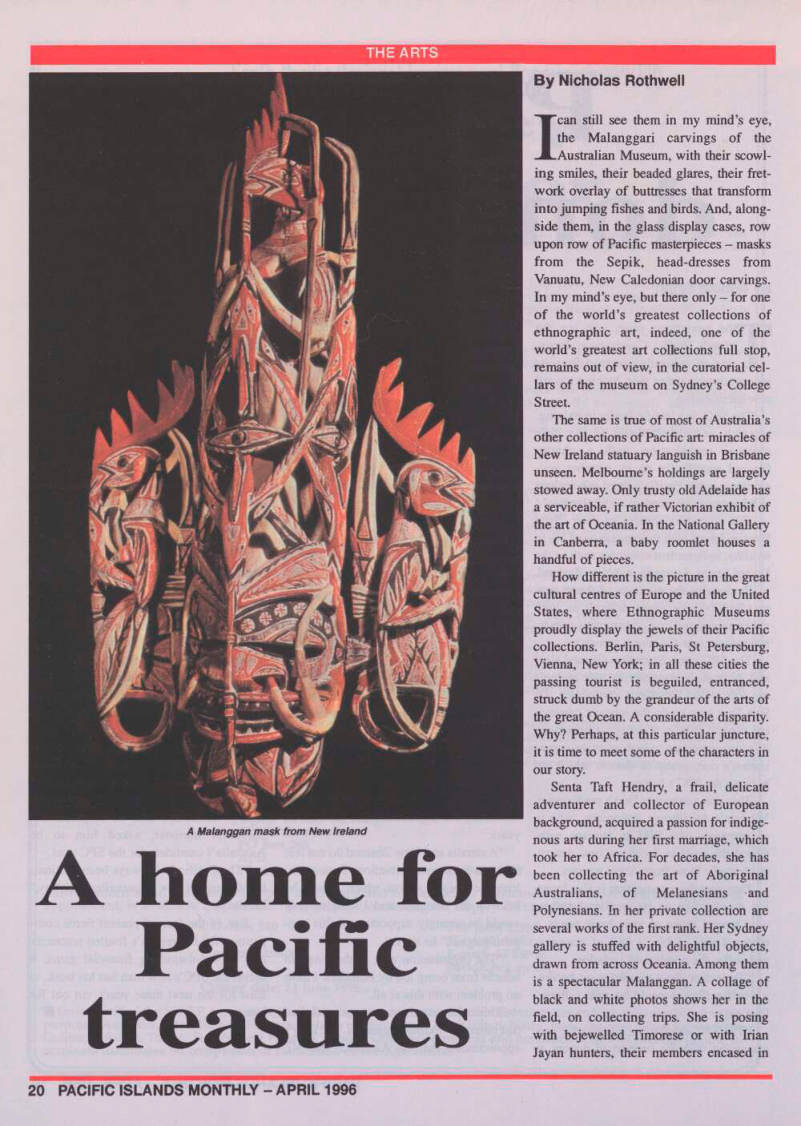
I can still see them in my mind’s eye, the Malanggari carvings of the Australian Museum, with their scowl ing smiles, their beaded glares, their fret work overlay of buttresses that transform into jumping fishes and birds. And, along side them, in the glass display cases, row upon row of Pacific masterpieces - masks from the Sepik, head-dresses from Vanuatu, New Caledonian door carvings.
In my mind’s eye, but there only - for one of the world’s greatest collections of ethnographic art, indeed, one of the world’s greatest art collections full stop, remains out of view, in the curatorial cel lars of the museum on Sydney’s College Street.
The same is true of most of Australia’s other collections of Pacific art: miracles of New Ireland statuary languish in Brisbane unseen. Melbourne’s holdings are largely stowed away. Only trusty old Adelaide has a serviceable, if rather Victorian exhibit of the art of Oceania. In the National Gallery in Canberra, a baby roomlet houses a handful of pieces.
How different is the picture in the great cultural centres of Europe and the United States, where Ethnographic Museums proudly display the jewels of their Pacific collections. Berlin, Paris, St Petersburg, Vienna, New York; in all these cities the passing tourist is beguiled, entranced, struck dumb by the grandeur of the arts of the great Ocean. A considerable disparity.
Why? Perhaps, at this particular juncture, it is time to meet some of the characters in our story.
Senta Taft Hendry, a frail, delicate adventurer and collector of European background, acquired a passion for indige nous arts during her first marriage, which took her to Africa. For decades, she has been collecting the art of Aboriginal Australians, of Melanesians and Polynesians. In her private collection are several works of the first rank. Her Sydney gallery is stuffed with delightful objects, drawn from across Oceania. Among them is a spectacular Malanggan. A collage of black and white photos shows her in the field, on collecting trips. She is posing with bejewelled Timorese or with Irian Jayan hunters, their members encased in
A Malanggan mask from New Ireland
enormous penis sheaths. On one occasion, in the highlands, Senta’s leg was pierced by a stray arrow-head, but she still collects the barbed, elegant shafts: “They’re like visiting cards,” she says: “Each one is indi vidual - human bone tips by the way.” A stuffed crocodile, ‘Mitzi,’ hangs in one alcove of her gallery. Bisi poles, Sepik hook figures and Ambrym sit-drums lean propped against the walls.
Senta has a dream: to create, or be involved in the creation of, an Australian i museum of tribal art, bringing together all the treasures dispersed throughout the country. Like many of her fellow-connois seurs of tribal art, she is appalled by the lack of such an institution.
Senta is attempting to drum up support for her scheme from the government bureaucracy, which has itself been lost for some years in the Keating-era project for a new national museum, to be located in
Canberra, with a dedicated Aboriginal wing. But Senta, like several other collec tors, prefers a rather different scheme: a world-class ethnographic museum in Australia; one that would bring together a representative selection of our scattered Pacific treasures under a single roof. She considers that the traditional Aboriginal art could fit into such an institution, and mod em Aboriginal works should remain the preserve of galleries. Others involved in the push for a new tribal arts museum would prefer only Pacific objects to he included; they regard Australia’s Aboriginal art as a separate category, and are aware of the political sensitivities sur rounding the various blueprints for a new national museum in Canberra.
The inspiration for Senta’s idea of a Pacific museum comes from one of the world’s most astonishing collections; the ethnographic museum in Mexico City’s Chapultepec Park, where all the cultures of the pre-Columbian era have been brought together.
So strong is her commitment to her dream that she is prepared to donate her entire house-full of works, and her library of Pacific ethnographic books, to the new museum. Her ideal space would be a large, capacious structure, sufficient to hold gen erous galleries, each with videos explain ing the life-patterns of specific cultures. In
the grounds, dance groups from the Pacific islands could give regular performances.
Where might one find such a building?
Well, Government House, now vacant, would be ideal.
Senta Taft Hendry is not alone in her dreams. Australian lovers of Pacific art are legion, and they are concerned. Last October, a group of them banded together in Sydney, and established an Oceanic Art Society. One of their principal concerns was, of course, the lack of Pacific art on public display.
The Australian Museum, probably the most internationally renowned of our museums, carries the dual responsibility of
“There’s not enough Pacific art on view.”
showing natural history and anthropologi cal collections. But, no matter how you dress things up, it is the Australian Museum’s policies that are being called in question by the very formation of the Oceanic Art Society. Last month, the Society, which had been told ‘sotto voce’ by Museum sources that it would be lucky to attract more than 25 backers, had a membership of 125 individuals, including artists, collectors and academics from sev eral states and from overseas. In essence, they want a new museum devoted to Oceania.
Their perspective is that Pacific art is the sublime pinnacle of tribal art and that it has been critically important in the history of western modernism - Henry Moore, for instance, was inspired by the Malanggan figures, Picasso looked long and hard at New Hebridean masks. Andre Breton owned Uli statues, among many other Pacific pieces. Where modernist art begins, there, with uncanny regularity, lurks a Pacific art exposition or a visit to the South Seas. Much of the best of this tribal art work is in Australia - and unseen.
The Society held a function last month to launch a lavish, and landmark publica tion: ‘Oceanic Art,’ a two-volume affair, by French-bom anthropologist Anthony Meyer. It brings together 800 illustrations of striking works, 40 per cent of which are
in Australia, mostly in museum deposito ries. A 100-piece loan exhibition from the Australian Museum is currently being pre pared, for dispatch, it is hoped, to the New York Metropolitan Museum - still the world’s top venue for art speculators - and will then travel through the United States.
It remains unsure whether it will receive an Australian showing.
“Of course it’s true! There’s not enough Pacific art on view!” In the director’s office of the Australian Museum, Des Griffin is typically forthright.
In Griffin’s time at the helm, there have been three major exhibitions at the Australian Museum of Pacific region art: one Maori, one from the Abelam
culture area of Papua New Guinea, and, above all, the spectacular pan- Melanesian survey, ‘Pieces of Paradise.’
“If you look at the reception given to them, it’s fair to say” - and he
does say - “that Australians have a lot of difficulty in understanding Asian and Pacific cultures. You see, ‘Pieces of Paradise’ was absolutely stunning, but not a lot of people came.”
It is Griffin’s impression that people don’t relate strongly to Pacific material, and do tend to think of it as ‘primitive’.
Partly because of this, he regards the push for a separate Pacific cultures museum as ‘nuts’. His chief reason, though, is that he believes stripping out the various elements from a museum removes the responsibility that museum has to represent, in rotating shows, the diversity of its collections, and of the population it serves.
Griffin is literally squeezed for space. A director must find a way to balance priori ties: and the Australian Museum is cur rently readying an Aboriginal art display which will be, quite simply, the most important of its kind in the world. In these circumstances the Pacific, however lovely, comes down the list.
And the Malanggan figures? The Sepik masks with drooping eyes? The wild, over modelled skulls from Vanuatu? What of them, as they wait, in their resting-places, unknown, like so many unsung spells of magic? They survive, of course, in the imaginations of those who have seen them.
But there are many who have not seen them, and cannot be beguiled. ■