Putting
p. 19 · Read in the full issue
Region
Putting donors first
By Debbie Singh
The next three years will see the South Pacific Commission focus ing on cultivating support from its present donors rather than looking toward new membership.
The SPC, as a Pacific leader in training, research and development is the only regional organisation with a charter focused specifically on its member gov ernments in the Pacific’s three sub-regions of Melanesia, Micronesia and Polynesia.
The countries range in size from Pitcairn Island with its population of 50, to wealthy, independent countries such as the United States, Australia and New Zealand.
Regionally, the question of donor sup port has become more difficult as both governments and non government organi sations compete for scarce resources.
The SPC’s new Secretary-General elect and Australia’s nominee for the region’s top job at last October’s conference. Dr Bob Dun says while the issue of canvass ing support from new donors is important, it is also important to look after the organ isation’s core group of donors which are basic to the SPC’s future.
This is in contrast to Dun’s predecessor, Vanuatu’s Ati George Sokomanu, who in an interview with PIM in January, men tioned the need to focus on new donors, particularly those from Asian nations.
Dun says the organisation is also focus ing its attention on its smaller members who have a range of very basic needs, a rigorous way of life, a lack of resources and suffer the problem of isolation.
“To lecture these countries on becom ing self-sufficient would be quite callous,”
Dun says.
“The SPC needs more imaginative pro gramming with the support of donors, to
enable the organisation to be seen and appreciated by smaller states.
“A lot of the larger states are indepen dent and show great pride in this. The SPC contribution to these islands would be more resource-based.”
This is the first time in 30 years that the organisation has had a person from a met ropolitan country at its helm. Dun says his appointment was made with the idea of sustaining the organisation for the next 50 years.
“Australia and New Zealand do not feel this is a permanent situation. Both coun tries feel this is a post which should be held by the islanders and I imagine they would be strongly supportive of this hap
pening again,” he says.
“The organisation will, in the long run benefit from being led by islanders. I have no problem with this at all.”
This comment also contrasts another of Sokomanu’s exiting remarks of Dun’s appointment, that of Australia and NZ
being advised to “keep away” from the post of secretary-general as it belonged to the islanders. Sokomanu also said he believed Australia was sending in their man to “clean up the SPC.”
Dun refutes the latter as an “emotional phrase” saying: “I hope I will be seen as a fairly friendly person. Someone who can help the conference set the pace for the organisation’s next 50 years. I am not new to the Pacific. I have been working in the region for the past 15 years. I would be upset if I offended the islanders as I would like to fit in. I haven’t come in with a huge clean-up axe”.
“The organisation has excellent strengths and excellent people. A technical research organisation like the SPC is like a delicate flower which must be nurtured,” he said.
“Socially, it is not as easy to interact with the islanders as I would be able with any Australian. But I am not going to renounce my Australian culture. And this would also apply to islanders coming to Australia.”
Dun, who worked with AUSaid for 10 years from 1983 before retiring, is a vet erinarian by profession. He says he was “working for his wife” when Gordon Bilney, Australia’s then development co operation minister, asked him to be Australia’s candidate for the SPC post.
“The Pacific has always been fascinat ing for me. It has a marvellous history,”
Dun says.
But, in the face of present fierce com petition for the region’s limited resources and its fast-dwindling financial gains, it seems the SPC’s new man has his work, at least for the next three years, cut out for him. ■
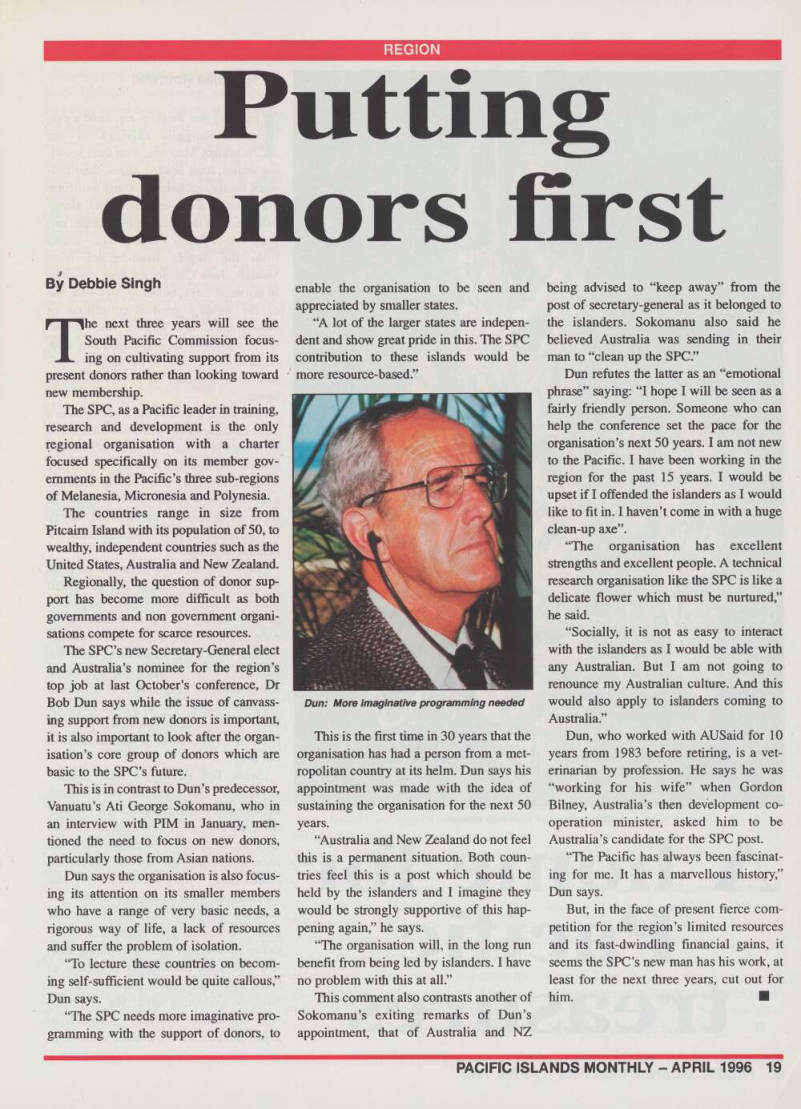
Dun: More imaginative programming needed