Rethinking sustainable
pp. 15-17 · Read in the full issue
Environment
Rethinking sustainable development
By Sophie Foster
The idea of sustainable development is one which has been thrown about a lot over the past five years.
Many global conferences have centred around this theme and the hope that this, and many other objectives will be achieved by the year 2000.
But what is sustainable development?
Is it truly something that can be achieved or is it merely an elusive dream?
More importantly, is it just another piece of United Nations jargon which has not been de-my stifled?
Overpopulation, deforestation, extinc tion of species, poverty.
These are some of the warning signs that humans are at a critical point in their relationship with the environment.
The warnings have meant tragic conse quences in some areas of the globe.
United Nations Development Programme Administrator James Speth defines it as the world screaming back at us.
“It is screaming back in hunger, in pain, across the wastelands, and dead waters.
Only the purposefully deaf have not heard it”, he says.
In the Pacific, with its fragile ecosys tems, high population pressure and vast array of political, economic and social conditions, development problems are
gaining prominence.
The Global Conference on the Sustainable Development of Small Island Developing States, held in Barbados in 1994, defines sustainable development as “development that meets present needs without jeopardising the welfare of future generations”.
Peter Hunnam, of the Suva-based World Wide Fund for Nature in the South Pacific, says: “What we need to stress overall in the Pacific is development that is not just eco nomic or ecological, but a combination of all these factors - environmental, econom ic and social”.
UN Human Development Reports con
sistently define the basic objective of development as enlarging people’s choic es.
Essentially, it means providing equal opportunities for all, at a sustainable level, and empowering people to gain from development processes.
But no matter what definition is used, it is clear that to achieve sustainable devel opment, the human element can never be ignored.
And follow-up action by governments and legislators must be consistent to fully implement policies and international con ference resolutions at national level.
Evidence of the sway of international opinion towards a more environmentally friendly development ethos is apparent judging by the response to the 1992 Earth Summit in Rio de Janeiro.
Together, industrialised and developing nations, government and non-govemment representatives called for a change in atti tudes and practices.
At the Earth Summit, a special confer ence was called in recognition of the unique problems facing small island states.
As a result, representatives of 100 island countries met to discuss the topic at the Global Conference for the Sustainable Development of Small Island States in Barbados in 1994.
Considerable attention was placed on issues such as climate change and sea level rise, biodiversity, land use, coastal and marine resources, and tourism develop ment.
But South Pacific Action Committee for Human Ecology and Environment (SPACHEE) coordinator Isoa Korovulavula says while the Barbados report highlighted the general problems facing island states, it ignored issues which were of highest priority to certain countries.
“Nuclear testing and the right to self determination as part of the sustainable development package is not part of the report because the issues were too politi cally sensitive,” he says.
For a report to receive UN recognition, both developing and industrialised coun tries must agree on its complete text.
“This is despite the fact the report is supposed to be about island states high lighting their pressing concerns,”
Korovulavula says.
“It has been almost two years since the conference, but few island countries have made progress towards the sustainable state idealised in Barbados.
“Pursuing sustainable development to make countries self-reliant and self-deter mining is difficult if the island countries do not have funds to set up institutions and legislation to facilitate the change.
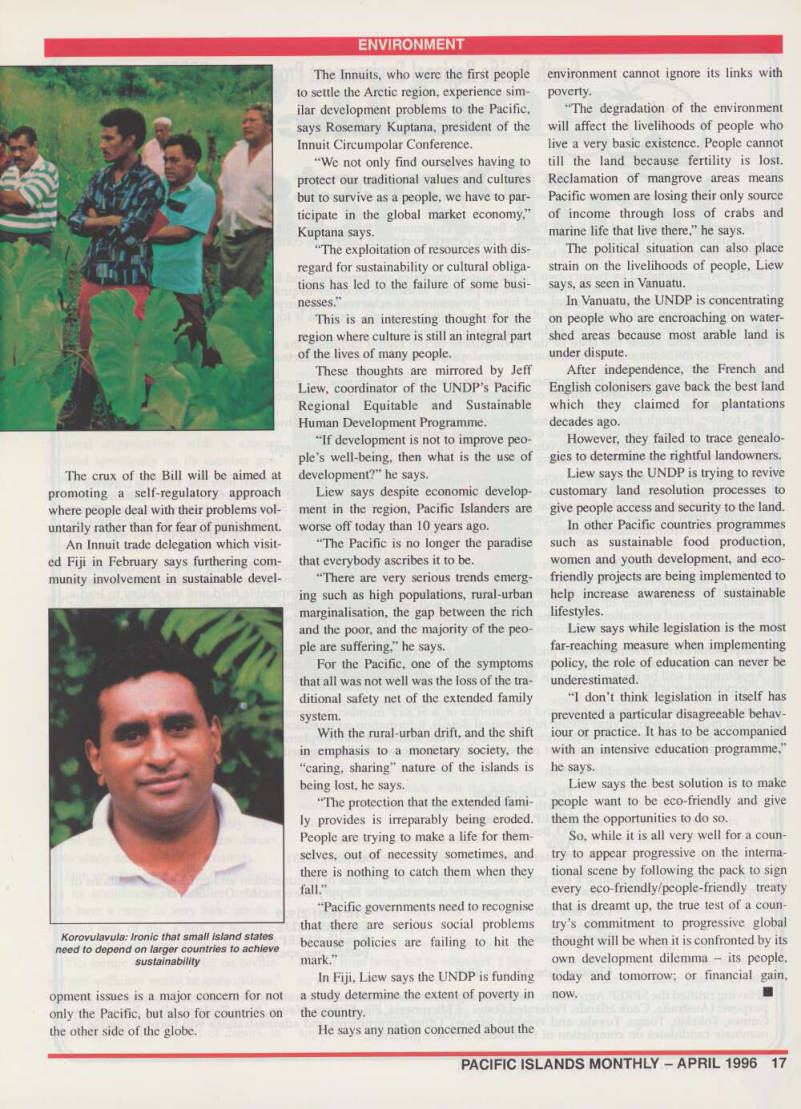
“It is ironic that in order for small island states to become sustainable, they have to depend on industrialised countries to finance their sustainability,”
Korovulavula says.
And this won’t be possible until there is international recognition of serious devel opmental concerns in the Pacific.
Korovulavula says population prob lems in the Pacific tend to be downplayed on the international scene.
“The attitude is like you’ve got to be kidding, look at our populations and you think you’ve got problems in the Pacific.”
Korovulavula says the onus is on Pacific Islanders to take charge of their own destinies.
“The challenge facing governments is to re-evaluate their priorities to see if they are helping the people they profess to serve,” he says.
In line with the outcomes of the Barbados conference, the Fiji government
is currently drafting legislation for a
Sustainable Development Bill.
The Bill is being developed to fulfdl Fiji’s obligations under the Rio and Barbados agreements, and to provide an integrated approach to environmental law making, says Fiji environment ministry
consultant George Deßomilly.
Deßomilly, who is drafting the bill for Government, says there are currently 60
different pieces of legislation dealing with
environmental or health issues which are dealt with by 15 ministries.
This problem is a common feature
throughout the region.
“There is a lot of concern that existing legislation is very sectoral causing tremen dous problems when you’re trying to look at sustainable development because the laws have been developed on a piece-meal or ad-hoc basis,” he says.
A wide consultation process has been used throughout Fiji to determine major concerns of individuals, industry and gov ernment.
Deßomilly says requirements under the bill will be phased in to help people adapt to the new legislation.
“The enforcement and implementation of the bill is a major concern for us, so we’re trying to make sure we’re not plac ing unrealistic targets or expectations which may not be achieved,” he says.
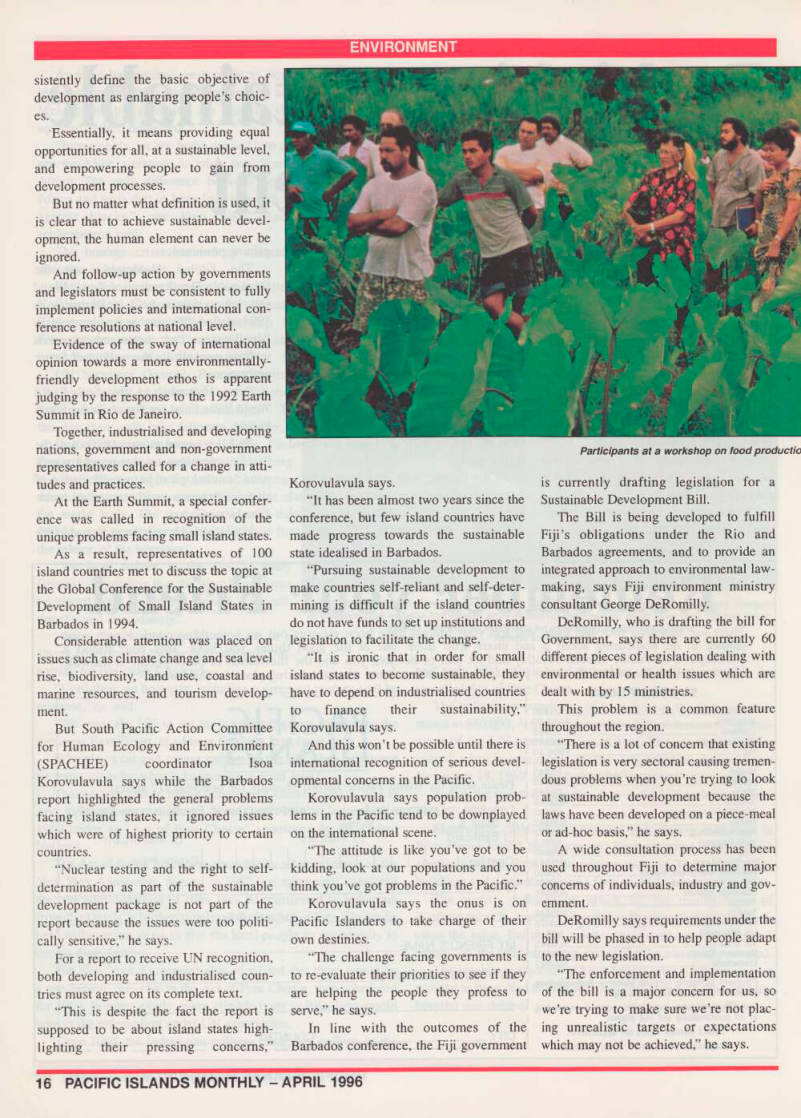
Participants at a workshop on food productio
opment issues is a major concern for not only the Pacific, but also for countries on the other side of the globe.
The Innuits, who were the first people to settle the Arctic region, experience sim ilar development problems to the Pacific, says Rosemary Kuptana, president of the Innuit Circumpolar Conference.
“We not only find ourselves having to protect our traditional values and cultures but to survive as a people, we have to par
ticipate in the global market economy,”
Kuptana says.
“The exploitation of resources with dis regard for sustainability or cultural obliga tions has led to the failure of some busi nesses.”
This is an interesting thought for the region where culture is still an integral part of the lives of many people.
These thoughts are mirrored by Jeff Liew, coordinator of the UNDP’s Pacific
Regional Equitable and Sustainable
Human Development Programme.
“If development is not to improve peo ple’s well-being, then what is the use of development?” he says.
Liew says despite economic develop ment in the region. Pacific Islanders are worse off today than 10 years ago.
“The Pacific is no longer the paradise that everybody ascribes it to be.
“There are very serious trends emerg
ing such as high populations, rural-urban
marginalisation, the gap between the rich and the poor, and the majority of the peo ple are suffering,” he says.
For the Pacific, one of the symptoms that all was not well was the loss of the tra ditional safety net of the extended family system.
With the rural-urban drift, and the shift in emphasis to a monetary society, the “caring, sharing” nature of the islands is being lost, he says.
“The protection that the extended fami
ly provides is irreparably being eroded.
People are trying to make a life for them selves, out of necessity sometimes, and there is nothing to catch them when they fall.”
“Pacific governments need to recognise that there are serious social problems because policies are failing to hit the mark.”
In Fiji, Liew says the UNDP is funding a study determine the extent of poverty in the country.
He says any nation concerned about the
environment cannot ignore its links with poverty.
“The degradation of the environment will affect the livelihoods of people who live a very basic existence. People cannot till the land because fertility is lost.
Reclamation of mangrove areas means Pacific women are losing their only source of income through loss of crabs and marine life that live there,” he says.
The political situation can also place strain on the livelihoods of people, Liew says, as seen in Vanuatu.
In Vanuatu, the UNDP is concentrating on people who are encroaching on water shed areas because most arable land is
under dispute.
After independence, the French and English colonisers gave back the best land which they claimed for plantations decades ago.
However, they failed to trace genealo gies to determine the rightful landowners.
Liew says the UNDP is trying to revive customary land resolution processes to give people access and security to the land.
In other Pacific countries programmes such as sustainable food production, women and youth development, and eco friendly projects are being implemented to help increase awareness of sustainable
lifestyles.
Liew says while legislation is the most
far-reaching measure when implementing
policy, the role of education can never be underestimated.
“I don’t think legislation in itself has
prevented a particular disagreeable behav
iour or practice. It has to be accompanied with an intensive education programme,” he says.
Liew says the best solution is to make people want to be eco-friendly and give them the opportunities to do so.
So, while it is all very well for a coun try to appear progressive on the interna tional scene by following the pack to sign every eco-friendly/people-friendly treaty that is dreamt up, the true test of a coun
try’s commitment to progressive global
thought will be when it is confronted by its own development dilemma - its people, today and tomorrow; or financial gain, now.
The crux of the Bill will be aimed at
promoting a self-regulatory approach
where people deal with their problems vol untarily rather than for fear of punishment.
An Innuit trade delegation which visit ed Fiji in February says furthering com munity involvement in sustainable devel-
Korovulavula: Ironic that small island states need to depend on larger countries to achieve sustainability