Will Indonesia
pp. 13-14 · Read in the full issue
Region
Will Indonesia listen?
By a Special Correspondent
In the late 70’s and early 80’s, the Indonesian government repeatedly told the world that the Organisasi Papua Merdeka (OPM) or Free West Papua Movement was a spent force.
Given time, it would fizzle out, or so reasoned Jakarta.
Indonesia’s assessment is based on the fact that the resistance movement has no military training and is poorly equipped. It con cludes that there is little hope for anyone surviving the thick, mos quito-infested jungles of what was western New Guinea.
But 20 years on, the Jakarta government has been proven embarrassingly wrong time and time again. Not only has the OPM appeared to have survived, much to the surprise and indig
nation of the Jakarta govern ment, but it has begun to attract international atten tion to the plight of Irian Jaya through its activities, spanning more than three decades. Its “bush” war activities against Indonesian rule in their homeland has intensified.
In recent months, hostage-taking now appears to be number one on OPM’s
political agenda. Foreign
nationals have been hot
favourites. According to the OPM, the more foreign nationals are taken hostage, the better the international exposure for the organ isation fighting on behalf of some one million Melanesian people in Irian Jaya.
For instance, in January this year, the OPM kidnapped 26 civil ians. They included two Britons, two Dutch and one German. The rest were Indonesian nationals. While others have been released unharmed, negotiations were continuing for the release of the remaining 12 including two British, two Dutch and a German.
According to reports filtering through from the capital, Jayapura, a report by the Catholic bishop of Jayapura provided the catalyst for the latest hostage crisis.
In his report, released last July, Bishop Munninghoff, was said to have uncovered widespread human rights abuses and atrocities committed by the Indonesian army against the local West Papua people. There were instances of people mysteriously disappearing almost on a daily basis.
A large number of local people were and are dying from mys terious diseases, especially in 300-kilometre stretch of swamp for-
The bishop’s report was said to have uncovered widespread human rights abuses and atrocities committed by the Indonesian army against the people of West Papua.
est around a huge gold and copper mine operated by Freeport - a United States firm.
The clergyman’s report alleged that Freeport was collaborating with the Indonesian army moving the local people away from their villages, often against their will, to make way for die expanding mining operations. Those who tried to put up any resis tance were rounded up by the military police, never to be seen again, according to the report.
There was no compensation and villagers who did move, were left to fend for themselves and their children.
The mine is situated at about 4000 metres above sea-level and is located about 90 km from Timika, a small mining town on
southern Irian Jaya. It is the world’s largest gold mine and the third biggest copper mine.
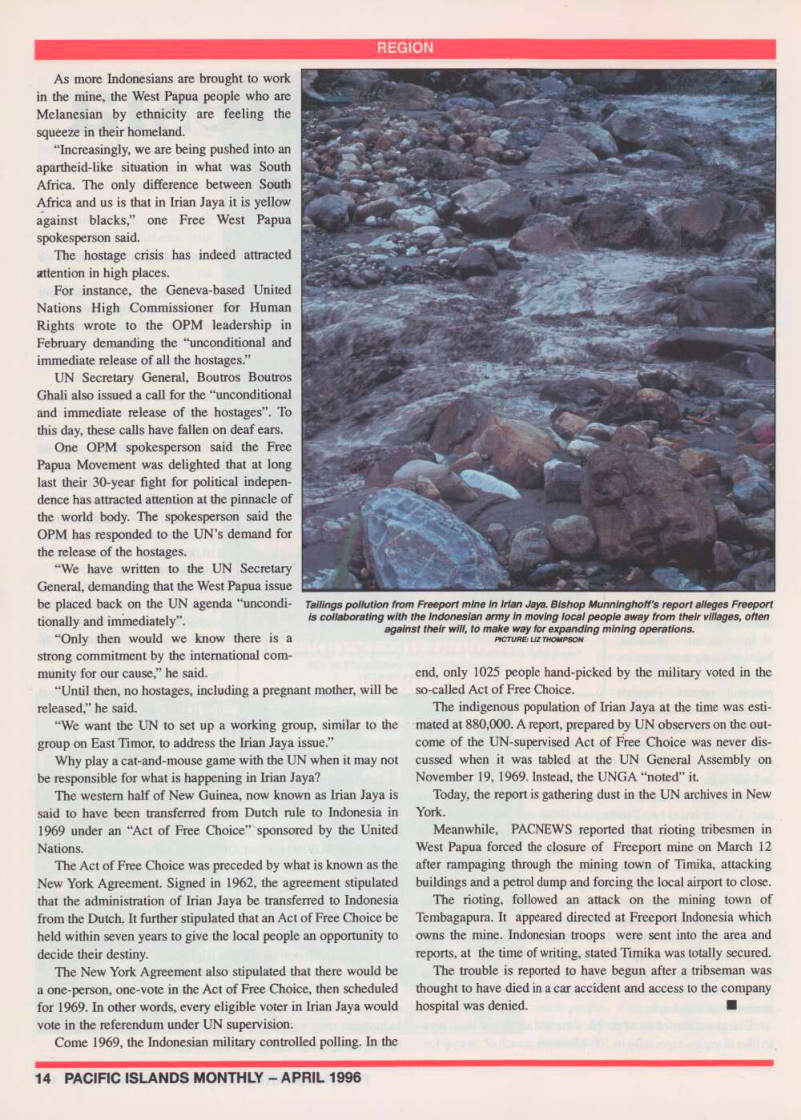
Freeport, a New Orleans compa ny, estimates that it dumps about 110,000 tonnes of waste into the local river systems a day.
It denies chemicals used in its operations are responsible for the
mysterious illnesses being expe
rienced by the local people. In fact, the company was so incensed by the allegations made against it in the Bishop’s report that it took out a full page adver
tisement in the New York Times newspaper recently.
In it, the multi-billion dollar concern dubbed the clergyman’s allegations as lies.
Published reports have stated that Washington has hit out at the company. The United States Overseas Private Investment Corporation (OPIC) - a political risk insurance agency - last November withdrew the mine’s five-year old insurance cover worth about SUSIOO million. OPIC cited environmental problems associated with “acid mine drainage, toxic metals and the mis management of solid and hazardous wastes at the mine site” for its action.
Bishop Munninghoff’s report also struck a chord in another quarter. It prompted the Indonesian government to set up a National Commission on Human Rights to investigate allegations of human rights abuses in Irian Jaya - Indonesia’s 26th province.
It has found evidence of human rights abuses and atrocities and has recommended action for those responsible. The Indonesian army was said to have identified those responsible, but to this day, it has not dealt with them.
As more Indonesians are brought to work in the mine, the West Papua people who are Melanesian by ethnicity are feeling the squeeze in their homeland.
“Increasingly, we are being pushed into an apartheid-like situation in what was South Africa. The only difference between South Africa and us is that in Irian Jaya it is yellow against blacks,” one Free West Papua spokesperson said.
The hostage crisis has indeed attracted attention in high places.
For instance, the Geneva-based United Nations High Commissioner for Human Rights wrote to the OPM leadership in February demanding the “unconditional and immediate release of all the hostages.”
UN Secretary General, Boutros Boutros Ghali also issued a call for the “unconditional and immediate release of the hostages”. To this day, these calls have fallen on deaf ears.
One OPM spokesperson said the Free Papua Movement was delighted that at long last their 30-year fight for political indepen dence has attracted attention at the pinnacle of the world body. The spokesperson said the OPM has responded to the UN’s demand for the release of the hostages.
“We have written to the UN Secretary General, demanding that the West Papua issue be placed back on the UN agenda “uncondi tionally and immediately”.
“Only then would we know there is a strong commitment by the international com munity for our cause,” he said.
“Until then, no hostages, including a pregnant mother, will be released,” he said.
“We want the UN to set up a working group, similar to the group on East Timor, to address the Irian Jaya issue.”
Why play a cat-and-mouse game with the UN when it may not be responsible for what is happening in Irian Jaya?
The western half of New Guinea, now known as Irian Jaya is said to have been transferred from Dutch rule to Indonesia in 1969 under an “Act of Free Choice” sponsored by the United Nations.
The Act of Free Choice was preceded by what is known as the New York Agreement. Signed in 1962, the agreement stipulated that the administration of Irian Jaya be transferred to Indonesia from the Dutch. It further stipulated that an Act of Free Choice be held within seven years to give the local people an opportunity to decide their destiny.
The New York Agreement also stipulated that there would be a one-person, one-vote in the Act of Free Choice, then scheduled for 1969. In other words, every eligible voter in Irian Jaya would vote in the referendum under UN supervision: Come 1969, the Indonesian military controlled polling. In the
end, only 1025 people hand-picked by the military voted in the so-called Act of Free Choice.
The indigenous population of Irian Jaya at the time was esti mated at 880,000. A report, prepared by UN observers on the out come of the UN-supervised Act of Free Choice was never dis cussed when it was tabled at the UN General Assembly on November 19, 1969. Instead, the UNGA “noted” it.
Today, the report is gathering dust in the UN archives in New York.
Meanwhile, PACNEWS reported that rioting tribesmen in West Papua forced the closure of Freeport mine on March 12 after rampaging through the mining town of Timika, attacking buildings and a petrol dump and forcing the local airport to close.
The rioting, followed an attack on the mining town of Tembagapura. It appeared directed at Freeport Indonesia which owns the mine. Indonesian troops were sent into the area and reports, at the time of writing, stated Timika was totally secured.
The trouble is reported to have begun after a tribseman was thought to have died in a car accident and access to the company hospital was denied. ■
Tailings pollution from Freeport mine in Irian Jaya. Bishop Munninghoff’s report alleges Freeport is collaborating with the Indonesian army in moving local people away from their villages, often against their will, to make way for expanding mining operations.