Lifestyle
pp. 11-12 · Read in the full issue
to die for
By Sophie Foster
Fiji is among the top 10 countries of the world with the highest incidence of diabetes. And over the past decade, there has been an alarming increase in the number of indigenous Fijians developing the condition.
This has been cause for concern among Fiji’s medical professionals who attribute the increase to a high dependence on processed food and a sedentary lifestyle.
According to Fiji’s National Diabetes Centre, the number of Fijians with dia betes increased 25-fold over the 15-year period from 1965 to 1980, and the figure is still rising.
In 1965, 0.6 per cent of indigenous Fijians were diabetic, but by 1980 the fig ure shot up to 15.8 per cent.
Centre head, Dr Margaret Cornelius says indigenous populations have been known to have the highest rates of diabetes in the world.
This is because of the movement away from traditional hunting, farming, and fishing lifestyles.
The Pima Indians in Arizona have the highest rates of diabetes in the world, where half the adult population is diabetic, and the island of Naum follows a close second, where one in three adults suffers from the condition.
Cornelius says the fact that indigenous people are not adapting well to lifestyle changes is cause for concern.
And while the increase should be more noticeable amongst Fiji’s urban indige nous who live away from the farming life, the worrying trend is that Fijians in vil lages, with usually healthy subsistence lifestyles, are also developing high sugar levels.
Taking away the genetic risk involved in developing diabetes, the condition is
caused or influenced by lifestyle changes such as a shift from traditional healthy diets and active living.
Diabetes is a condition where there is too much sugar in the blood, which occurs when there is not enough insulin to break it down into energy. The build-up of sugar is linked to increased consumption levels of high-calorie, low-fibre diets common in the modem-day Fijian household.
Cornelius says use of imported and processed foods such as tinned meat, bis cuits and soft drinks is widespread throughout Fiji and other Pacific Islands.
She says because of the convenience and prestige attached to such items, they are now even available in villages.
Where once people fished and farmed, they now turn to can-openers for their daily meals.
“Pacific people tend to have big appetites, and this would not be a problem if they were still eating locally grown food, but if processed foods are the mainstay of their diets, the direct result will be obesity, diabetes and a host of other complica tions,” she says.
Cornelius says a change in attitudes is necessary if diabetes is to be controlled in Fiji.
On a personal level, there needs to an understanding of the dangers of a diet based on processed food, dependence on alcohol and cigarettes, high stress levels and lack of exercise, she says.
But in a modem society, where people are finding it harder to make ends meet, Cornelius says it is not surprising that cheaper, less nutritional foods are being bought.
She says if local foods are available at a cheaper rate, along with a vigorous educa tion campaign, reverting to traditional foods and healthy diets is possible.
(Continued on page 12)
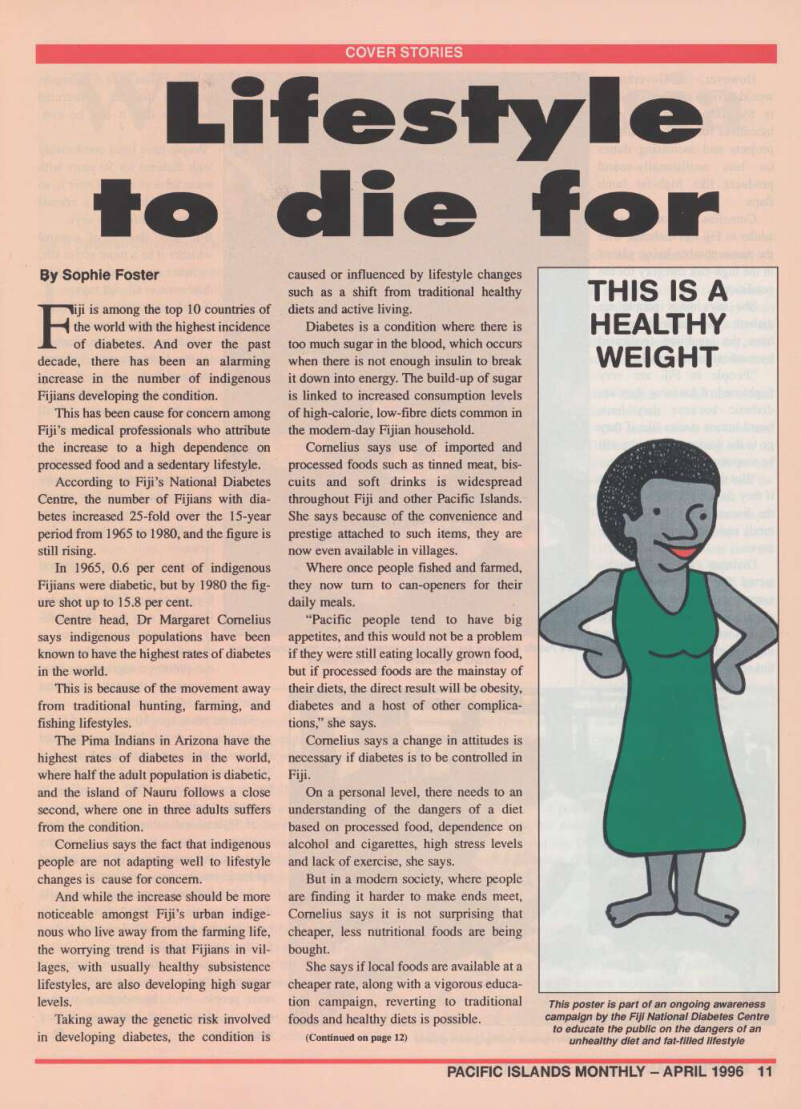
This Is A
Healthy
Weight
This poster is part of an ongoing awareness campaign by the Fiji National Diabetes Centre to educate the public on the dangers of an unhealthy diet and fat-filled lifestyle
However, Government would have to take responsibili ty for such action, providing incentives for local agricultural projects and increasing duties on less nutritionally-sound products like high-fat lamb flaps.
Cornelius says one in eight adults in Fiji has diabetes, with the same number being placed in the high-risk category for the condition.
She says many people are diabetics but are frightened to have the condition confirmed by medical professionals.
“People in Fiji are very frightened of knowing they are diabetic because they have heard horror stories like if they go to the doctor, their limbs will be amputated.
“But they have to realise that if they do not attempt to control the disease they will die prema turely and suffer in the end,” she says.
Diabetes can remain unde tected for years because the symptoms such as passing lots of urine, feeling very thirsty, feeling weak and tired, and los ing weight are not usually linked to a diabetic condition.
But Cornelius says it is impor tant that diabetes is detected early, so that it can be con trolled.
“People have lived comfortably with diabetes for 50 years with some form of control over it, so it is possible to live a normal and healthy life,” she says.
But, any degree of control whether it be a more active life, or better eating habits, is better than none at all, she says.
If the condition is ignored, many complications can occur, including irreversible damage to the heart, nerves, kidneys, legs and eyes.
In Fiji’s Colonial War Memorial Hospital, 80 per cent of all amputations are diabetes-relat ed.
Seven per cent of all visually impaired people in the country are diabetic. One in four people admitted to Suva’s Coronary Unit for heart attacks have dia betes.
Diabetes has also surpassed hypertension as the second biggest cause of kidney failure.
Cornelius says the responsibili ty for controlling diabetes is placed on the individual who can prevent complications from occurring through a better
understanding of the condition.
Sixteen years ago, 10 per cent of Fiji’s population, or about 20,000 people had diabetes. Today, the figure is estimated at 30,000, with a projection for 48,000 dia betics by the year 2000, according to national statistics.
If Fijians and other Pacific islanders continue to live fast and unhealthy lifestyles, the condition will soon exceed epidemic proportions in the region.
And if diabetes is passed on genetically through people in whom it could have been prevented, there will be a terrible cost for the next generation to pay.
It is a tragedy that such a picture of rampant diabetes is envisioned for indige nous people, who, by adopting another culture’s lifestyle and habits, are killing themselves. ■
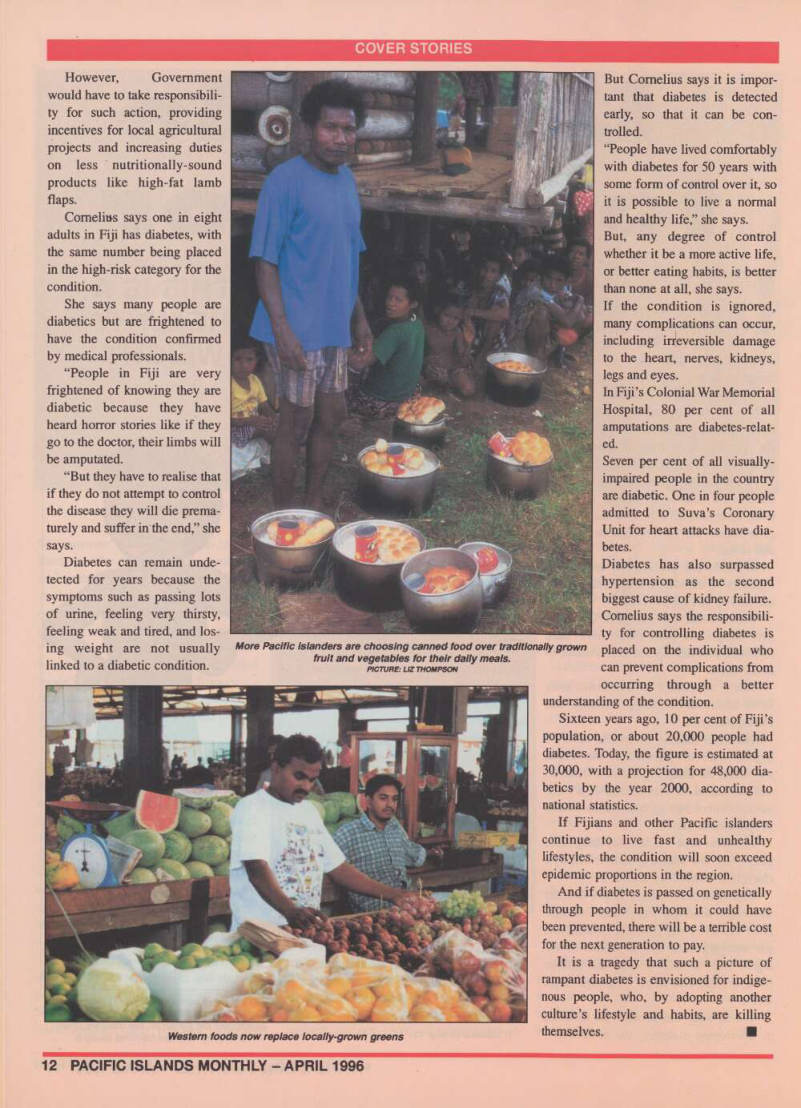
Western foods now replace locally-grown greens
More Pacific islanders are choosing canned food over traditionally grown fruit and vegetables for their daily meals.