A killer
pp. 8-10 · Read in the full issue
Cover Stories
A killer in paradise
By Lili Truwai
Thirtty years ago, diabetes was a rela tively unknown medical condition to tthe islander populations through out the S*outh Pacific. Today, the region rates the hughest diabetes prevalence in the world. Am alarming incidence of diabetes with all its various life-threatening compli cations imcluding blindness and amputa tions, comtinues to inform the medical world of tthe urgent need to develop ways of addresssing the problem. Increased mor tality and morbidity associated with the disease is having devastating social and economic consequences in countries which can ill afford the burden. The World Health Organisation and the International Diabetes Federation describe the statistics of diabetes in the Pacific as “epidemic like in magnitude”. Tonga, New Caledonia, Western Samoa, Papua New Guinea, Kiribati and Fiji are just some of the islands grappling with the disease.
Australia’s two leading centres in the field, the Royal Prince Alfred Hospital Diabetes Centre (RPAH) and the International Diabetes Institute with a funding commitment from Australian Agency for International Development (AUSaid) have combined to devise meth ods to tackle the growing diabetes epidem ic. Working with medical staff from the islands, the joint forces are currently work ing on strategies to cany out primary and secondary intervention measures. Fiji’s assistant director of the ministry of health, Vilikesa Rabukawaqa, was amongst sever
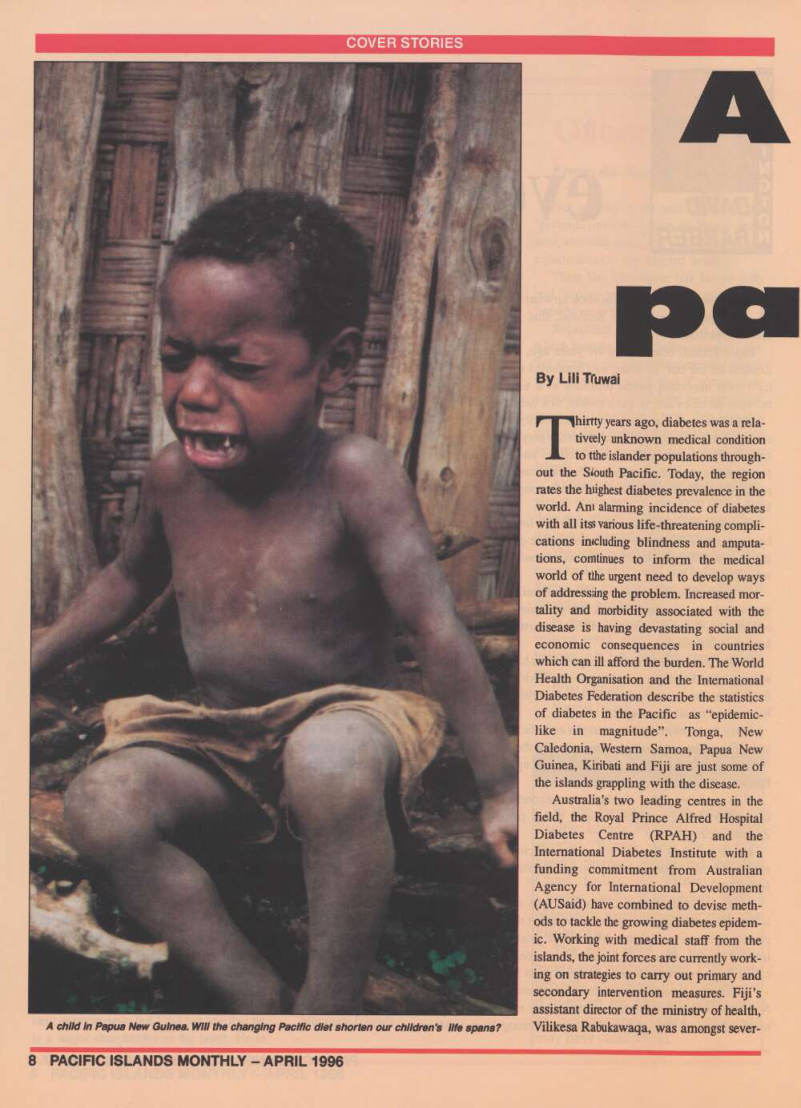
A child In Papua New Guinea. Will the changing Pacific diet shorten our children’s life spans?
al doctors from the Pacific region who met at the RPAH to discuss project develop ments. For almost a decade the Diabetes Centre in Sydney has been working very closely with the diabetes programme in Suva. AUSaid funding will ensure and enable Australia to continue to be support ive through resource provision and collab oration to combat the disease.
“We are at the stage now where the complications or secondary stage of dia betes is very prevalent and taking up a lot of hospital beds which is very expensive.
The situation is self perpetuating. Initially, the population is unaware of the combina tion of early warning signs indicating dia betes - so the diabetic with the foot prob lem or eye problem seeks help very late, usually at the stage where it is difficult to save their eyesight or limb,” says Dr Rabukawaqa.
Currently 10-15 per cent of pregnan cies in the Pacific region are complicated by gestational diabetes. In Fiji alone, over 400 amputations are performed annually for diabetes foot sepsis, at least 50 per cent of which could be prevented by simple education in preventative foot care. The incidence of diabetes amongst the Fijian and Indian population is almost identical but the incidence of Fijians suffering com plications and having limbs removed or becoming blind is about 10 times higher than within the Indian population.
There are a number of important fac tors that contribute to indigenous Fijians experiencing greater complications with the disease. Many Fijians still seek advice
from their traditional healers whose mas sage techniques and natural remedies are often not effective with diabetes. There is a prevailing feeling of mistrust toward the medical profession because of the number of foot amputations which have been per formed over the last 10 years.
“We have found that the population with diabetes has developed the mentality that if you go to the hospital with a foot problem they will take your foot off. It’s got to the stage where this has become a vicious cycle, so we are trying to go in again with secondary intervention and say - these are the signs and if you don’t seek early treatment you might end up with an amputation,” said Dr Rabukawaqa.
As the Pacific increasingly becomes part of the global environment through trade, tourism and economic development, traditional diets and lifestyles are being replaced by westernised food and dietary patterns and less exercise. The traditional hunter-gatherer existence is no longer pos sible for the majority of the population who live in urban centres. The change is a major factor to the development of non insulin dependent diabetes (NIDDM) becoming a major health problem for Fiji and its neighbours.
Traditional foods contain the nutrition al values necessary for the well being of the island populations, while the Western and imported foods being consumed hold less nutrition but are more affordable and readily available. There is also a certain social kudos associated with purchasing westernised foods. “You are supposed to
be ‘someone’ if you are seen to buy these foods or offer them to families and friends during their visits to your home. Families in the islands will offer you tinned fish,
corned beef and rice, rather than the plentiful fresh fish or local greens.
People generally look down on local foods as being inferior to imported foods”, explains George Borugu, a Household Food Security Officer for the South Pacific Commission based in New Caledonia.
Lack of trained medical personnel poses another difficulty for Pacific Island nations. While there is a con scious move by governments to encour age young people to engage in medical studies, too often students leave their islands to attend universities in New Zealand, Australia and the USA and do not return home to practice. Enticed by the West’s higher economic and materi al gains a “brain drain” continues to hin der South Pacific progress.
The islands have long suffered from a
shortage of doctors, nurses and technical personnel. Currently in Fiji an estimated 50 retired doctors have been re-employed while approximately 100 non indigenous
health professionals spread throughout the Fiji Islands make up the bulk of the medical staff, and still medical positions remain vacant. Constant rotation of shifts
and locations in an attempt to balance the shortage often means that staff do not get the opportunity to specialise. As well, patients are not given an opportunity to
build familiar and trusting relationships with medical staff which could ultimately work to allay much of the public suspicion regarding modem medicine.
Interviewed in Sydney for this article, Dr Rabukawaqa identified the priorities that Fiji’s Non-communicable Disease Taskforce intend to focus on in their work on Primary Prevention. The strate gy is to tackle the epidemic as three major issues - diet and nutrition, exer cise, and tobacco. Fiji, as with many of the Pacific Islands, has no tobacco legis lation or restrictions. Aggressive market ing of tobacco by western tobacco com panies into these island nations is increasing the number of tobacco users.
“We hope to have tobacco legislation which will bring about reduction in advertising and some sort of ban on chil dren under the age of 18 being able to buy cigarettes. We need to create an awareness that tobacco is bad. Studies have shown that tobacco causes vascular problems and diabetes causes vascular
restrictions - so if people are diabetic and they smoke, the chances of vascular restriction or stroke are going to be that much higher”. ■
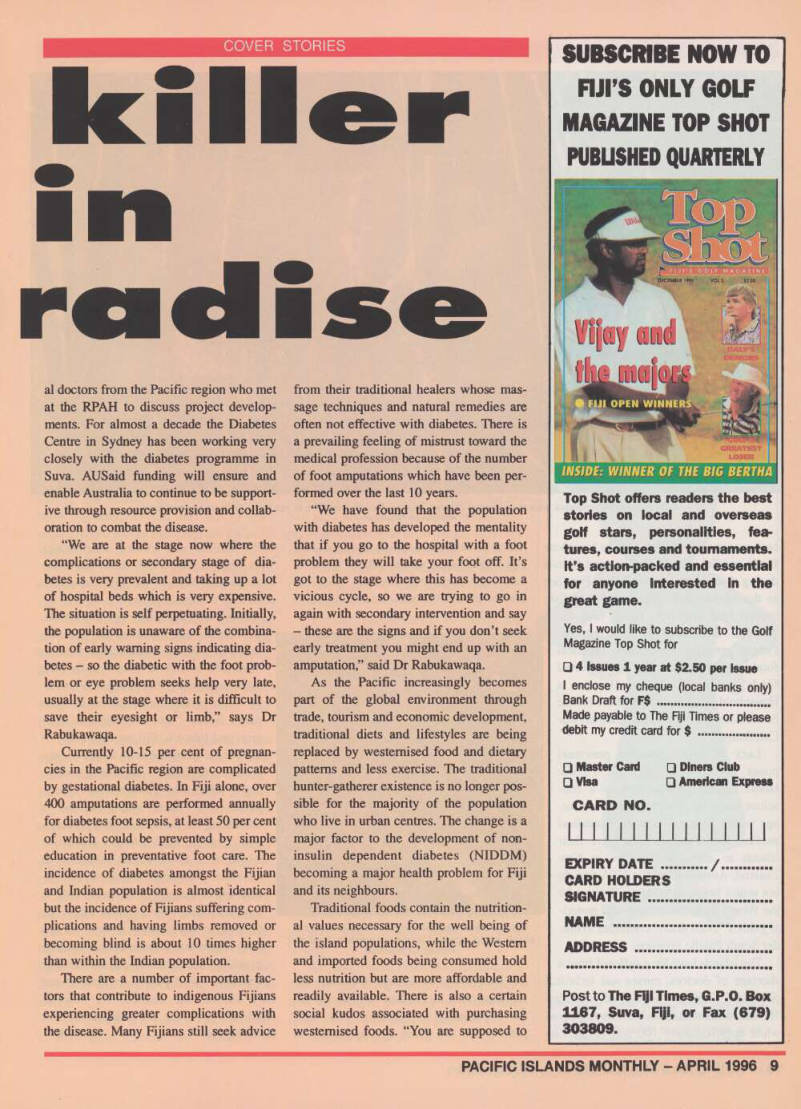
A decreasing dependence on a subsistence lifestyle has led Pacific islanders to eat more high-fat canned food.
Picture: Uz Thompson
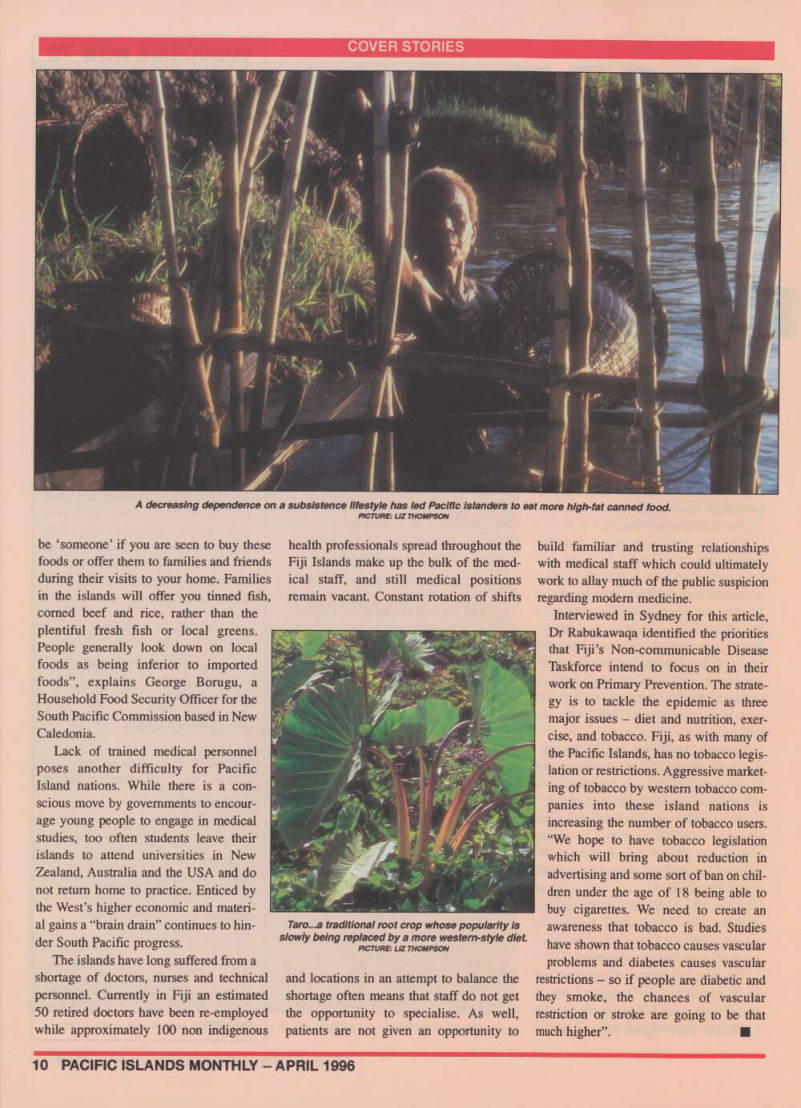
Taro...a traditional root crop whose popularity is slowly being replaced by a more western-style diet.