Australia makes
pp. 34-36 · Read in the full issue

Advertising Feature
Australia makes its mark
Big is not always beautiful. Small Australian businesses are increas ingly joining their large counter parts in translating good domestic perfor mances into offshore market strategies.
These businesses’ primary offshore desti nation continues to be the South Pacific.
First-time visitors are struck by the high visibility of Australian institutions, products and services throughout the region. Australian household names - Westpac, ANZ, QBE Insurance, Amotts, Golden Circle, Edgell, BHP and Foster’s are all there, most often as market leaders.
In several countries, Australian televi sion channels are accessible and in some cases the Australian dollar is the national currency. In New Caledonia, the local peo ple play a unique version of cricket proba bly introduced by early Queensland cattle men; in Nauru, they play Australian Rules while everywhere else, Rugby Union has become a passion.
Australia is usually the main influence and source of supply, and its quality stan dards are frequently adopted as bench marks by neighbouring countries.
Australian banking, insurance, accounting,
legal and other service providers are throughout the region, providing valuable support and facilities to new and estab lished exporters alike.
Despite the come-hither attractions of the present glamour markets like China and South East Asia, the South Pacific remains a big export market for Australia.
It is the world’s largest consumer of elab orately transformed manufactures (ETMs) and 25 per cent of Australia’s global ETM exports go to the region.
ETMs now constitute 60 per cent of Australia’s total exports to the South Pacific while market shares in the region in 1994-95 were larger than elsewhere - 22 per cent in New Zealand (where market share is rising slightly); 50 per cent in
Papua New Guinea (where market share is being maintained); 12 per cent in New
Caledonia (despite unrestricted duty-free
entry for European exports) and 30 per cent in the non-French Pacific Islands.
But the big figures do not obscure the fact that this is not the territory for multi million dollar opportunities. They are rare on the ground except, perhaps, in New Zealand and through the infrequent com mitment of a major mining project in PNG or New Caledonia. Regional infrastructure
projects generally require aid or conces
sional funding packages.
Australia’s comfortable position in the region is based on the long-term, solid per formances of small operators and, in gen eral, the importers of the South Pacific are happy to keep it that way.
Australia’s merchandise exports to the South Pacific in 1994 were valued at $6.2 billion, the main individual markets being
New Zealand ($4.4 billion), Papua New Guinea ($968 million), Fiji ($351 million) and New Caledonia ($l5O million). Australian exports to the rest of the South Pacific, to places such as Tahiti, Vanuatu and Tonga, amounted to a further $3OO million.
Reflecting the key importance of the four primary markets, Austrade’s South Pacific offices are situated in Auckland, Port Moresby, Suva and Noumea. In Suva, assisted by its Noumea office and Australia’s diplomatic staff in other Pacific missions, staff are also helping exporters with information, local briefing, contacts and appointments in small island markets.
The chief Australian focus in the South Pacific is on manufac tured exports, with the lion’s share going to NZ ($3.1 billion in 1994),
eclipsing the US and Singapore as cus tomers.
New Zealand is the export market where most Australian manufacture exporters get started and where they con tinue to prosper after striking further afield.
PNG is also an important ETMs market for Australia ($409 million last year) and ETMs sales to Fiji reached $lB6 million, placing that country ahead of South Africa, France, Canada and India in the top 20 of Australia’s ETM customers.
Even New Caledonia, where French and other European Union exporters have duty-free access, is a growing outlet for Australian manufacturers. Australian prod ucts already established in these affluent Franco-Melanesian markets include min ing equipment, various household appli ances, car parts, motor mowers, garden sheds, casual and beach apparel, pleasure
boats, solar water heaters, house-building systems, above-ground pools - even bar becues and the charcoal to fuel them.
Additionally, the region is a good mar ket for processed food and beverages, which constitute a large part of the $7OO million of rural products Australia export ed to the South Pacific last year. The main
competition food exporters usually
encounter is from their NZ counterparts, who service customers assiduously and are
generally price-competitive despite the
recent appreciation of the NZ dollar.
In 1993-94 Australian services exports to the world were valued at $18.3 billion.
A breakdown by individual countries is not yet available, but in the preceding year the main markets were Japan ($3.2 billion), the US ($2.1 billion), and Britain ($1.7 bil lion). Service exports to the South Pacific region were valued at $1.7 million, or around one-tenth of Australia’s global ser-
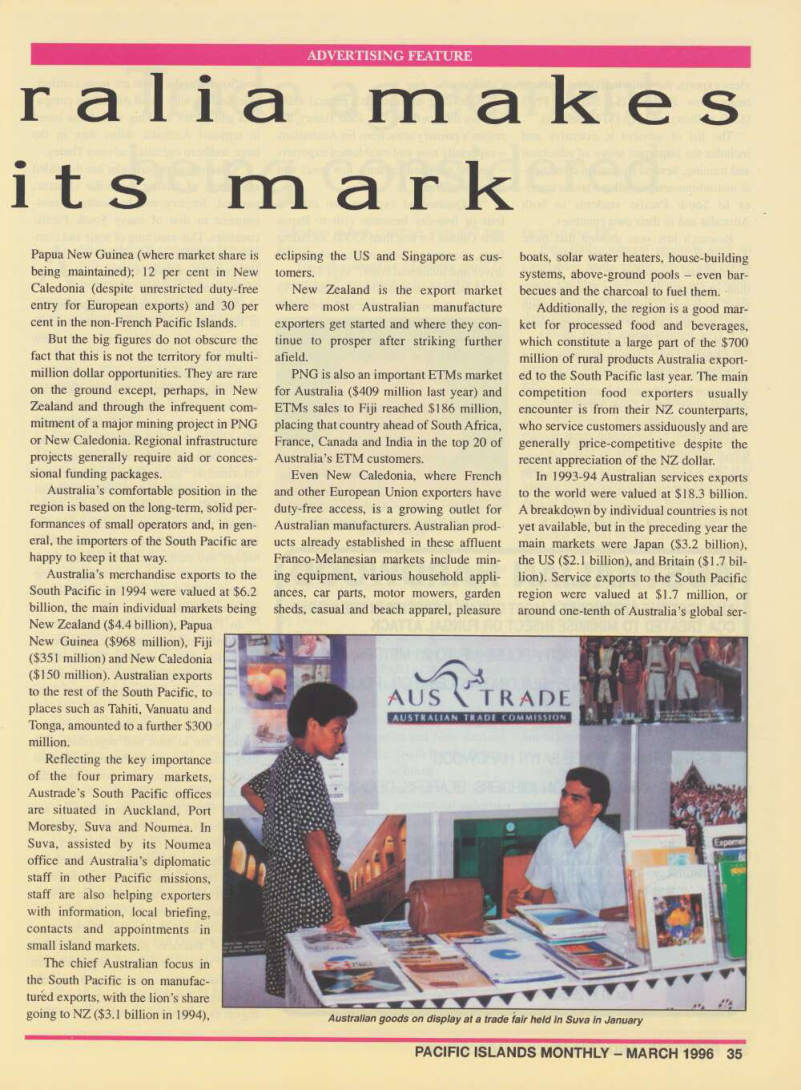
Australian goods on display at a trade fair held in Suva in January
vices exports, the main individual markets being New Zealand ($1 billion), PNG ($303 million), and Fiji ($145 million).
The list of services is extensive and includes the important sector of education and training. Several Australian education al institutions are providing various cours es to South Pacific students in both Australia and in their own countries.
Research last year showed that more Australian services exporters begin their international marketing in New Zealand than anywhere else - just like manufac tures exporters. Having cut their teeth there, they then expand into the larger mar kets of the main OECD economies.
Added to the merchandise exports of $6.2 billion, Australia’s services exports to the region bring the total Australian export market to $8 billion with ETMs and ser
vices predominating.
Australia is an important supplier to the South Pacific. Its share of total imports into the region varies from more than 50 per cent in PNG to about 35 per cent in Fiji and neighbouring islands, 22 per cent in New Zealand and 12 per cent in New
Caledonia.
According to Austrade’s general man ager for the South Pacific, John Tinney, the region’s primary attractions for Australians - especially new and established exporters - can be summed up thus: low costs and user-friendliness.
“A Queensland exporter can make a four or five-day business visit to Papua New Guinea for less than $3OOO, including fares, accommodation, meals, hire car and driver and incidental costs,” says Tinney.
“A business trip to New Zealand or Fiji would cost about the same and somewhat more for New Caledonia, where costs are higher. But these costs pale into insignifi cance when you line them up against a week in Japan or the American west coast.”
Tinney says language and business practices are familiar (it helps to have some French in New Caledonia, but many exporters succeed there without it) and transport and communication links are generally easy and efficient. Time zones are similar to eastern Australia and PNG is on the same time as Queensland.
“South Pacific firms are more comfort able dealing with small Australian compa nies and prefer working with firms based in regional Australia rather than in the large southern capitals,” advises Tinney.
“Queensland in particular has the added advantage of having a similar climatic, pastoral, forestry and horticultural envi ronment to that of many South Pacific countries. This matching of scale and com mon experience can facilitate small-scale joint ventures as well as the simple export of goods and services.”
Austrade says the present opportunities in the main South Pacific markets are in New Zealand, PNG, Fiji and New Caledonia.
In New Zealand, the areas most attrac tive to exporters are wastewater processing technology and equipment, agricultural
equipment, fishing boats, ferries, pleasure
boats apparel and fashion-lifestyle prod ucts, processed foods, railway equipment, information technology, software and medical, scientific and hospital equipment. , In PNG, potential areas for investiga tion are road projects, education and train ing services, health services, mining tech nology and equipment, building materials and equipment, food and beverages, infor mation technology, software, boats and telecommunications.
In Fiji, exporters should look at the fields of consumer products, engineering products, automotive items, food and bev erages, building materials, construction, education and training services and telecommunications.
In New Caledonia, the most attractive markets are in fruit and vegetables, gro cery lines, agriculture horticulture, live stock, construction, meat, boats, and min ing systems and equipment.
The South Pacific is user-friendly, and cost-effective for all exporters, particularly for potential and new exporters. Yet, sur prisingly, companies tend to overlook this market on their doorstep and opt for more difficult markets further afield in a bid to boost their business, says.
“Australia ,is the leading economy and favoured business partner in the South Pacific region and it is important that Australian exporters comprehend this, take advantage of it and develop trade with the region even further,” he says. ■