a nation
pp. 32-33 · Read in the full issue
Rebirth of a nation
Nauru’s newest president sets himself a daunting task
By Jemima Garrett
Nauru’s new president Lagumot
Harris has set himself a task which he describes as no less than the “rebirth” of his nation - the greening of Nauru’s mined-out phosphate lands.
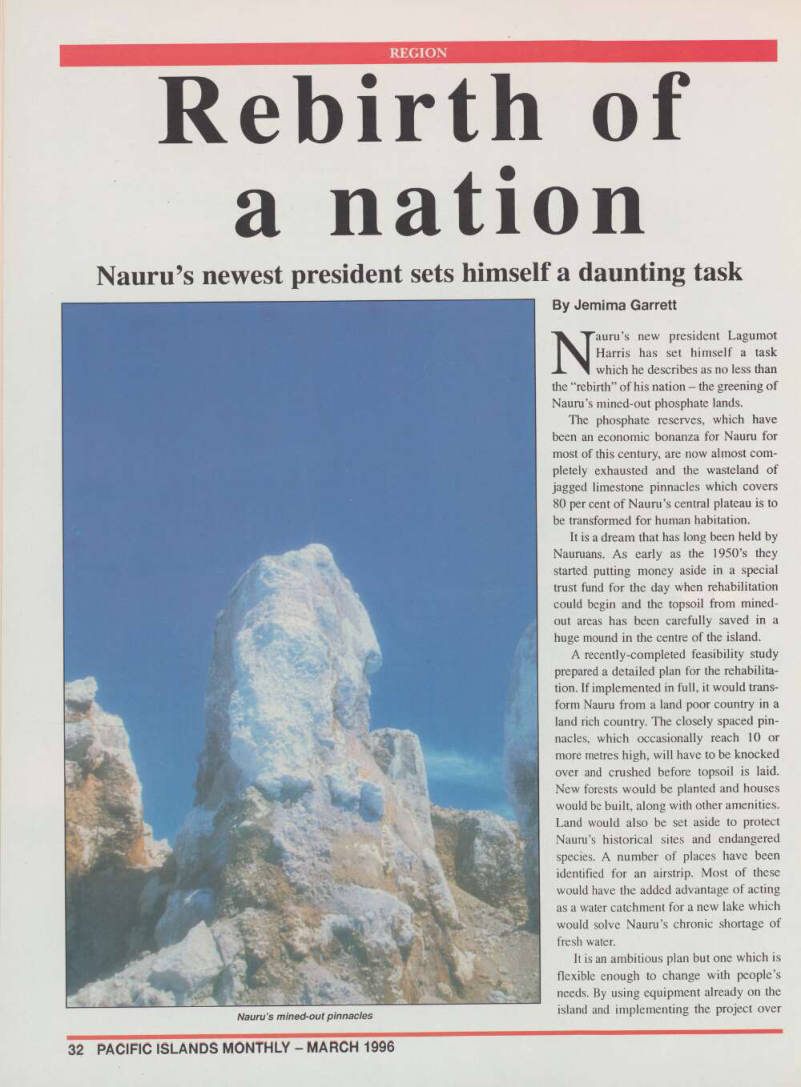
The phosphate reserves, which have been an economic bonanza for Nauru for most of this century, are now almost com pletely exhausted and the wasteland of jagged limestone pinnacles which covers 80 per cent of Nauru’s central plateau is to be transformed for human habitation.
It is a dream that has long been held by Nauruans. As early as the 1950’s they started putting money aside in a special trust fund for the day when rehabilitation could begin and the topsoil from mined out areas has been carefully saved in a huge mound in the centre of the island.
A recently-completed feasibility study
prepared a detailed plan for the rehabilita tion. If implemented in full, it would trans form Nauru from a land poor country in a land rich country. The closely spaced pin nacles, which occasionally reach 10 or more metres high, will have to be knocked over and crushed before topsoil is laid.
New forests would be planted and houses would be built, along with other amenities.
Land would also be set aside to protect Nauru’s historical sites and endangered species. A number of places have been identified for an airstrip. Most of these would have the added advantage of acting as a water catchment for a new lake which would solve Nauru’s chronic shortage of fresh water.
It is an ambitious plan but one which is flexible enough to change with people’s needs. By using equipment already on the island and implementing the project over
Nauru’s mined-out pinnacles
23 years the cost could be brought down to SA23O million, excluding housing which will have to be paid for by individuals rather than the government.
President Harris probably knows more about the possibilities for rehabilitation than anyone on the island. He is a civil
engineer and, before taking his country’s
top job last November, was Nauru’s chief advisor on the feasibility study.
“I believe we should be looking at it as a vision for the future and while we have not yet put everything on the table for our people a lot of our people are talking about rehabilitation and what this will mean for the future of our children and the future of Nauru,” the President told PIM.
For the president the first priority once the rehabilitation gets underway is hous ing. Most people live on the narrow coastal strip which at its widest point is just 400 metres from the beach to the cliffs that mark the beginning of the mined-out plateau. In some cases 20 or more people are sharing a single house and around 400 houses are needed immediately if the housing shortage is to be dealt with.
Before any work is done on “Topside”,
president Harris plans a wide-ranging pub
lic discussion of the proposals which he describes as a “Nauru theme”. The “Nauru theme” is intended to ensure landowners ideas are included and that the plan, much of which has thus far been drawn up by Australian consultants, becomes uniquely Nauruan.
As would be expected with any big pro ject, there are some difficult issues which must be resolved before the first pinnacle can be knocked over. One is the question of land. Most of the land on Topside is divided into small parcels each of which is owned by a single landowner. Before any rehabilitation can occur the landowners must agree to the plan.
With some land marked out for leafy housing sites and others for sewage works or industrial areas president Harris does not under-estimate the difficulty in win
ning their approval. Various proposals
have been put forward to ensure all get returns from their land. President Harris is optimistic that, with his insistence that a solution comes from the people and the obvious fact that the land is useless in its current form, the project will go ahead.
The other stumbling block is money.
With mining winding down Nauru’s phos
phate revenues have dropped sharply. In
the past few years it has lost millions of dollars from share deals on the Tokyo stock market and more still to internation al conmen. The island’s foreign debt stands at SA2OO million and its cash flow problems have forced the bank of Nauru to place a cap on the amount of cash deposi tors can withdraw.
The new government is confident that with serious belt tightening, some asset sales and the help of international account ing firm Price Waterhouse, it will be able to come up with a debt servicing plan and put Nauru’s economy back on a sustain
able path.
Other measures, some of which were started by the Dowiyogo government, are already starting to show results. The cor poratisation of Air Nauru in particular, has stemmed a big drain on the budget. Under the guidance of Peter Roberts, who helped Vanuatu turn its airline into a profit-mak ing venture, Air Nauru is now doing more with one plane than it was before with two, and hopes to show a profit within three years.
Even so, the solution to Nauru’s money troubles will not be easy. President Harris has used his public addresses since taking office to warn his people that they will have to make sacrifices and on January 31
appealed to Nauruans to look at the exam ple of strength and fortitude shown by Nauruans who lived through the starvation and forced labour imposed on them by the Japanese during their two and-a-half years of exile during World War 11.
Lagumot Harris was a small boy of seven when the war ended. His Works and Community Services Minister, Roy Degoregore, who was a young man during the war, endured the sustained allied bombing of Nauru and many beatings
from the Japanese. Degoregore’s experi
ences have made him keen to see young Nauruans learn from those hard times. If the rehabilitation goes ahead it will pose many challenges as well as open many new training opportunities for young Nauruans.
More immediately, president Harris is considering a range of possibilities to deal with his country’s unfamiliar economic circumstances, including reforms to the
public sector, deregulation, privatisation,
increased productivity and the establish ment of a fishing industry and small-scale agriculture.
In his New Year’s address to the nation president Harris nominated rehabilitation of the mined out lands as “foremost on this government’s agenda” and predicted that it would become “the focal point of Nauru’s economic activity in years to come”. ■
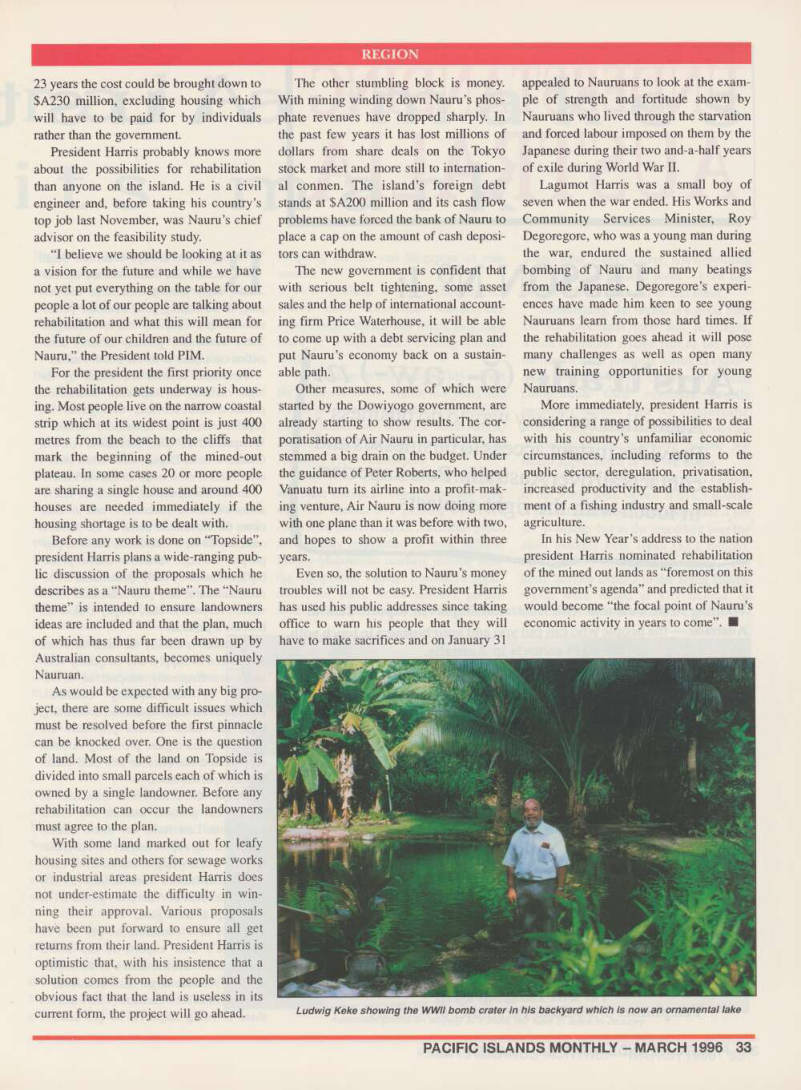
Ludwig Keke showing the WWII bomb crater in his backyard which is now an ornamental lake