Stepping into
pp. 28-29 · Read in the full issue
the boy’s club
By Sophie Foster
ideal community where individuals are accepted as they are, where human barriers are continuously being broken down, where there is love, forgiveness, reconcili ation, then where else can such a commu nity exist?”Lomaloma says.
She says the church is the best avenue for providing a model of an ideal society where being a woman does not disqualify one from their “calling”.
The Dean of the Holy Trinity Anglican Cathedral in Suva, Father Winston Halapua, who was instrumental in moves to ordain Pacific women, is adamant about equality in the church.
“There is no other way for the church except to love God and love your neigh-
Priesthood has been a male domain for longer than religion has been in the Pacific.
But in keeping with the tides of change, the Anglican Church in the Pacific took a dynamic step over the Christmas period when it ordained its first indigenous
woman priest.
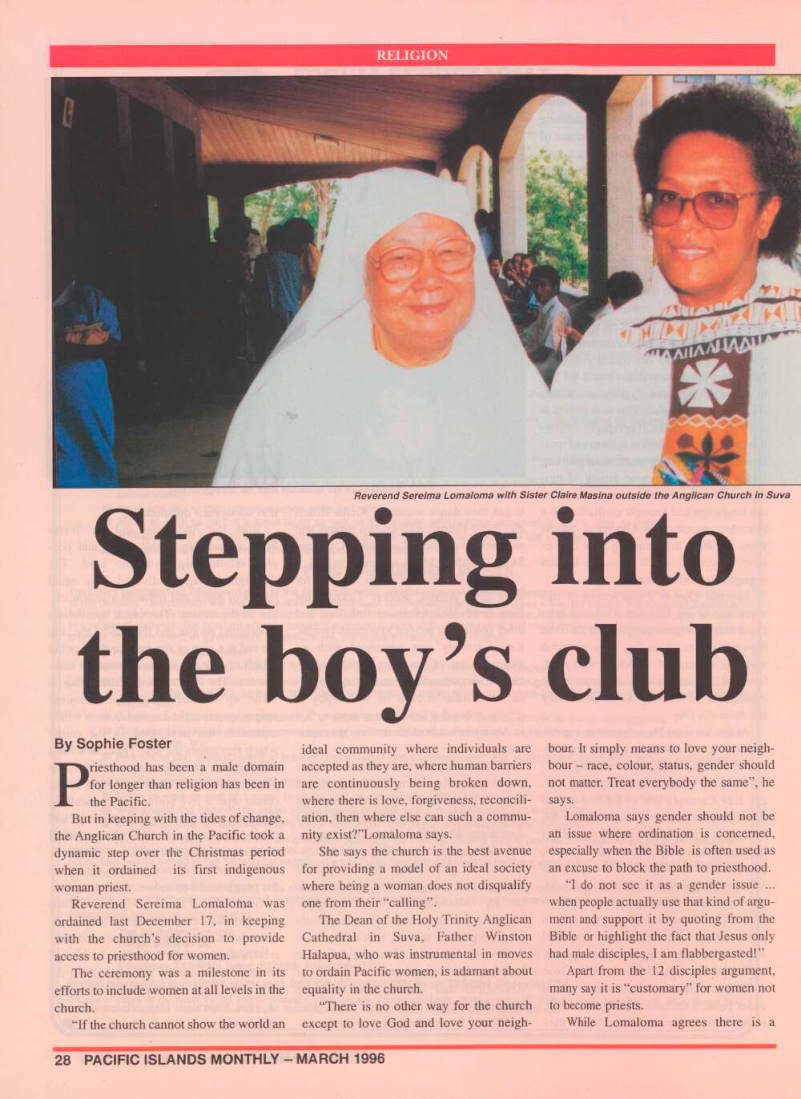
Reverend Sereima Lomalofna was ordained last December 17, in keeping with the church’s decision to provide access to priesthood for women.
The ceremony was a milestone in its efforts to include women at all levels in the church.
“If the church cannot show the world an
hour. It simply means to love your neigh bour - race, colour, status, gender should not matter. Treat everybody the same”, he says.
Lomaloma says gender should not be an issue where ordination is concerned, especially when the Bible is often used as an excuse to block the path to priesthood.
“I do not see it as a gender issue ... when people actually use that kind of argu ment and support it by quoting from the Bible or highlight the fact that Jesus only had male disciples, I am flabbergasted!”
Apart from the 12 disciples argument, many say it is “customary” for women not to become priests.
While Lomaloma agrees there is a
Reverend Sereima Lomaloma with Sister Claire Masina outside the Anglican Church in Suva
“heavy predominance” of males in the ministry, she insists it is not just a male domain.
“But I also recognise that there are some people who have reservations or who do not support women’s ordination.”
Indeed more than a decade ago, such free expression of female equality in the church would have been unheard of.
The drive towards including women at all levels in the Anglican Church resulted from a recognition of the importance of women’s roles and changing attitudes of the clergy and community.
But it was not until 15 years ago that the church accepted that women could fol low “God’s calling”.
It was then the Diocese of Polynesia, which includes Fiji, Tonga and Samoa, made the decision to allow women to be ordained.
Halapua, who was a part of that monu mental debate, says a lot of the criticism of women’s ordination stems from a power
struggle.
“It has to do with power and domi nance. Some people think that by being a man they have extra power.
“The church needs to open up and dis mantle boundaries that have (been) built over the years because of historical beliefs
of other countries.”
According to the Centre for Women’s Global Leadership, there is no value in protecting parts of culture and religion that serve to keep women in subordinate posi tions.
Women have a right to help change those parts of religion or culture that are in direct conflict with their human rights, the Centre says.
“Women...should be able to challenge regressive practices within their own tradi tions as well as protest human rights abus es without feeling that they are denying their entire culture or religion,” it says.
Halapua agrees saying cultural prac tices that discriminate against a certain part of the population should be removed.
“Biblically, God made us to be partners, as in culture. And if there are cultural val ues that are irrelevant, they should be destroyed. We shouldn’t harp on cultures that reduce another human being,” he said.
“That is the problem with the church today. They highlight bits that serve their own interests.”
The use of cultural practices to prevent women from exercising their rights as individuals is universal, but Lomaloma says it is a pity it has permeated into reli
gion.
“There are indeed cultural barriers that exist that prevent women from exercising their ministries. And this is the greatest tragedy of all.”
Since the introduction of female ordi nation, only three women, including Lomaloma, have progressed towards becoming part of the clergy of the Anglican Church.
Part of the problem, Lomaloma says, is women are not aware of their right to join the priesthood of the Anglican Church.
“At one of the meetings I attended, one of the women there said she did not know that the ordination of women had been
approved.
“She also said that if she had known then perhaps other women may have come forward earlier.”
The lack of a support network for women wanting to be ordained, says Halapua, can be attributed to the priorities
of priests in charge of parishes.
“There are a lot of things going on in the church here (in the Anglican Church)
and outside and some of them depend very much on the leadership of the priest-in charge because what they like seems to be put forward and encouraged. There are some things like women’s ordination which perhaps are not their priorities.”
Priests play a major role, says Lomaloma, in encouraging and supporting women who feel they have a calling.
“Unfortunately in some parishes, the clergy themselves will need to be emanci pated”, she says.
Halapua admits the Anglican Church is divided on the issue of female ordination, purely because different branches of the church make their own decisions.
He says the church in Melanesia does not condone female ordination.
Although Fiji could be considered Melanesian, its progressive views are a result of its inclusion in the Diocese of Polynesia, whose missionaries came from Australia.
But by far history’s biggest opponent to female ordination has been the Catholic Church.
Indeed, when the question of ordination first arose in the Anglican Communion in 1975, Pope Paul VI reminded the Archbishop of Canterbury of the Catholic Church’s firm stance against females entering the priesthood.
The church’s reasons include the exam ple that Jesus chose his 12 apostles from amongst men and its teaching that the exclusion of women from the priesthood is in accordance with “God’s plan”.
But Halapua says the ideology against the ordination of women overlooks the real issue of the Christian ministry as being God’s calling.
“If women coming in enriches the min istry, a ministry that belongs to somebody else - it belongs to God - we have to acknowledge it in the church.
“It’s like a house where you open the windows and suddenly you see the light come inside and you feel warm. And you think why haven’t we opened the windows in all those years.”
Perhaps the best way forward Halapua says, would be to lead by example and -pray for change.
But for now, Lomaloma is providing a much-needed role model for other Pacific Island women wanting to be ordained.B