Survival day
pp. 25-27 · Read in the full issue

Culture
By Liz Thompson
and Non-Aboriginal Australians queue for tickets to Survival Day.
On Survival Day, Aboriginal people celebrate the fact their community has sur vived white invasion, assimilation policies and attempts at cultural genocide. In com ing into contact with the white community the Aboriginal people were subject to dis eases they brought with them.
As their land was taken from them and they were moved into reservations and dealt with a multitude of new influences and ensuing problems, they required legal advice and assistance but had access to none. When the misguided assimilation policy came into play and children with
any white blood bom to Aboriginal women were immediately removed and placed in care, later to be fostered out to white fam ilies, there was little recourse for
Aboriginal families.
Today, though many inequalities
remain, things are changing. It is widely agreed that the assimilation policy was an abomination of human rights. The Aboriginal community has established it’s own legal advisory service. Concerned that as children attend school and no longer learn from their elders Aboriginal publishing companies are taping, tram scribing and publishing traditional stories from old people.
As a result, when young children go to school and leam to read and write they can continue to leam of the stories of their ancestors.
One of the loudest voices of the Aboriginal community has been heard through the arts. In the last decade
Aboriginal playwrights, actors, poets,
writers, musicians, painters and fdmakers have addressed their experience and their history through their art. My Place, a book
written by Aboriginal writer Sally Morgan
documenting her harrowing experience of
trying to discover her own identity was extremely successful and for the first time, brought the experience of many Aboriginal
On January 26, when many Australians celebrate Australia Day marking the beginning of white colonisation of the country, Aboriginal Australia celebrates Survival Day.
In Sydney army tanks roll, trucks, ambulances, all in the familiar khaki green of battle. People driving the open jeeps wear helmets and the Australian flags fly.
A 20-minute drive away at La Perouse, a headland on the Southern side of Sydney the now familiar black, red and yellow Aboriginal flag is raised above the rooftops. A mixed audience of Aboriginal
Blekbala mujik
people to the mainstream Australian
public. Glenyse Wards book Wandering
Girl’ provided an equally tragic account of being removed from her parents as a very young child and working as a house maid for rich and often obnoxious white employees. The stories, recounted in songs, in plays, books, films and paintings are emotionally harrowing ones which have finally forced many of the Australian public to face the less appealing and often hidden side of their own history.
This process of rewriting Australian history through art has been responsible for a significant change in attitudes of both
non-Aboriginal and Aboriginal Australia.
Non-Aboriginal Australians could not fail to acknowledge the history on which Australia was founded. This new picture is a far cry from historical perspective domi nant within the education system and rein
forced by much early Australian painting
which described a heroic arrival of pio neers and explorers who conquered a bar ren landscape and brought civilisation to a primitive people. For Aboriginal people there has been a continuing flow of cre ative expression which continues to gain strength and momentum.
Survival Day is a celebration of this voice and of the fact that it’s sound con firms that Aboriginal people have survived the atrocities to which they were subjected with the coming of whites to their land.
Survival Day marks what is known in the Aboriginal community as Invasion Day not Australia Day.
At the Survival Day concert an impres sive line-up of Aboriginal bands and per formers fill the stage on a sweltering after noon. Many of the songs lyrics are politi cal. Kev Carmody one of the best-known Aboriginal singers and songwriters in the country is a poet with a guitar. One of his most poignant songs, Thou shall not steal’, plays on the message of white Christian morality and the fact that Aboriginals land, children and lifestyle were stolen from them. The Bangarra Dance Company’s
performance included a powerful
sequence in which four male dancers, con cealed behind twisted tree branches, rose up in time to the music and slowly spread white paint, a traditional body decoration, across their bodies and faces before they
began their dance sequence. Archie Roach and Ruby Hunter, well-known singers and songwriters performed as well as Coloured Stone, Blekbala Mujik and many others.
During the afternoon, the minister for Aboriginal Affairs, Robert Tickner, the New South Wales Premier Bob Carr and other politicians arrived to present awards.
Kev Carmody was presented with an award as one of the most popular musi cians. Later when he came on stage to per form, he made it clear he was happy to receive it but that it was for everyone, that in Aboriginal culture there were no super stars.
Around the main theatre area were numerous stalls selling T-shirts designed
by Aboriginal people or advertising and
promoting various organisations. Central Australian Aboriginal Media Association, CAAMA, were there, selling recorded cas settes of performers who appeared throughout the day. CAAMA is responsi ble for recording numerous Aboriginal
singers and songwriters and is constantly
producing new talent. ‘Black Women’s Action in Education Foundation’ were handing out newsletters, ATSIC or Aboriginal and Torres Strait Islander Commission were giving out Aboriginal and Torres Strait Island flags and informa
tion about their organisation.
Both the Aboriginal and the Torres Strait Island flag reflect Aboriginal peo ples relationship with the land. The
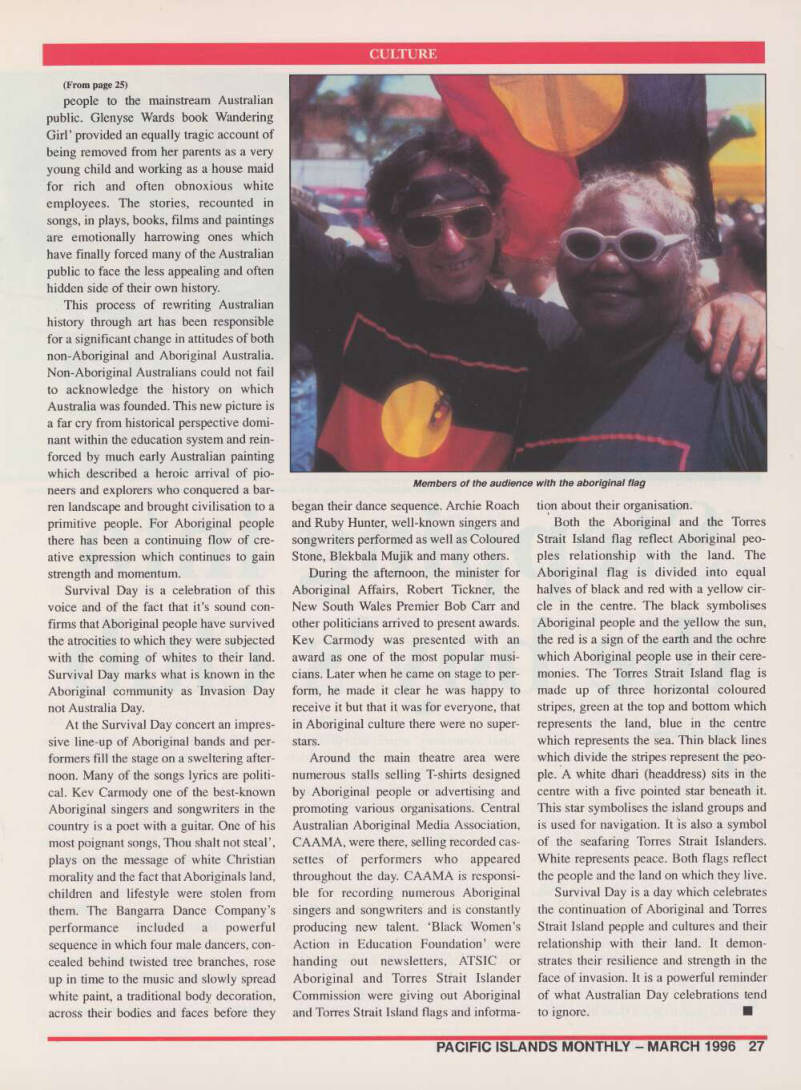
Aboriginal flag is divided into equal
halves of black and red with a yellow cir cle in the centre. The black symbolises Aboriginal people and the yellow the sun, the red is a sign of the earth and the ochre which Aboriginal people use in their cere monies. The Torres Strait Island flag is made up of three horizontal coloured stripes, green at the top and bottom which represents the land, blue in the centre which represents the sea. Thin black lines which divide the stripes represent the peo ple. A white dhari (headdress) sits in the centre with a five pointed star beneath it.
This star symbolises the island groups and is used for navigation. It is also a symbol of the seafaring Torres Strait Islanders.
White represents peace. Both flags reflect the people and the land on which they live.
Survival Day is a day which celebrates the continuation of Aboriginal and Torres Strait Island pepple and cultures and their relationship with their land. It demon strates their resilience and strength in the face of invasion. It is a powerful reminder of what Australian Day celebrations tend to ignore. ■
Members of the audience with the aboriginal flag