being considered
pp. 37-39 · Read in the full issue
Trade agreement being considered
A bilateral trade agreement between Fiji and Australia, which could supersede SPARTECA, will not eradicate the need for Fiji businesses to
improve their international competitive
ness.
According to Australian officials, Australia’s open economic policy means countries like Fiji will have to develop a more competitive edge to survive in the international market.
The Australian Foreign Affairs and Trade magazine. Insight, said Fiji’s reliance on preferential trading could not last long with the continuous erosion of
SPARTECA’s margin of preference
through Australia’s drive to open its econ omy.
A bilateral trade agreement had been the objective of the Fiji Government and some industry sectors for some time.
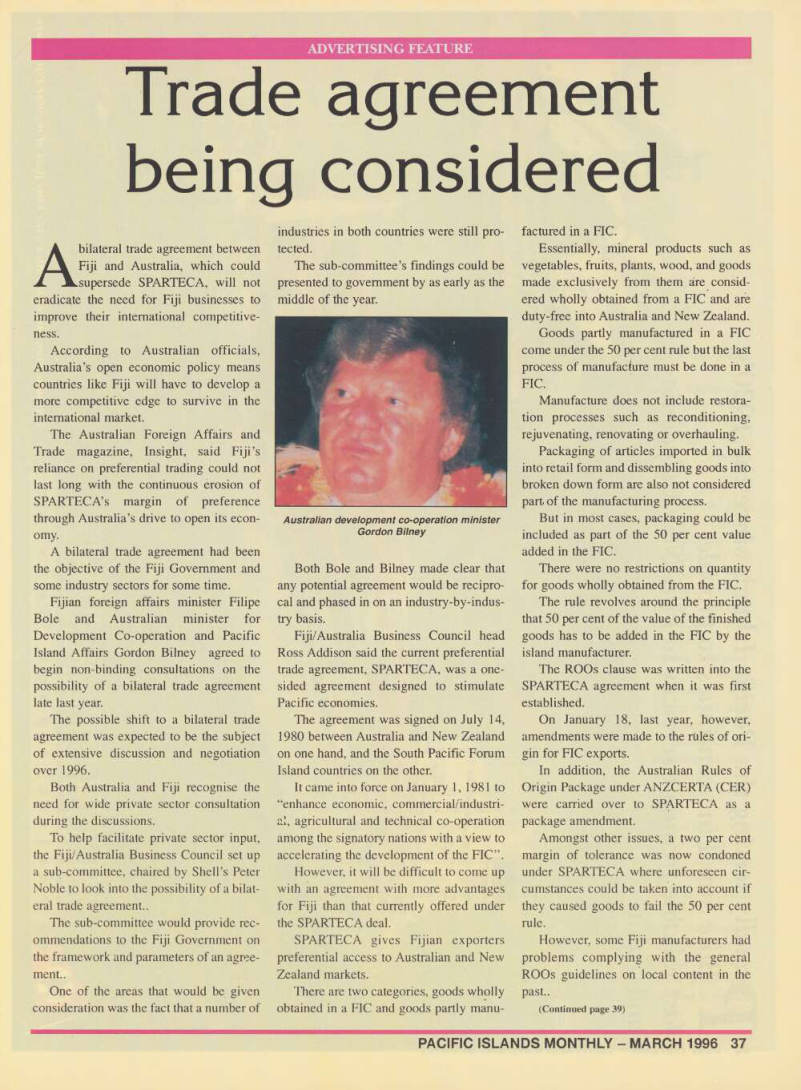
Fijian foreign affairs minister Filipe Bole and Australian minister for
Development Co-operation and Pacific
Island Affairs Gordon Bilney agreed to begin non-binding consultations on the possibility of a bilateral trade agreement late last year.
The possible shift to a bilateral trade agreement was expected to be the subject of extensive discussion and negotiation over 1996.
Both Australia and Fiji recognise the need for wide private sector consultation during the discussions.
To help facilitate private sector input,
the Fiji/Australia Business Council set up a sub-committee, chaired by Shell’s Peter Noble to look into the possibility of a bilat eral trade agreement..
The sub-committee would provide rec ommendations to the Fiji Government on the framework and parameters of an agree ment..
One of the areas that would be given consideration was the fact that a number of
industries in both countries were still pro tected.
The sub-committee’s findings could be presented to government by as early as the middle of the year.
Both Bole and Bilney made clear that any potential agreement would be recipro cal and phased in on an industry-by-indus try basis.
Fiji/Australia Business Council head Ross Addison said the current preferential trade agreement, SPARTECA, was a one sided agreement designed to stimulate Pacific economies.
The agreement was signed on July 14, 1980 between Australia and New Zealand on one hand, and the South Pacific Forum Island countries on the other.
It came into force on January 1, 1981 to “enhance economic, commercial/industri al, agricultural and technical co-operation among the signatory nations with a view to accelerating the development of the FIC”.
However, it will be difficult to come up with an agreement with more advantages for Fiji than that currently offered under the SPARTECA deal.
SPARTECA gives Fijian exporters
preferential access to Australian and New Zealand markets.
There are two categories, goods wholly obtained in a FIC and goods partly manu
factured in a FIC.
Essentially, mineral products such as vegetables, fruits, plants, wood, and goods made exclusively from them are consid ered wholly obtained from a FIC and are duty-free into Australia and New Zealand.
Goods partly manufactured in a FIC come under the 50 per cent rule but the last process of manufacture must be done in a
Fic.
Manufacture does not include restora tion processes such as reconditioning,
rejuvenating, renovating or overhauling.
Packaging of articles imported in bulk into retail form and dissembling goods into broken down form are also not considered part of the manufacturing process.
But in most cases, packaging could be included as part of the 50 per cent value added in the FIC.
There were no restrictions on quantity for goods wholly obtained from the FIC.
The rule revolves around the principle that 50 per cent of the value of the finished goods has to be added in the FIC by the island manufacturer.
The ROOs clause was written into the SPARTECA agreement when it was first established.
On January 18, last year, however, amendments were made to the rules of ori gin for FIC exports.
In addition, the Australian Rules of Origin Package under ANZCERTA (CER) were carried over to SPARTECA as a
package amendment.
Amongst other issues, a two per cent margin of tolerance was now condoned under SPARTECA where unforeseen cir cumstances could be taken into account if they caused goods to fail the 50 per cent rule.
However, some Fiji manufacturers had
problems complying with the general
ROOs guidelines on local content in the past..
(Continued page 39)
Australian development co-operation minister Gordon Bilney
The result was a failure in certain
goods qualifying as duty-free under
Sparteca.
In response to such problems, both the Australian and Fiji governments took steps to implement a self-help system for manu facturers to comply with ROOs criteria.
This led to the establishment of the
Informed Compliance Programme which
helps local manufacturers identify those items which could be listed as FIC content.
For example, the ROOs criteria includ ed factory costs, but not all such costs were allowable under the system.
A protocol was signed in Suva on October 30 by Filipe Bole which governed customs procedures for goods entering Australia under SPARTECA.
It established a mechanism for ensuring that ROOs was being observed by Fiji
exporters by giving them clear guidelines
on which costs could be included to make up the 50 per cent local content.
A joint ministerial statement released after the October meeting said the protocol would allow Fiji manufacturers and Australian importers to trade in a ““clear and predictable environment”.
According to Australian officials, this gave FIC exporters a chance to smarten-up their act and reduced the need for the Australian Customs Service to police such exports.
Adherence to the ICP enabled Australian customs personnel to concen trate on those who were breaking the rules
intentionally.
The next round of ministerial talks were due to take place in Canberra but a date had not been confirmed as yet.
Meanwhile, trade between Australia and Fiji is progressing well with sophisti cated products hitting the both markets
almost simultaneously.
One of the latest products to be released is a high pressure water blaster called the “concept” suitable for both domestic and light industrial applications.
With a series of standard features not found on conventional machines, it has a standard lance which can work at both high and low pressures at a touch.
Such Australian products are becoming more accessible to people in Fiji through better communication and trade links between the two countries. ■