Manoa Thompson
pp. 50-51 · Read in the full issue
Sports
Troubling times for Manoa Thompson
By Atama Raganivatu
These are troubling times for Fijian
rugby league player Manoa
Thompson.
Thompson recently jointed his fourth club within three years and, once hailed as an exceptional young prospect, he is now a 27 year old with limited time left to fulfil his early potential. Irrespective of whether or not he succeeds in this, Thompson is at least assured of a unique place in Fiji’s sporting
history.
Although Noa Nadruku is often accredit ed with being the first Fijian to make a major impact in Australian rugby league, that hon our actually belongs to Thompson. At the time Nadruku made his Winfield Cup debut in 1993, Thompson had already gained con siderable acclaim as a vital member of the outstanding South Sydney team which won the 1989 under 21 premiership and could boast two years first grade experience.
Unlike Nadruku, Thompson left for Fiji at an early age and was raised in Sydney. But in common with the great Canberra Raiders winger, he displayed immense ability as a
junior rugby union player and represented
the Sydney Schoolboys XV.
Rugby league, though, was always Thompson’s first love and, in 1987, he joined the famous South Sydney club. South Sydney are, historically, Australia’s most successful outfit with 20 first grade premier ships to their credit. However, the last of these occurred in 1971 and since then, due primarily to ongoing financial problems, the “Rabbitohs” have spent most of their time amongst the also cans.
That appeared likely to change in the early 19905. With Thompson a pivotal figure through his strong, elusive running and
deep, accucate positional kicking, South
Sydney gave every indication of being on the verge of a long overdue revival. It was not to be. In 1993 their form plummeted as
the edge went off Thompson’s play.
The turning point for South Sydney - and Thompson - can be pinpointed to the day the Rabbitohs’ management decided against releasing him to play in Fiji’s first ever inter national, versus Papua New Guinea at Port Moresby. Resentful of his treatment, Thompson demanded a transfer and merely went through the motions until Western Suburbs signed him for the 1994 season.
Sadly, Thompson’s career did not regain
momentum with the “Magpies”. A serious knee injury sidelined him for several months and, when he did return to duty, he made lit tle impression in a mediocre side.
Thompson could be forgiven if he was not fully committed to Western Suburbs’ cause during his final months with the Campbelltown club, for he had already agreed to become an Auckland Warriors recruit in 1995.
Auckland were newcomers to the Winfield Cup and its first participants from outside Australia. As one of the few Warriors with extensive Cup experience, Thompson was expected to be a key performer through out their debut season. Instead, it proved to be a campaign of bitter disappointments for him.
He made just seven first grade appear ances last year, five of those after coming onto the field as a replacement, before being relegated to the Auckland reserve combina tion. Despite some sterling displays for the Warriors’ second string lineup that gained a place in the reserve grade finals, club offi cials decided Thompson was superfluous to requirements after they acquired All Black Marc Ellis in November.
A mere few days after Auckland discard ed him, Thompson was snapped up by Warrington, who had been observing his sit uation closely, despite being located on the opposite side of the world. The "Wires” are one of England’s premier clubs. Three times they have been British champions and on
five occasions the celebrated Rugby League Challenge Cup has been placed in their tro phy cabinet. Few teams are better qualified to give him a career lifeline and route back to the international arena.
Thompson’s moderate performances
with the Warriors and'lingering doubts over the durability of his knee robbed him of the chance to represent Fiji at the 1995 World Cup. However, he retains international aspi rations while realising that opportunities for a call up to Bati colours are running out.
“My career is at the crossroads,” he
acknowledged after joining Warrington. “I
really want to play first grade and interna tional football. I’ve got about four seasons left in me and I am keen to finish on a top note. Reserve grade gave me little satisfac tion and I want to play in the top team from the first game to the last.”
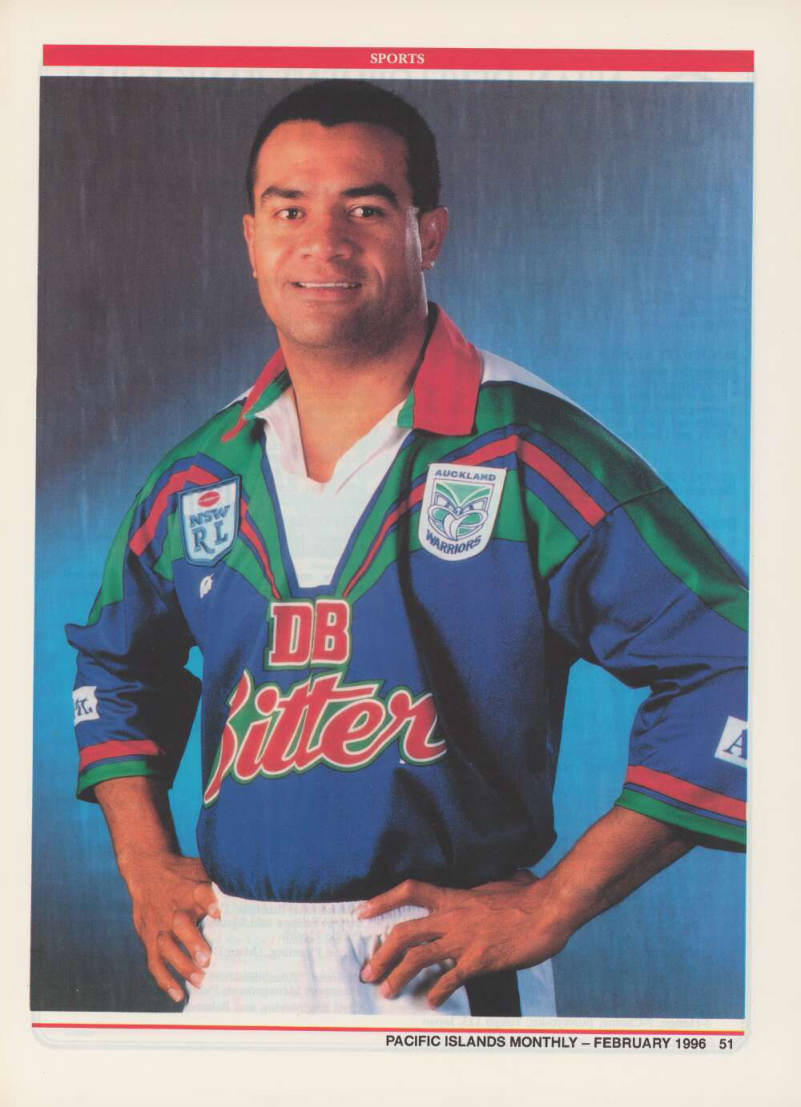
The affable Thompson will be 28 on I,lth June. He is 190 cm. tall and weighs 98kgs. an ideal physique for a utility back like him.
He has been fielded at fullback and on the wing, although the centre’s role remains his
preference.
All rugby league fans will wish Thompson well as he attempts to resurrect his career; particularly those in Fiji.
Thompson has been frustrated over his inability to contribute more to Fijian rugby league during its formative years. But, there are legitimate reasons to believe that he may yet play a meaningful role in Bati’s quest for international credibility.
Thompson’s initial outings in the English first division have been most encouraging and with the Super League organisation - to which both Warrington and the Fijian Rugby League are attached - keen to promote the game in the Pacific islands, him being based in the northern hemisphere will not hamper his availability for Bati.
And it is still too early to write off Manoa
Thompson as Fijian rugby league’s “nearly
man”. ■