president
pp. 47-49 · Read in the full issue
Event
Suicide of a president
By Arnold Leibowitz
In the summer of 1988, with the November Palau presidential elections
coming up, the political sniping
against Lazarus Salii, Palau’s president, intensified. Salii’s opponents in the Palau legislature accused Salii of covering-up his corruption and denying Palau precious United States aid in the process.
For Salii, the news grew worse as the days grew longer. In the middle of August, Vice-President Remengesau broke with Salii and publicly endorsed congressman Ron de Lugo’s legislation. He was chair man of the Territorial Subcommittee in the House of Representatives. He and his committee had been the primary oppo nents of the Compact, very distrustful of Salii and wanting a detailed federal inves tigation of conditions in Palau. His legisla tion would approve the Compact but only if Salii and the Palau government agreed to a special prosecutor and special auditor.
Remengesau added pointedly he couldn’t understand why anybody would not sup port having a special prosecutor in Palau unless they had something to hide.
The following week, John Ngiraked, Salii’s Minister of State, also broke ranks and came out in favour of the de Lugo leg islation. In State elections on the island of Koror, where one-half of the entire Palau populace lives, Salii’s opponents won 14 or 16 seats. Was Salii so vulnerable he would lose the presidential election in November? Most people did not think so.
Not yet, at least. The charges of corruption had weakened him, but it was his inability to deliver the Compact - the agreement with the United States providing $5OO mil-
lion to Palau in exchange for military base rights - that was hurting him the most. The
Compact was his strength.
On Sunday, August 21, the Ta Belau party was scheduled to nominate Salii.
This would kick-off his presidential cam paign. Salii flew to Peleliu on Thursday to tell his followers informally of his candi
dacy.
In the president’s office that Thursday business continued normally. Wilhelm Rengiil, the Minister of Natural Resource, had flown back from the States and saw Salii on Thursday. Ngiraked, while cam paigning with Rengiil in the States, con tinually mentioned that if for any reason Salii could not run, he, Ngiraked, would run instead. Rengiil had been offended by Ngiraked’s statements and had flown
home to tell Salii about them. Salii made light of Ngiraked’s ambition and seemed unconcerned.
On August 18, Thursday, Salii received by fax a letter from the General
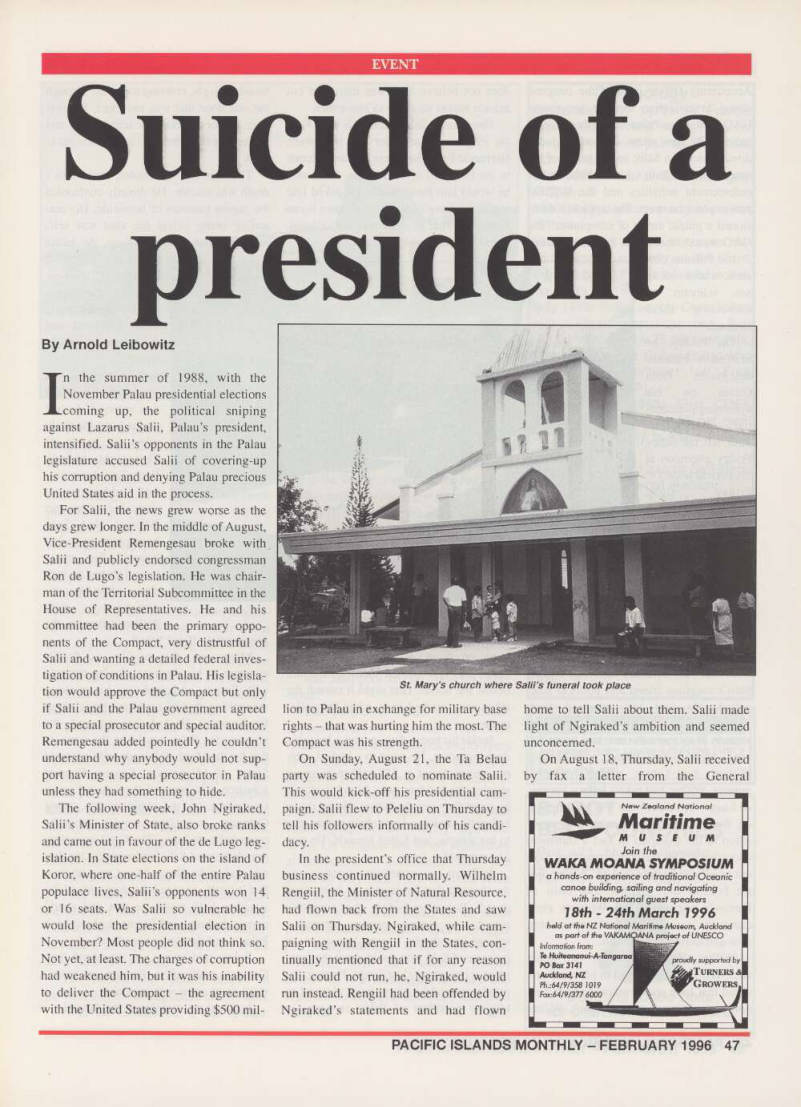
St. Mary’s church where Salii’s funeral took place
Accounting Office (GAO), the congres sional investigative arm. It announced GAO’s return to Palau for further investi gation. The new scope of work included direct attacks on Salii; investigation of the renovations to Salii’s home, Palauan law enforcement activities and the IPSECO power plant contract. The approach envi sioned a public airing of complaints. The GAO would "meet with Palauan officials
... and Palauan citi zens whose views are relevant to addressing these issues...”
On Friday, he briefed a Palauan delegation from Guam on his
upcoming presiden
tial nomination.
Salii left the office Friday afternoon at his normal hour. On
Friday night,
August 19, Joyce Isechal, Salii’s sec retary, went to his home and delivered the nominating petitions and letters to be answered. He looked them over.
took action on some, deferred action on others. She thought it all normal.
About 7am Saturday morning, Willter, Salii’s longtime friend and political aide, called. He had just returned from Washington. Salii asked him to come over at once. They spent the next two hours dri ving around the island together, in Winter’s new Subaru, talking. At Salii’s request, Willter had asked Jeffrey Farrow, de Lugo’s key aide, what was really going on. Was the committee’s unrelenting oppo sition to the Compact in fact a statement about Salii? Did the committee want Salii out of office? Farrow said no. Willter did n’t believe him. Willter told Salii of Farrow’s response. Then Winter’s gloss came: the committee would oppose him, now and during the election.
Willter dropped Salii off two hours later. Willter has replayed in his mind and aloud that long conversation and can find nothing suggestive of a farewell. Willter
does not believe Salii was murdered but suicide makes no sense to him either.
Once home, Salii greeted his wife Tina, his Filipino housekeeper and his driver, Hernando lyar. They were preparing lunch in the backyard of their home. Salili said he would join them shortly. He asked lyar to destroy some papers he had taken home with him. That in itself was not unusual.
Salii frequently took papers home with
him from the office and after completing work on them, asked for them to be destroyed. lyar burned them on the hill beside the house. That night it rained; the ashes were washed away when the police came.
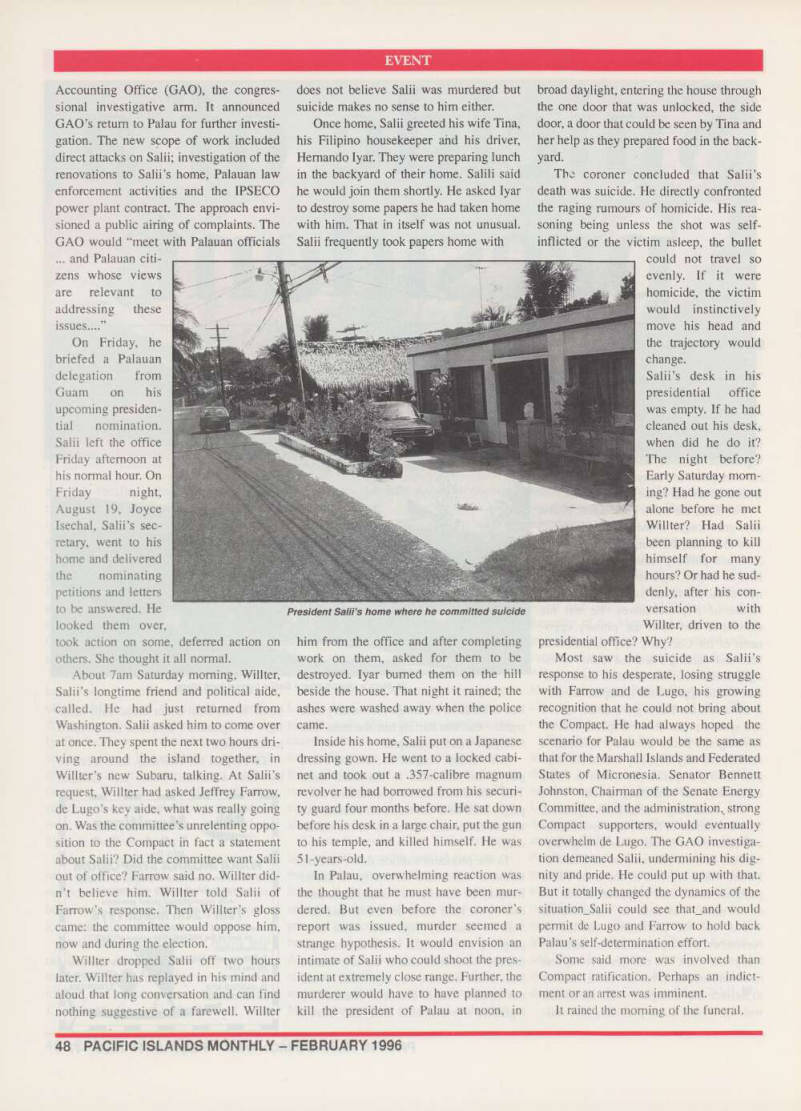
Inside his home, Salii put on a Japanese dressing gown. He went to a locked cabi net and took out a .357-calibre magnum revolver he had borrowed from his securi ty guard four months before. He sat down before his desk in a large chair, put the gun to his temple, and killed himself. He was
51-years-old.
In Palau, overwhelming reaction was the thought that he must have been mur dered. But even before the coroner’s report was issued, murder seemed a strange hypothesis. It would envision an intimate of Salii who could shoot the pres ident at extremely close range. Further, the murderer would have to have planned to kill the president of Palau at noon, in
broad daylight, entering the house through the one door that was unlocked, the side door, a door that could be seen by Tina and her help as they prepared food in the back yard.
The coroner concluded that Salii’s death was suicide. He directly confronted the raging rumours of homicide. His rea soning being unless the shot was self inflicted or the victim asleep, the bullet
could not travel so evenly. If it were homicide, the victim would instinctively move his head and the trajectory would
change.
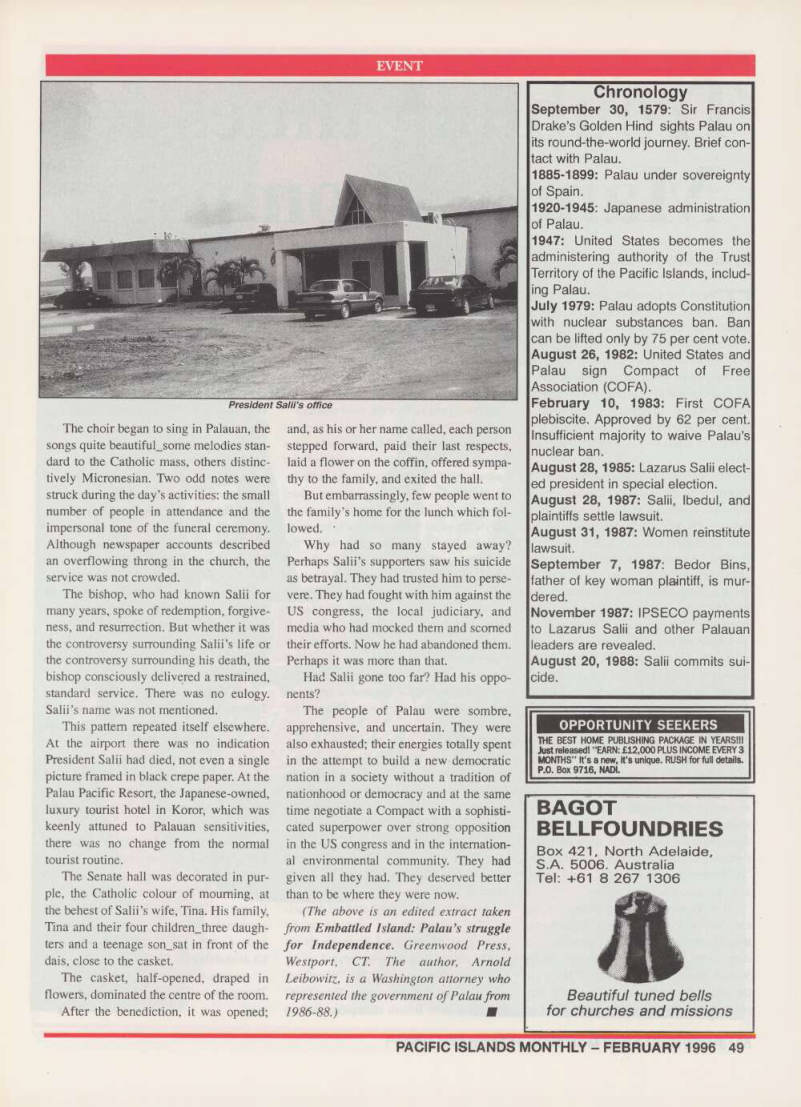
Salii’s desk in his
presidential office
was empty. If he had cleaned out his desk, when did he do it?
The night before?
Early Saturday morn ing? Had he gone out alone before he met Willter? Had Salii been planning to kill himself for many hours? Or had he sud denly, after his con versation with Willter, driven to the
presidential office? Why?
Most saw the suicide as Salii’s response to his desperate, losing struggle with Farrow and de Lugo, his growing recognition that he could not bring about the Compact. He had always hoped the scenario for Palau would be the same as that for the Marshall Islands and Federated States of Micronesia. Senator Bennett Johnston, Chairman of the Senate Energy Committee, and the administration, strong Compact supporters, would eventually overwhelm de Lugo. The GAO investiga tion demeaned Salii, undermining his dig nity and pride. He could put up with that.
But it totally changed the dynamics of the situation_Salii could see that_and would permit de Lugo and Farrow to hold back Palau’s self-determination effort.
Some said more was involved than Compact ratification. Perhaps an indict ment or an arrest was imminent.
It rained the morning of the funeral.
President Salii’s home where he committed suicide
The choir began to sing in Palauan, the songs quite beautiful_some melodies stan dard to the Catholic mass, others distinc tively Micronesian. Two odd notes were struck during the day’s activities: the small number of people in attendance and the impersonal tone of the funeral ceremony.
Although newspaper accounts described an overflowing throng in the church, the service was not crowded.
The bishop, who had known Salii for many years, spoke of redemption, forgive ness, and resurrection. But whether it was the controversy surrounding Salii’s life or the controversy surrounding his death, the bishop consciously delivered a restrained, standard service. There was no eulogy.
Salii’s name was not mentioned.
This pattern repeated itself elsewhere.
At the airport there was no indication President Salii had died, not even a single picture framed in black crepe paper. At the Palau Pacific Resort, the Japanese-owned, luxury tourist hotel in Koror, which was keenly attuned to Palauan sensitivities, there was no change from the normal tourist routine.
The Senate hall was decorated in pur ple, the Catholic colour of mourning, at the behest of Salii’s wife, Tina. His family, Tina and their four children_three daugh ters and a teenage son_sat in front of the dais, close to the casket.
The casket, half-opened, draped in flowers, dominated the centre of the room.
After the benediction, it was opened;
and, as his or her name called, each person stepped forward, paid their last respects, laid a flower on the coffin, offered sympa thy to the family, and exited the hall.
But embarrassingly, few people went to the family’s home for the lunch which fol lowed. ' Why had so many stayed away?
Perhaps Salii’s supporters saw his suicide as betrayal. They had trusted him to perse vere. They had fought with him against the US congress, the local judiciary, and media who had mocked them and scorned their efforts. Now he had abandoned them.
Perhaps it was more than that.
Had Salii gone too far? Had his oppo nents?
The people of Palau were sombre, apprehensive, and uncertain. They were also exhausted; their energies totally spent in the attempt to build a new democratic nation in a society without a tradition of nationhood or democracy and at the same time negotiate a Compact with a sophisti cated superpower over strong opposition in the US congress and in the internation al environmental community. They had given all they had. They deserved better than to be where they were now. (The above is an edited extract taken from Embattled Island: Palau’s struggle for Independence. Greenwood Press, Westport, CT. The author, Arnold Leibowitz, is a Washington attorney who
represented the government of Palau from
1986-88.) m
President Salii’s office