Islands gambling
pp. 44-46 · Read in the full issue
Gambling
Islands gambling on casino draws
By David North
Tropical sunsets and palm-fringed
beaches may soon be replaced by the silhouettes of gambling ships anchored offshore and the glow of coastal strip neon lights as the major tourist attractions of US-affiliated Pacific islands.
Beset by sagging economies, mounting competition for East Asian tourists, and declining US government economic assis tance, voters in the Commonwealth of the Northern Mariana Islands (CNMI) and Guam face casino gambling initiatives in 1996.
The referendums pose a difficult choice for the islanders, many of whom
want the jobs and revenue that a gaming industry would create, but fear the adverse social and political effects. These include the drug and commercial sex trades which cater to the industry and the influence of organised crime syndicates, which so far have been unsuccessful in setting-up casi no gaming operations in the islands.
The CNMI was the first US territory in the region to legalise casino gambling and many of its current leaders see a gaming industry as the key to expanding the touVism industry and generating revenue to replace the $2OO million in economic aid the island will lose over the next seven years to US budget cuts. One US firm, Lone Star Casino Corporation, has already
set up a $3O million facility on Tinian.
Although Lone Star is embroiled in a dis pute with Northern Marianas governor Froilan Tenorio, its successful operation, following other firmS|’ failed attempts at
establishing gaming operations on Tinian,
has spurred Japanese and US gaming groups to move quickly to consolidate the beachhead.
Governor Tenorio is negotiating with a Japanese firm that wants to bring a $35 million casino ship to the islands and a US firm that wants to open a 35,000-square foot casino on Saipan. Although Tinian legalised casinos in 1989, the Saipan casi no would require new legislation and voter approval. In October, Tenorio and
Tinian officials signed a Memorandum of
Understanding with the Hong Kong
based Yoshiya Corporation in Manila. The firm wants to operate a Louisiana-built gambling ship off the coast of Tinian, beginning as early as December, while it develops plans for a 300-room resort with casinos which would be built on Tinian.
Another firm, Sodak Gaming, Inc., a South Dakota Company that distributes slot machines to tribal casinos, is negoti ating to build a gaming facility on Saipan with World Corp, a Korean firm.
But for casino advocates, there are plenty of storm clouds on the horizon, as the CNMI remains embroiled in a political struggle over control of the gaming indus try and the Catholic Church remains adamantly opposed to casinos. The crux of the local power struggle lies in the fact that Saipan, with 90 per cent of the islands’ 56,000 residents, and virtually all of the infrastructure serving 500,000 visi tors annually, also wants casinos to bolster that industry. But Saipan’s leaders have not been able to gain majority support from the island’s voters.
Sparsely-populated Tinian opted for casinos in a large part to attract some of
the development Saipan enjoys. Many in
the central government do not want casi nos on Tinian unless they also are permit
ted on Saipan and regulated by the com monwealth government.
Although Tenorio and Saipan’s tourism interests back legislation to legalise casino gambling on Saipan, the local Catholic Church and other anti-gambling groups are fighting the initiative. Ninety-five per cent of the population is Catholic and a large percentage believe the island would be virtually taken over by organised crime if casinos are permitted. - A measure of the opposition was revealed during the islands’ recent Constitutional Convention, when dele gates overwhelmingly adopted a proposed amendment to the GNMI constitution that would remove legislators’ authority to legalise casinos. If the proposed amend ment is ratified in a November, 1996, ref erendum, only voters in a CNMI-wide election (Saipan, Tinian and Rota) could approve casino gambling.
Tenorio and other Saipan leaders also see the gambling initiative as a way to avoid the onerous task of raising taxes on local residents and businesses to meet the islands’ development needs and social responsibilities. The CNMI’s tax code rebates as much as 90 per cent of income taxes to corporations and individuals.
There is considerable political risk for any elected GNMI official who seeks to sig
nificantly reduce or eliminate that rebate programme.
On Guam, a pro-gambling organisation submitted more than 9000 signatures to the Guam Election Commission on October 16 to petition for a voter initiative on legalising casinos. If Taotao Guam’s (The People of Guam) petition is verified by the commission, the initiative could be voted on in early 1996 in a special elec tion or in a November general election.
The group has campaigned on the plat form that legalised gambling could gener ate millions of dollars in licence fees and tax revenue for Guam.
“A lot of people realise that this is what we need to at least help our economy recover,” said Pat San Nicolas, a Taotao Guam spokesperson.
“Our economy needs an infusion of cash.”
Like the Northern Marianas, Guam has bet on mass tourism, heavily dependent on Japanese, Korean and Taiwanese visi tors, to bring the island out of its current economic slump and maintain its high standard of living. Guam has a per capita Gross Island Product of $20,640, which is the second highest (behind only Japan) in the Asia-Pacific region, but growth has been flat or falling over the past few years because of the Japanese and US reces-
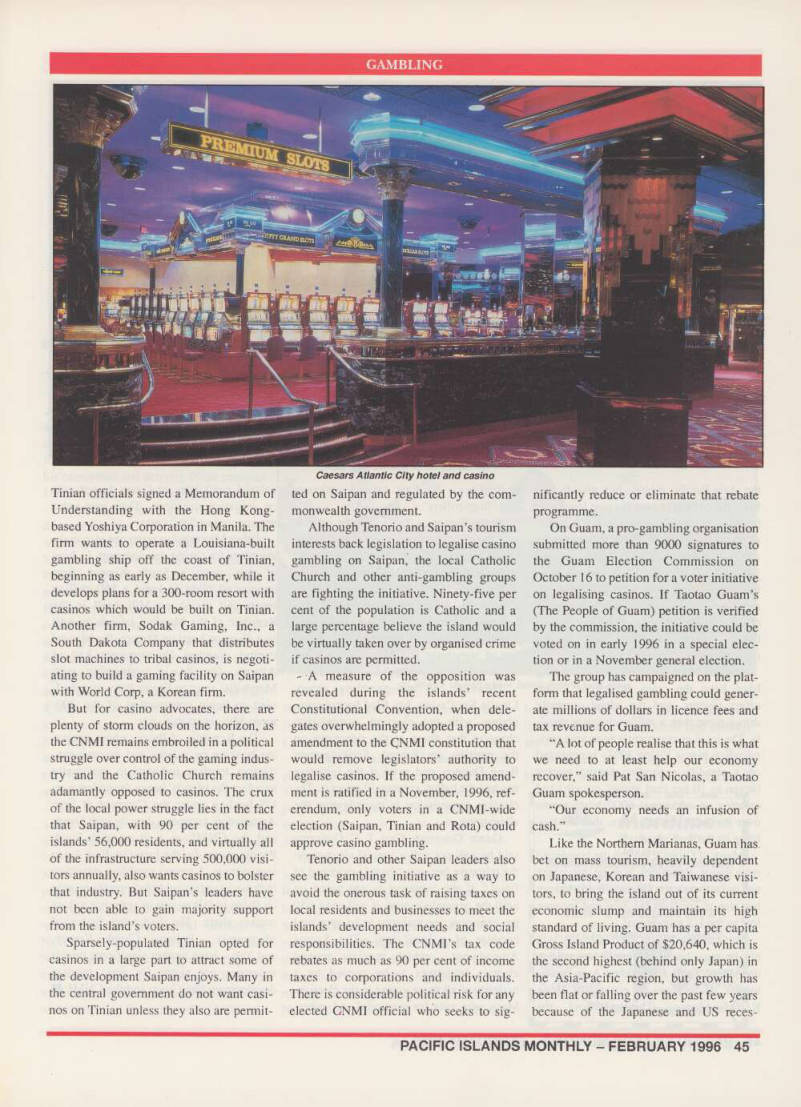
Caesars Atlantic City hotel and casino
the Asia-Pacific region, but growth has been flat or falling over the past few years because of the Japanese and US reces sions, and continued US defence cutbacks on Guam. More than 5000 defence-related jobs will be lost on the island over the next few years, increasing unemployment and reducing tax revenue by tens of millions of dollars. The US defence downsizing on Guam is expected to accelerate, leaving tourism "the only game in town.”
Tropical beaches, golf, and shopping have been the main attractions Guam offers visitors, and the island currently draws more than a million tourists anual ly. The local government’s economic revi talisation plan - Vision 2001- is predicted on a steadily expanding tourist market (seven to 10 per cent annual growth) and creating an additional 6000 hotel rooms over the next several years, that is, dou bling its current capacity.
Many of Guam’s leaders are convinced new major attractions will be necessary not only to sustain Guam’s market share but also to supplant the jobs and revenue lost to the US withdrawal.
But making Vision 2001 a reality will not be easy because of stiff competition the island faces from other Asia-Pacific tourist destinations - especially Hong Kong, Macao, Thailand and the
Philippines - for East Asian vacationers
and "high-rollers”.
Roke Santos, a Taotao Guam official said the group prefers a special election so the initiative will not become entangled with the selection of 21 Guam legislators in the general election. He predicted an easy victory for the gambling measure in a special election, which would require only a simple majority for approval. "The num ber of signatures should tell our leaders the people'have spoken,” Santos said.
However, an anti-gambling group, Lina’la Sin Casino, has filed formal com plaints with the election commission charging that many of the signatures on the petition are forged. Spokesperson Benit Dungca said even if the initiative reaches the ballot, voters will reject it. The election commission is investigating the
allegations.
Guam Governor Carl T C Gutierrez said he will not call a special election on the initiative because "there is evidence of fraud.” If the initiative is not voted on until the general election, it will need a 50 per cent plus one majority to be approved because of a local law -The Santos Amendment - which requires general election initiatives to be carried by a majority of all those voting in the election.
Many who vote for senatorial and guber
natorial candidates on Guam do not vote on initiative questions. Their non-votes are counted as "no” votes.
Other Micronesian states are also mak ing plans for casino development. In June of this year, a South Korean firm announced plans to build a SSO million resort and casino on Mili Atoll in the Republic of the Marshall Islands as well as a 40-room hotel on Majuro, the islands’ capital. Sumhee Development Ltd of Alberta, Canada, in partnership with Marshalls’ senator Keijjo Bien, is sched uled to begin construction of the 200room Mili resort this year.
The Republic of Palau, whose leaders are banking on a large and revenue-pro ductive tourism industry to eventually supplant the islands’ heavy dependence on US funding under the Compact of Free Association, competes directly with Guam and the CNMI, as well as with South Pacific states, for the lucrative East Asian tourist trade. A casino gambling attraction in those islands would place great pressure on Palau to follow suit in order not to lose market share. The Federated States of Micronesia - Pohnpei, Chuuk, Kosrae, and Yap - have neither significant tourist industries nor plants for mass tourism development like Guam and the CNMI. ■
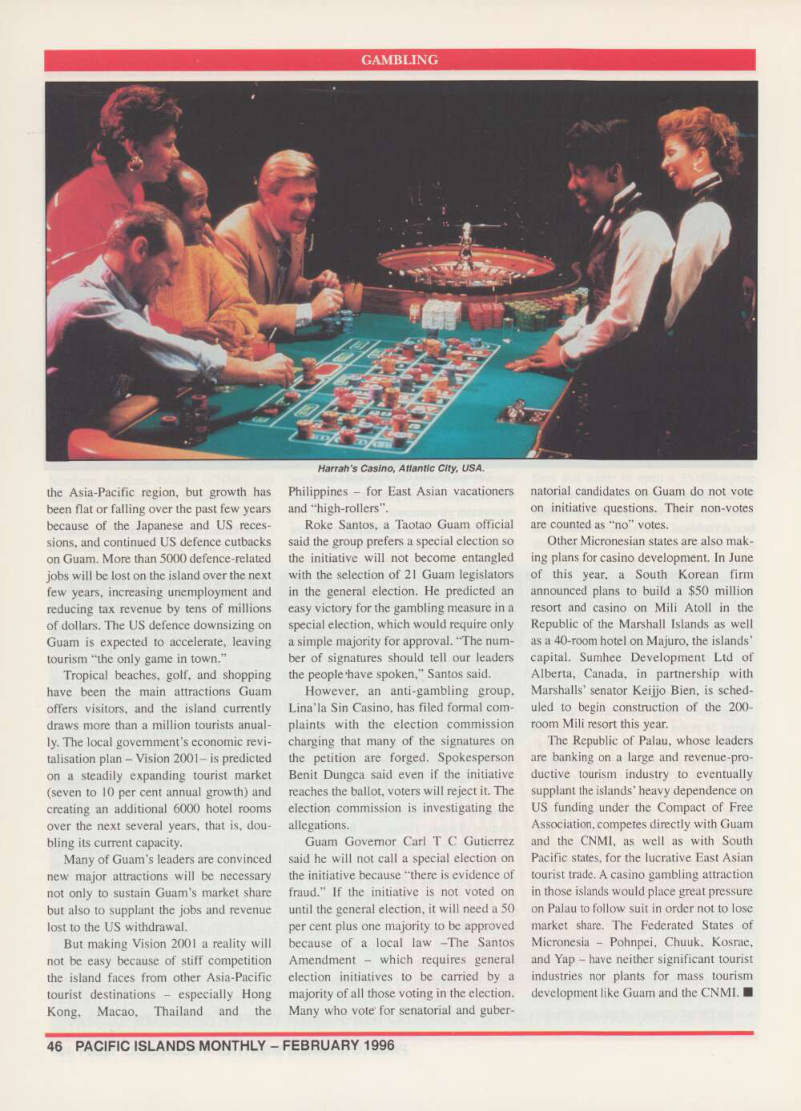
Harrah’s Casino, Atlantic City, USA.