Politics stalls Guam
pp. 42-43 · Read in the full issue
Politics
Politics stalls Guam land rush
By David North
After 20 years of waiting and sever al years of protests and demon strations, landless natives of Guam were on the verge of receiving free public land from the local government in November. It would have been the first installment of a programme aimed at giv ing some of the lands returned to the Guam government by the US government to the Chamorro people - those who could legal ly prove they either lived on Guam in 1950 or were descendants of those residents.
But as the deadline approached, island leaders fell to fighting once again - this time over who would choose those lucky enough to be selected for one of the 4000 parcels ready for the taking - and the long awaited day was once again postponed.
Over the past few months, the
Chamorro Land Trust Commission had distributed some 17,000 applications to qualified indigenous residents and was preparing for a November 1 “first-come first-served” process that would receive
the completed forms, verify the qualifica
tions of the applicants, and award the lots in the order in which the applicants had filed.
The recipients would receive a 99-year lease on a house lot for $1 a year. The pro ject was to be the first such conveyance by the commission and a model for future conveyances as the Government of Guam received additional excess lands from the U.S. military.
However, just a few days before the fil ing date, Guam Governor Carl T.C.
Gutierrez, expressing concern over what he called the “unfairness” of the “first
come-first-served” process and fears of traffic and crowd control, called for a post ponement and offered a bill that instead would establish a "land lottery”.
The 21st Guam Legislature rejected the governor’s proposal, drafted a measure that specifically detailed the application procedures to ensure the fairness of the “first-come-first-served” process, and postponed the filing date until December.
The governor disagreed with that offer and during the stalemate, the executive director and deputy director of the commission
resigned, leaving the body without leader
ship.
Guam Senator Angel Santos, who for the past several years has led the move to implement the Chamorro Land Trust Act, called Gutierrez’ move a Halloween "Trick or Treat” and accused the governor of plot
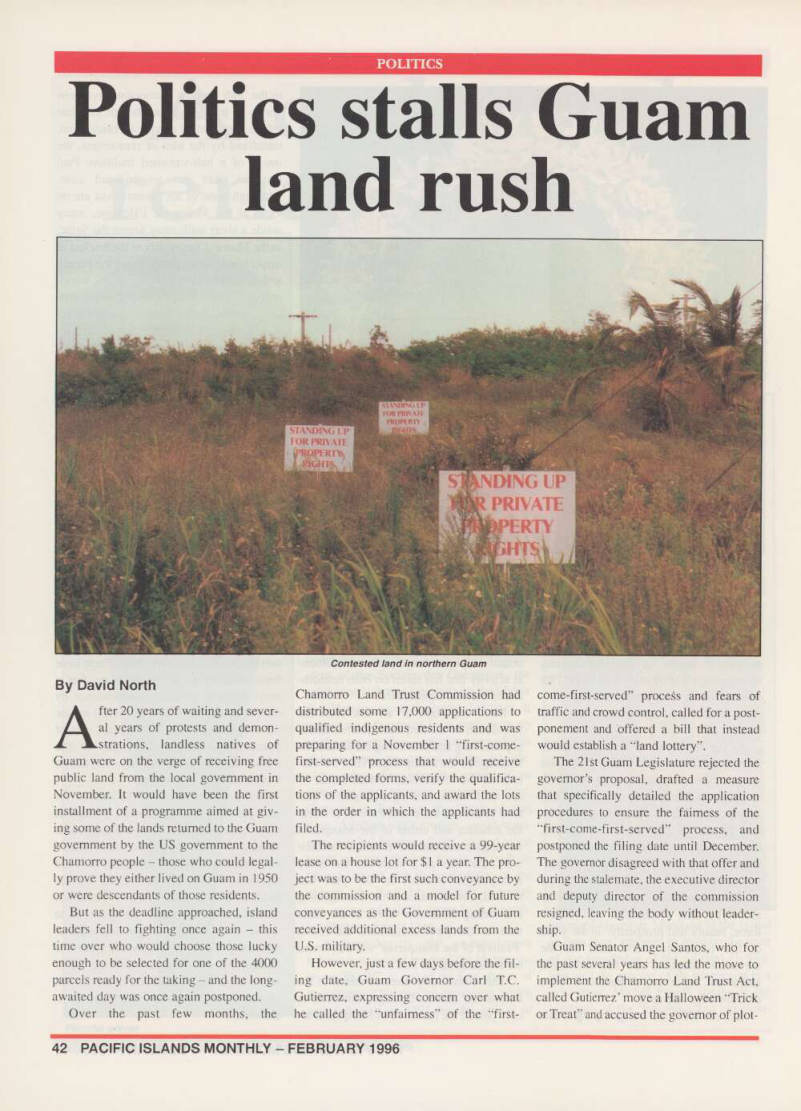
Contested land in northern Guam
ting with commission officials to politically orchestrate a false crisis. Santos said when Gutierrez couldn’t have his way legislatively, he engineered the resignation of the executive director and deputy director, bringing the process to a halt.
Gutierrez wants a lottery because that process will be easier for his administration to “fix”, Santos charged, allowing the govemor to “give” land to his supporters, Santos said Gutierrez’ officials have received more than 300 applications from Chamorros, in violation of the commission procedures, with the understanding, “Don’t worry, your name will be pulled.”
Gutierrez’ spokesperson denied the allegations and said the governor was concemed that people who were sick, or off island, in school, or had to work would not be able to file their applications. Santos said that was patently false because power of attorney forms have been available for those who could not personally file their application.
The Chamorro Land Trust Commission, which was authorised by a legislative act 20 years ago, had never been implemented because Guam leaders said they feared it was unconstitutional. After
months of demonstrations against former Governor Joe Ada, and a Guam court order, the Act was finally implemented, but languished until Santos forced the current legislature and Gutierrez to empower the commission and transfer excess public lands to it for distribution to Chamorros.
Since then, the commission has gained control of about 10,000 acres of local govemment property, much of it land returned by the US government many years ago with the understanding (in so-called reversion clauses) that some of it would be used to provide land for residents who had lost property to federal condemnation procedures after World War 11.
The US also returned about 3500 acres of excess lands last year under a bill sponsored by Guam delegate Robert Underwood, but those parcels are still in the process of being surveyed and transferred. They are not yet under the commission’s jurisdiction. Nor does the commission have jurisdiction over the former Naval Air Station, Agana, which also was transferred to the local government last year as part of the US base closure and realignment process. Ironically, the former base, which is now occupied by several
Government of Guam agencies, was to be the site where land applications were to be received.
Much of the acreage under commission control however, is still jungle and unim proved by roads, water, power, sewer, or telephone access. Some of it are wetlands and clifflines unsuitable for housing, About 4000 lots, transferred to the com mission from a Land for the Landless pro gramme formerly under the governor’s purview, have been surveyed and are near ly ready for distribution. They are located in the residential communities of Dededo (2000 lots), Yigo (1800), and Agat (200).
Yet even these plots pose problems because many of them are occupied by non-Chamorros, either illegally or under the terms of local government lease pro grammes superseded by the land trust act.
Most of the residents are either Filipinos or Micronesians. They will have to be given notice, perhaps as much as 180 days, to vacate the properties before those parcels can be turned over to landless Chamorros.
Qualified native residents occupying these lots will be allowed to continue on the land under the new lease programme. ■