A cultural
pp. 40-41 · Read in the full issue
Art
A cultural renaissance
By Nicholas Rothwell
As the season of nuclear testing on Mururoa Atoll reaches its climax, there is an ambiguous pleasure in being able to report from Paris on an impressive French venture, aimed at com
memorating the splendours of Polynesian
civilisation.
At the Musee de I’Homme, one of the great cathedrals of Parisian culture, an important exhibition, devoted exclusively to the art and history of the Marquesan islands, opened in December.
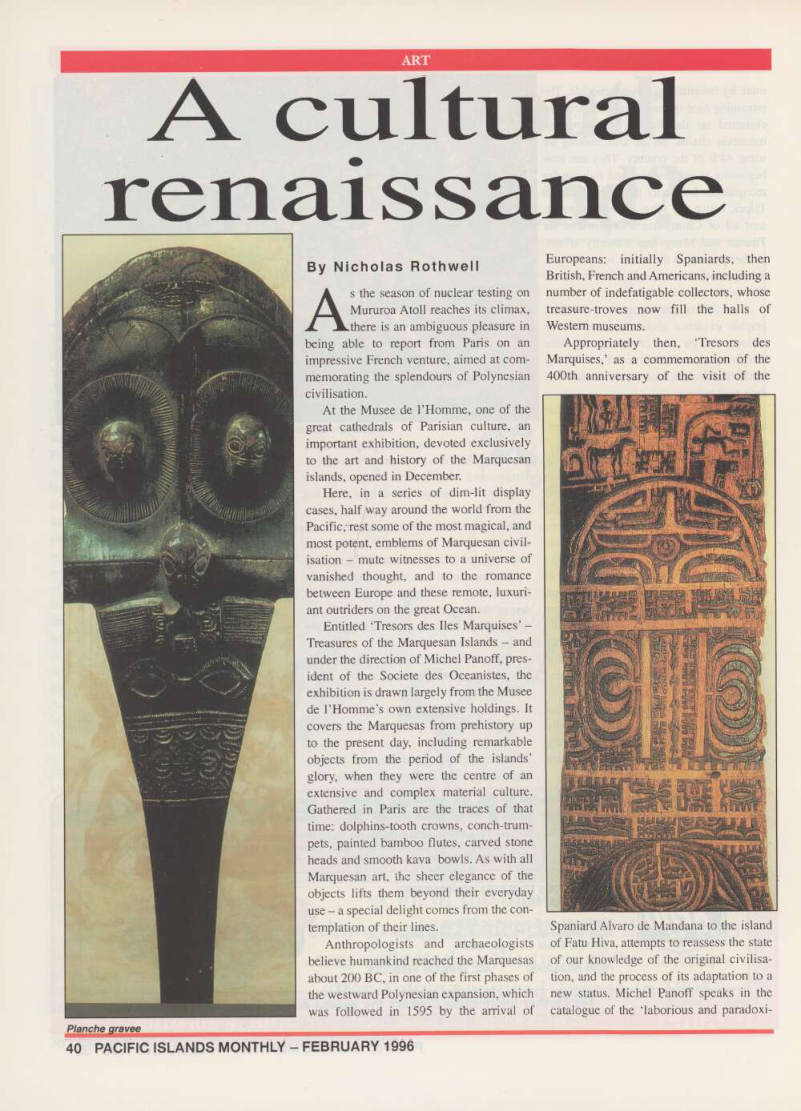
Here, in a series of dim-lit display cases, half way around the world from the Pacific,'rest some of the most magical, and most potent, emblems of Marquesan civil isation - mute witnesses to a universe of vanished thought, and to the romance between Europe and these remote, luxuri ant outriders on the great Ocean.
Entitled ‘Tresors des lies Marquises’ - Treasures of the Marquesan Islands - and under the direction of Michel Panoff, pres ident of the Societe des Oceanistes, the exhibition is drawn largely from the Musee de I’Homme’s own extensive holdings. It covers the Marquesas from prehistory up to the present day, including remarkable objects from the period of the islands’ glory, when they were the centre of an extensive and complex material culture.
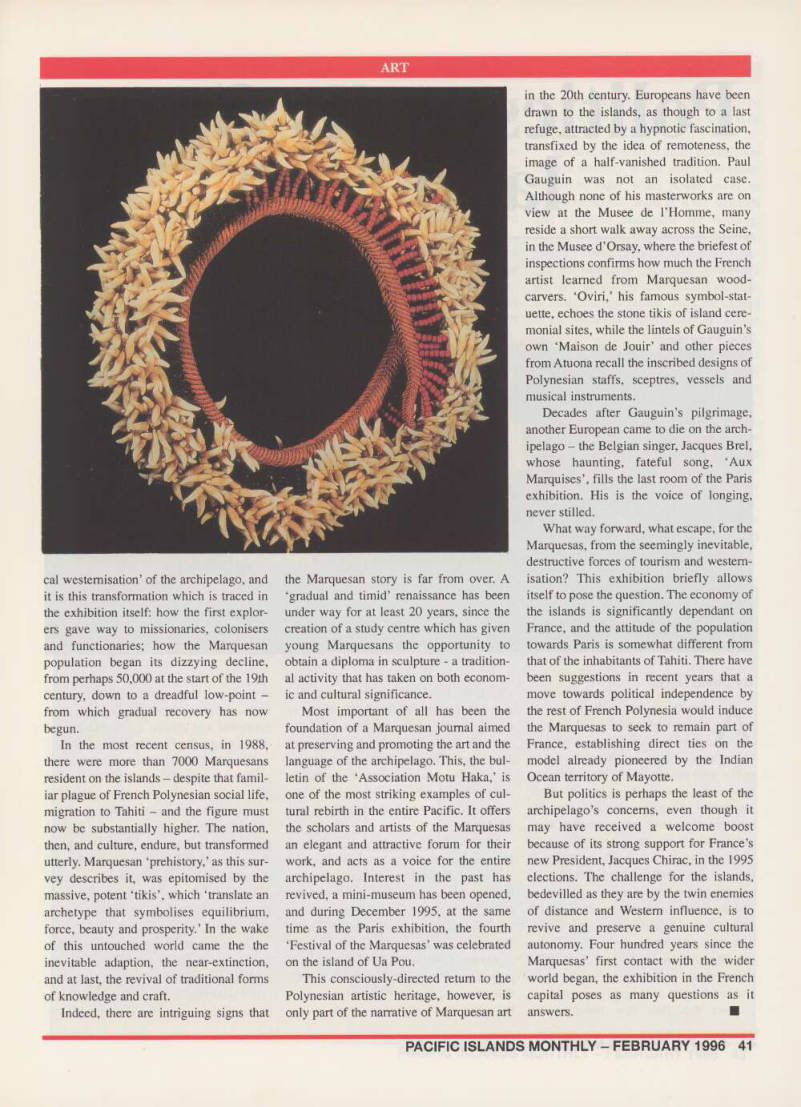
Gathered in Paris are the traces of that time: dolphins-tooth crowns, conch-trum pets, painted bamboo flutes, carved stone heads and smooth kava bowls. As with all Marquesan art, the sheer elegance of the objects lifts them beyond their everyday use - a special delight comes from the con templation of their lines.
Anthropologists and archaeologists
believe humankind reached the Marquesas about 200 BC, in one of the first phases of the westward Polynesian expansion, which was followed in 1595 by the arrival of
Europeans: initially Spaniards, then British, French and Americans, including a number of indefatigable collectors, whose treasure-troves now fill the halls of Western museums.
Appropriately then, ‘Tresors des Marquises,’ as a commemoration of the 400th anniversary of the visit of the
Spaniard Alvaro de Mandana to the island of Fatu Hiva, attempts to reassess the state of our knowledge of the original civilisa tion, and the process of its adaptation to a new status. Michel Panoff speaks in the catalogue of the ‘laborious and paradoxi-
Planche gravee
cal westernisation’ of the archipelago, and it is this transformation which is traced in the exhibition itself: how the first explor ers gave way to missionaries, colonisers and functionaries; how the Marquesan population began its dizzying decline, from perhaps 50,000 at the start of the 19th century, down to a dreadful low-point from which gradual recovery has now begun.
In the most recent census, in 1988, there were more than 7000 Marquesans resident on the islands - despite that famil iar plague of French Polynesian social life, migration to Tahiti - and the figure must now be substantially higher. The nation, then, and culture, endure, but transformed utterly. Marquesan ‘prehistory,’ as this sur vey describes it, was epitomised by the massive, potent ‘tikis’, which ‘translate an archetype that symbolises equilibrium, force, beauty and prosperity.’ In the wake of this untouched world came the the inevitable adaption, the near-extinction, and at last, the revival of traditional forms of knowledge and craft.
Indeed, there are intriguing signs that
the Marquesan story is far from over. A ‘gradual and timid’ renaissance has been under way for at least 20 years, since the creation of a study centre which has given young Marquesans the opportunity to obtain a diploma in sculpture - a tradition al activity that has taken on both econom ic and cultural significance.
Most important of all has been the foundation of a Marquesan journal aimed at preserving and promoting the art and the language of the archipelago. This, the bul letin of the ‘Association Motu Haka,’ is one of the most striking examples of cul tural rebirth in the entire Pacific. It offers the scholars and artists of the Marquesas an elegant and attractive forum for their work, and acts as a voice for the entire archipelago. Interest in the past has revived, a mini-museum has been opened, and during December 1995, at the same time as the Paris exhibition, the fourth ‘Festival of the Marquesas’ was celebrated on the island of Ua Pou.
This consciously-directed return to the Polynesian artistic heritage, however, is only part of the narrative of Marquesan art
in the 20th century. Europeans have been drawn to the islands, as though to a last refuge, attracted by a hypnotic fascination, transfixed by the idea of remoteness, the image of a half-vanished tradition. Paul Gauguin was not an isolated case.
Although none of his masterworks are on view at the Musee de I’Homme, many reside a short walk away across the Seine, in the Musee d’Orsay, where the briefest of inspections confirms how much the French artist learned from Marquesan wood carvers. ‘Oviri,’ his famous symbol-stat uette, echoes the stone tikis of island cere monial sites, while the lintels of Gauguin’s own ‘Maison de Jouir’ and other pieces from Atuona recall the inscribed designs of Polynesian staffs, sceptres, vessels and musical instruments.
Decades after Gauguin’s pilgrimage,
another European came to die on the arch ipelago - the Belgian singer, Jacques Brel, whose haunting, fateful song, ‘Aux Marquises’, fills the last room of the Paris exhibition. His is the voice of longing, never stilled.
What way forward, what escape, for the Marquesas, from the seemingly inevitable, destructive forces of tourism and western isation? This exhibition briefly allows itself to pose the question. The economy of the islands is significantly dependant on France, and the attitude of the population towards Paris is somewhat different from that of the inhabitants of Tahiti. There have been suggestions in recent years that a move towards political independence by the rest of French Polynesia would induce the Marquesas to seek to remain part of France, establishing direct ties on the model already pioneered by the Indian Ocean territory of Mayotte.
But politics is perhaps the least of the archipelago’s concerns, even though it may have received a welcome boost because of its strong support for France’s new President, Jacques Chirac, in the 1995 elections. The challenge for the islands, bedevilled as they are by the twin enemies of distance and Western influence, is to revive and preserve a genuine cultural autonomy. Four hundred years since the Marquesas’ first contact with the wider world began, the exhibition in the French capital poses as many questions as it answers. ■