Taiwan, South
pp. 38-39 · Read in the full issue
Region
Taiwan, South Pacific Island?
By lan Williams
Across the globe, billions of people
follow the arguments about whether Taiwan is part of China.
But few, even in the region, consider that the island is definitely firmly part of the South Pacific - and not just geographically.
Almost half of Taiwan is home to some 320,000 of what are called “Aborigines.”
I had heard of them, but it was not until I walked into the Shung Ye Museum of Formosan Aborigines that saw what it meant. The building is striking enough - a huge concrete and glass building modelled on a traditional aboriginal house, which in its shape at least, would not look out of place in many Pacific islands. Around the walls of this new, S2O million museum were carvings, tools, fabrics and pictures of people who looked like Pacific Islanders. Indeed the texts accompanying the pictures show that this people also sound and behave more like Pacific islanders than Chinese. Indeed, some scholars argue that the original speakers of most Pacific island languages, the Austronesian languages, came into the ocean via Taiwan, perhaps originally from South China or Indochina.
Chinese annals from two thousand years ago record the conquest of people known as the hundred Yueh, a seafaring people who tatooed their faces, and archaeologists say that they used the same type of pottery and tools as the indigenous people in Taiwan. But it seems that the Austronesian people were in the island for another two thousand years even before then.
In fact, it is the Han Chinese who are the latecomers in Taiwan. They began move from the mainland in the seven teenth and eighteenth centuries, and by sheer weight of numbers assimilated the native inhabitants on the fertile plains -
“A lot of the photographic and ethnographic evidence about the peoples was collected at the turn of the century after Tokyo acquired Taiwan in 1895”
more by intermarriage then genocide. The remaining nine or ten or so tribes are now clustered on the Eastern seaboard and mountain chains, on an area making up some 44% of the country. They are now beginning to get restless, and fighting for recognition. Ironically the government in Taipei, which for years claimed to repre sent all of China, has a department for Tibetan and Mongolian minority affairs, neither present on the island, but until now, no department for the minorities that were first on the island.
A lot of the photographic and ethno graphic evidence about the peoples was collected at the turn of the century after Tokyo acquired Taiwan in 1895 by Japanese scholars, who were fascinated by their new colony.
While they are now lumped together under one heading, either aborigines, mountain people, or now “first residents,” the ten or so different tribes have mutually unintelligible languages and different tra ditions - in some, like the Ami and Puyuma, property descends in the female line, in others from the fathers. Some have a clan system, and others have an aristo cratic feudal society.
One thing that they have in common is that while Anthropologists all believe that the tribes came either from the mainland or from the Pacific by sea, their own tradi tions all claim that they originated in Taiwan. But since they have been there for up to four thousand years at least, it is per haps understandable that they have forgot ten whatever voyage first brought them to these shores. For example, the Atayals have a rock two by three metres that they say is their birthplace, on which the chief used to sit to issue instructions.
As with all indigenous peoples, there are big problems with alcohol, with assimilation, and outmigration. Since they are different in language and culture, it is not easy for them to unite and insist, say on broadcasts in their own language. Even the efforts to revive or maintain old festivals and traditions face the risk of becoming saccharine touristic ventures. On the other hand, selling handicrafts to tourists can be one of the few sources of income available for people in the mountains who do not got to the cities for work.
One of the positive aspects is that the majority Han Chinese are now more sensitive and supportive of the indigenous cultures. Safe C. Lin, the founder of the Shung Ye Museum made his fortune as a car importer and began collecting Taiwanese paintings before he became interested in the indigenous culture. The
interest grew enough for him to endow the Museum. “They were here before us Hans!
And they are different. If we don’t pre serve their culture and languages, a major part of the island’s heritage will be lost,” he told PIM.
He began to collect their artifacts and as his horde grew bigger and bigger he decid ed to mount it in a museum. Now lie has aborigine friends and buoyantly claims “I can sing a song from every region.” As well as the museum, he has endowed
scholarships in indigenous cultures.
But he looks puzzled when I ask if they have any connection to the University of the South Pacific. No. Perhaps it’s time for some of those Pacific Anthropologists tired of looking into the trail Margaret Mead was so careful to hide, to take a look at the Pacific cousins in Taiwan. ■
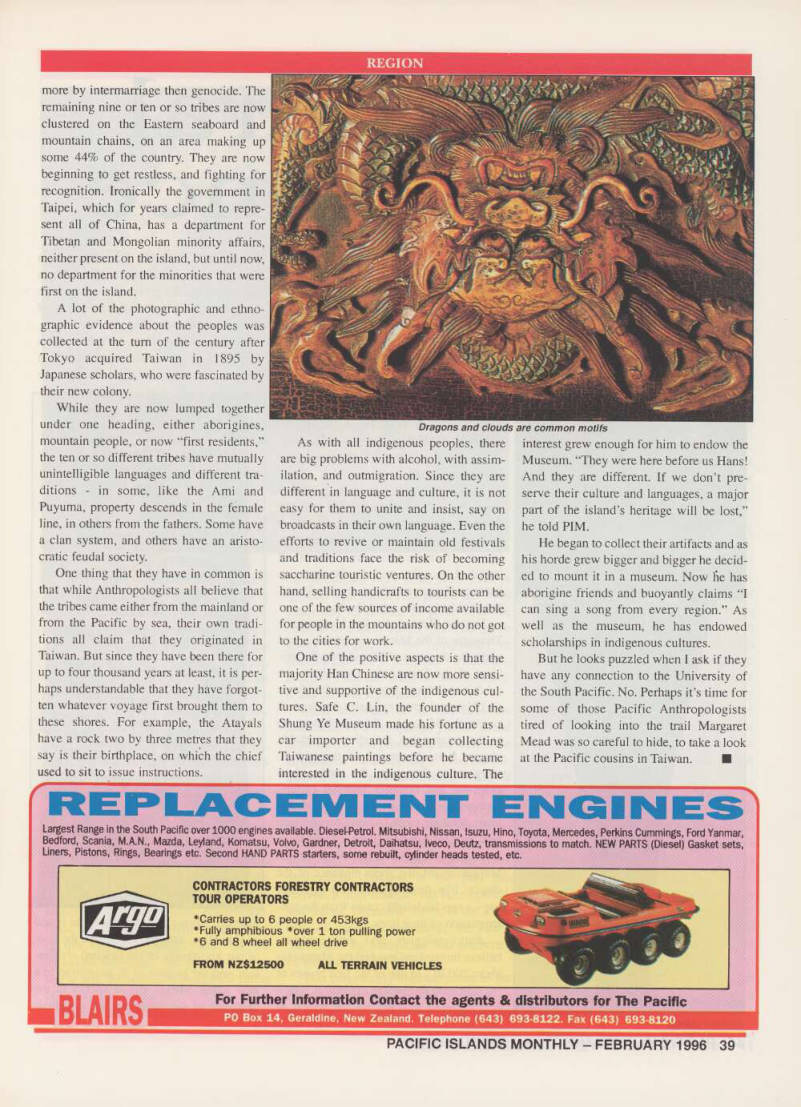
Dragons and clouds are common motifs