Surviving beyond
pp. 34-37 · Read in the full issue

Business
Surviving beyond economic aid
By Yunus Rashid
The Marshall Islands are at a cross roads, unable to decide which way to turn, as its aid funds of SUS7OO mil lion slowly grind to a halt.
With coral being its only available export - if anyone is interested in buying coral that is - the Marshallese people, who have since World War 11, led a basic, but highly-Americanised lifestyle, are expected to undergo yet another major social revolu tion.
When the country became another Pacific island United States Trust Territory in July 1947, things looked good due to a large inflow of cash through the American military presence. When the Trust lapsed in 1986, the Marshallese people began receiv ing the SUS7OO million, which was spread over 15 years, under the Compact of Free
Association. This amount has now been overdrawn and very little is left to come in.
With a few people holding the reins of the economy, the vast majority of the esti
mated population of 40,000 have to find alternative means of earning. This is not going to be easy according to Grant Labaun, general manager and owner of Midtown
Shop, and vice-president of the Majuro
Chamber of Commerce.
Labaun said in an effort to deal with the oncoming crisis, a committee has been appointed from the chamber to formulate ideas which could be used for a proposal to government to help generate income to off set the effects of dwindling US government funds.
“We feel that because of the plugging of funds to Marshall Islands, we, as the people of Marshall Islands need to wake to the pos sible scenarios we will be faced with and get down to doing something about them, (con tinued on 36) This may be a little late but it is not too
GrantLabaun
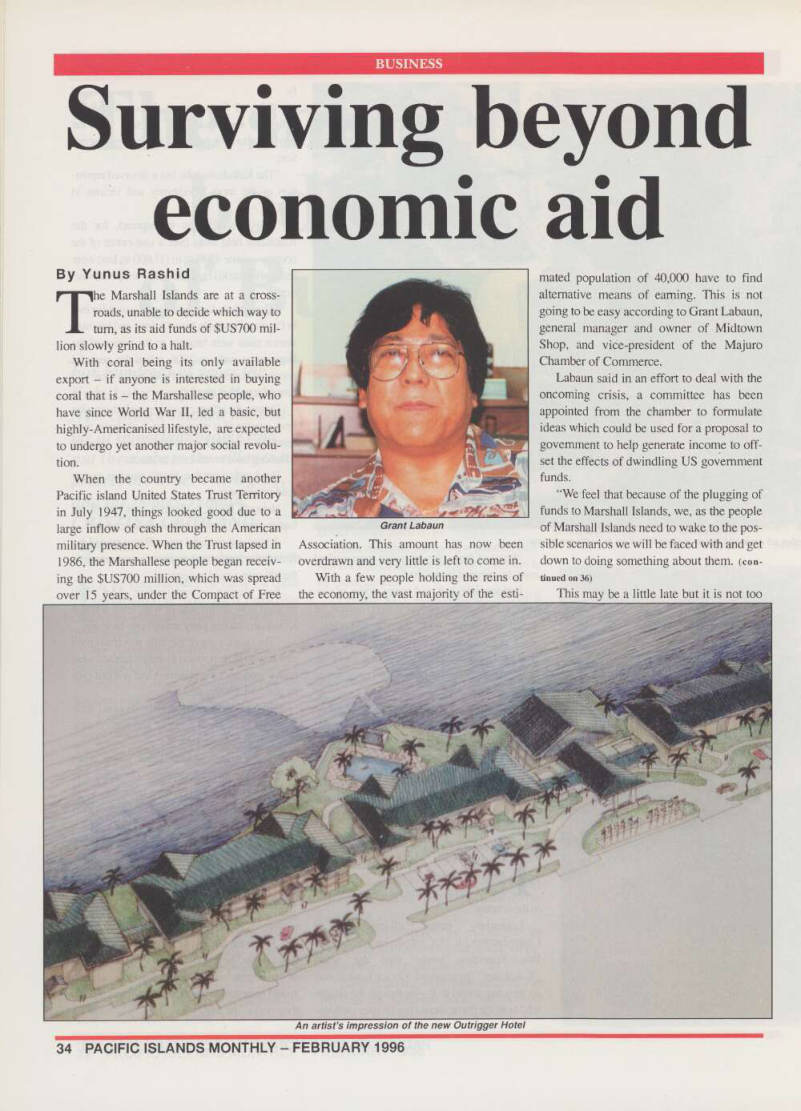
An artist’s impression of the new Outrigger Hotel
late.
“We have to work closely with govern ment to share ideas which would benefit not only the government, which is the largest employer, but also the private sector.”
So, with virtually no export possibilities, the Marshall Islands has to make do with the only thing it can possibly exploit - tourism.
Majuro, its capital, on its own, cannot pro vide a competitive tourist destination. But outer islands like Bikini are exclusive tourist attractions and boast pristine waters, golden beaches and one of the most rare diving spots in the world. Bikini has many sunken World War II relics.
But for tourism to bloom, the Marshallese may need to compromise aspects of their culture which prohibit the wearing of swimming trunks or bikinis on beaches. Tourists would also need landown er approval before taking to the water as beaches are normally private property.
Labaun said the private sector had the ability to cater for tourism but it was gov ernment’s prerogative to spell out the indus try’s benefits in terms of concessions and incentives.
“Tourism has not been thoroughly explored as a revenue earner but immediate steps need to be taken to conduct feasibility
studies and (the) cost of establishing this industry on a large scale.”
Labaun said one of the tasks to be under taken by the ad hoc committee of the cham ber was to come up with a list of things the private sector could do to help government secure a tourist market.
“We need to sit and talk about simple things like what help government can afford us if we were to clean up the islands. Would we get garbage trucks and helpers, for
example.”
However, it would be wrong to assume every Marshallese person knows they are standing at a junction and must decide whether to discard old spending habits and work toward establishing a strong economy or to maintain old habits and face an eco nomic doom.
“We have a problem. We had the luxury of cash flow in the past and we did not real ly have to work together and we did not worry. The people now realise that a prob lem - a very big problem - is facing the country and we can no longer afford to work independently any more. The situation is very simple, if the government suffers we suffer and vice-versa.
“Any confrontational attitude would hamper progress and they have to be kept
under check. The bottom line is to generate revenue.”
But is there light at the end of the tunnel?
“Yes, there is. I would not say it is a very bright light but there is light. Ultimately, our proposals would need the blessing of gov ernment to succeed.”
Has the problem reached a panic point?
“I’m not in a panic stage and I don’t think the other business people are panick ing either. A decline in government’s stan dard revenue from the United States does not mean that it is the end of the world,”
Labaun says in a fighting spirit.
The bespectacled Marshallese business man himself is a success story of Majuro.
From a humble civil servant he rose to become a millionaire businessman. It is this hard achieved success that inspires Labaun not to lose now.
“There are other Marshallese business people around who have not relied com pletely on the US grants and have thrived in business. We have a lot to loose if we don’t find alternative ways.
Yet another business-minded but humane philosophy that Labaun has is that the government and the private sector need to enhance the earning capability of the
Marshallese people.
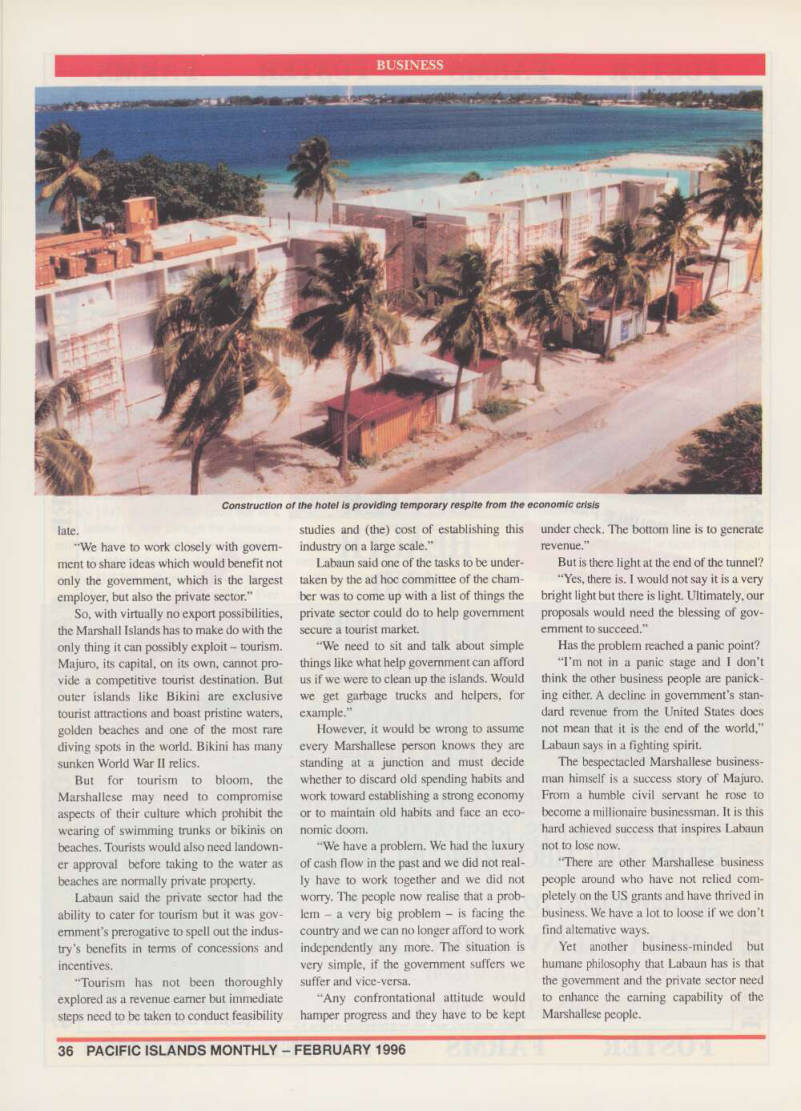
Construction of the hotel is providing temporary respite from the economic crisis
“On one hand this will ensure a good standard of living for them and on the other it will allow businesses to continue normal ly-”
Faced with an uncertain economy, Labaun intends to re-structure his business depending on his study of the market base and its purchasing power. His strategy
would include supplying goods at prices
affordable by the market even if this meant
lower profits.
“I am hoping that with smaller profits and a high turnover I will be able to break even in the long run. Waiting for high prof its would definitely mean low turnover of goods and in the end greater losses due to
shop soiled goods.”
The immediate future - that is two years down the lane - things do not look too grim.
The South Pacific Forum will hold its annual meeting in Majuro this year and for this a 150-room hotel is being built to be
managed by Hawaii’s Outrigger Group of
Hotels. The major shareholder is a promi nent entrepreneur named Jerry Kramer who has other business interests in which some Marshallese have shares.
And several large-scale civil infrastruc ture projects funded by the Asian Development Bank will inject large sums of money into the economy. This will see a
momentary rise in jobs and cash.
But Labaun’s fear is after the Forum and the completion of the ADB projects, the Marshall Islands will not have any concrete plans on how its workforce will be main tained.
The Marshall Islands does not have a large local professional workforce and relies heavily on foreigners to fill the vacuum.
This situation arises from the fact that professionals normally decide to remain in the US or Hawaii after completing their studies for better job opportunities.
A lot of people go to elementary school where instructions are given both in the
English and Marshallese languages.
A select few then prefer to pursue a col lege education and as can be seen in Majuro, not many Marshallese go into business.
Many survive on US Trust Fund mon eys, wear American clothes and eat American food.
Labaun says the education system is not very effective and is not reason enough for people to aspire for better things in life.
“Nobody can say because they don’t have enough education they can’t do hard work to be successful,” he said.
But why did many Marshallese choose not to do business?
“One reason many Marshallese did not
go into business because society is not com plicated. Subsistence survival was accepted form of living.”
The minimum wage in the Marshall Islands is SUS 2 an hour for the private sec tor and about SUS4.SO for government workers.
Money derived from various sources is normally spent on food and on luxury items.
Marshallese people are not thrifty by nature and so saving has not been seen as anything
important.
However, this is expected to change because economic pressures may force a change of attitude.
“Marshallese do not know how to spend their money. They spent money on wants rather than on needs,” Labaun said.
He said in the last couple of years he has detected a want in parents to better educate their children and they have started to save.
Children are sent abroad (mainly to Hawaii and mainland USA) to complete college.
But the question that remains is whether these college graduates would return to the Marshall Islands, and if so, why?
It is also important as Labaun says, for the Marshallese to decide quickly about their future. If this is not done then his state ment on there being a light at the end of the tunnel may well backfire. ■
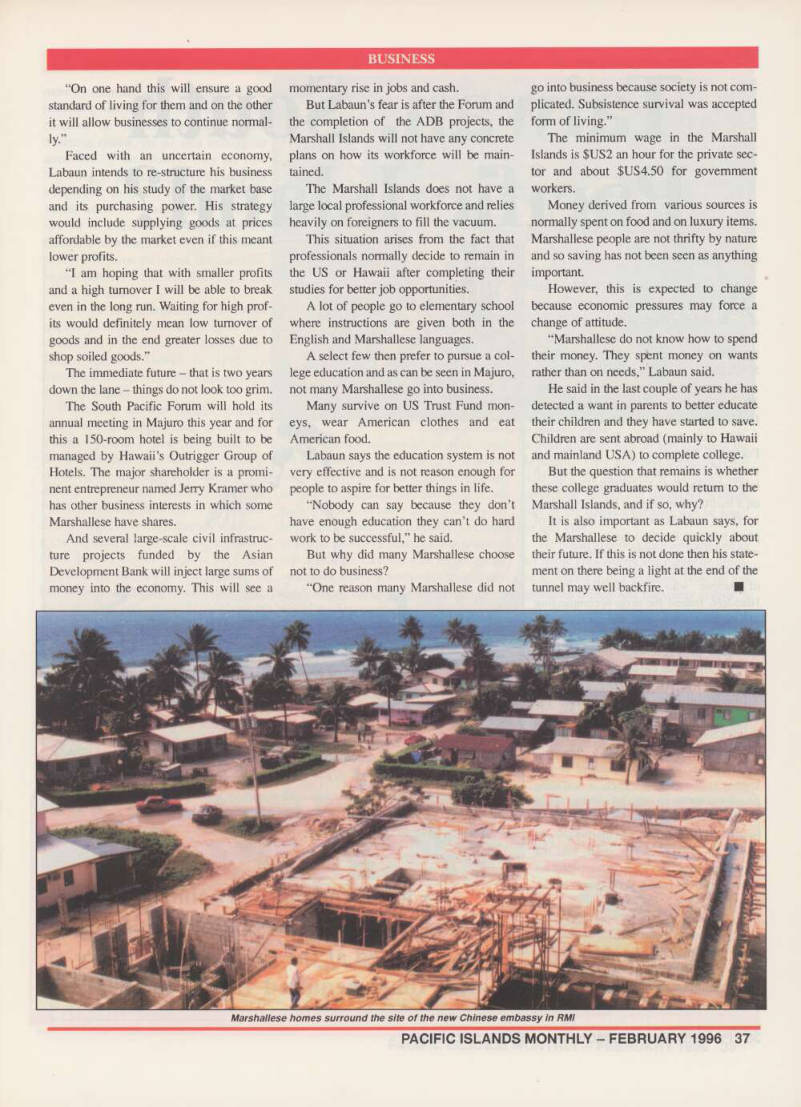
Marshallese homes surround the site of the new Chinese embassy in RMI