Bloodthirsty
p. 33 · Read in the full issue
warriors
THE Kukukuku, who live in one of the most remote and rugged areas of Papua New Guinea, are among the most feared in the country.
Legendary patrol officer District
Commissioner J K McCarthy in his book. Patrol Into Yesterday, writes that the word "Kukukuku” (pronounced Kooka-Kooka) had an amusing sound to it - as though the people who bore the name should not be taken serious
iy- “When I first wrote it, I took a childish delight in spelling it Ku 4,” he said. “But the
comical-sounding name is a misleading descrip
tion.
'The Kukukuku tribe has a deserved reputa tion as the most bloodthirsty and vicious in
Png.
“Their record was widespread, for the Kukukuku held sway over a vast extent of the country - some 4500 sq m (11,600 sq km) were
jealously guarded by those quick-tempered war
riors.
“The Kukukuku was as well-known for evil in Papua as he was in New Guinea, and his mur derous raids were brought to the notice of the Papuans as early as 1906, when the peaceful people of Keiema on the Papua coast were vic tims of a sudden attack.”
Despite the efforts of many patrols during the next quarter of a century, the Kukukuku suc
cessfully “resisted all punitive and friendly
advances” to convert them to peace.
But it took more than hostile warriors to stop gold prospectors.
Helmuth Baum, a German, was one of the first to search for gold in Kukukuku country.
A kind and peaceful man, Baum treated the Kukukuku kindly and, at first, there were signs the hill men would reciprocate.
But district commissioner McCarthy recalled how Baum was ill with fever when a Kukukuku trading party arrived one morning.
'The quick eyes of the little mountain men saw he was in no position to defend himself - his native workers were unarmed and without pro tection,” McCarthy said. ‘Two of the men suddenly dropped their bilum (bag) of sweet potatoes and pushed their way into the prospector’s tent.
"They jerked hidden stone clubs from beneath their mal hoods (bark overcoat) and struck him dead as he lay in his bunk.
"The remainder of the Kukukuku then attacked Baum’s natives and killed eight, which was all they could catch. The rest escaped to tell the tale.”
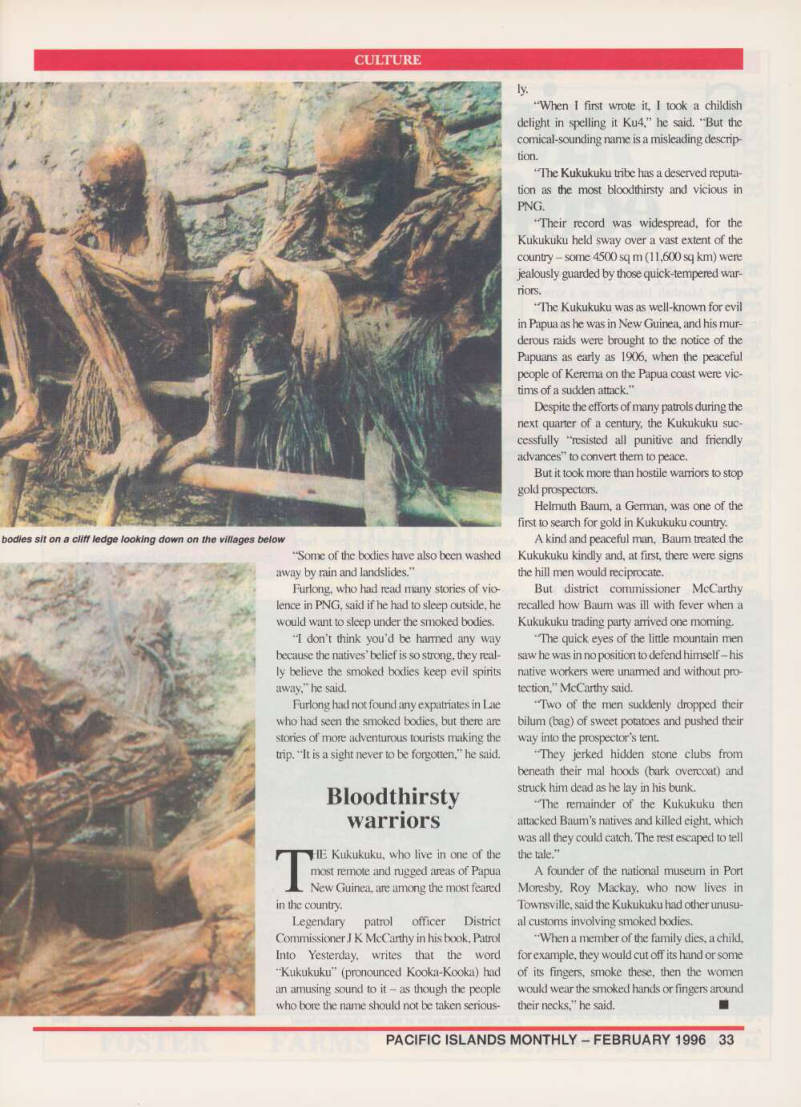
A founder of the national museum in Port Moresby, Roy Mackay, who now lives in Townsville, said the Kukukuku had other unusu al customs involving smoked bodies.
"When a member of the family dies, a child, for example, they would cut off its hand or some of its fingers, smoke these, then the women would wear the smoked hands or fingers around their necks,” he said. ■