The smoked
pp. 32-33 · Read in the full issue
Culture
The smoked bodies of Bulolo
For hundreds of years the Kukukuku people of Papua New Guinea smoked the bod ies of important people and put them above the villages to protect the tribe. The legacy, and the bodies, remain.
Cristina Cridland
reports.
It is the creepiest place on Earth a burial ground high in the mountains of Papua New Guinea where the bodies of the dead have been smoked.
For Australian documentary producer and presenter Rick Anderton it was “a very eerie and awesome experience, especially through the
highland mist”.
“I’ve seen many strange things in PNG, like head-hunting and other strange customs, but I’ve never seen anything like the smoked bod ies,” he said.
Anderton and his camera crew, Evan Furlong and Paul Robinson, travelled to PNG to film the smoked bodies of Bulolo, a gruesome sight few outsiders have seen.
The crew had been told about the smoked bodies, high on a cliff overlooking a valley of villages, on previous visits to PNG.
They found “this eerie but fascinating spot” near Aseki, a village 3500 metres up in the north ern ranges, a three-hour drive along a steep, winding road from the township of Bulolo, about two hours drive from the provincial capi tal of Lae.
For hundreds of years, the Kukukuku used a unique technique to preserve the bodies of
important people in their tribes.
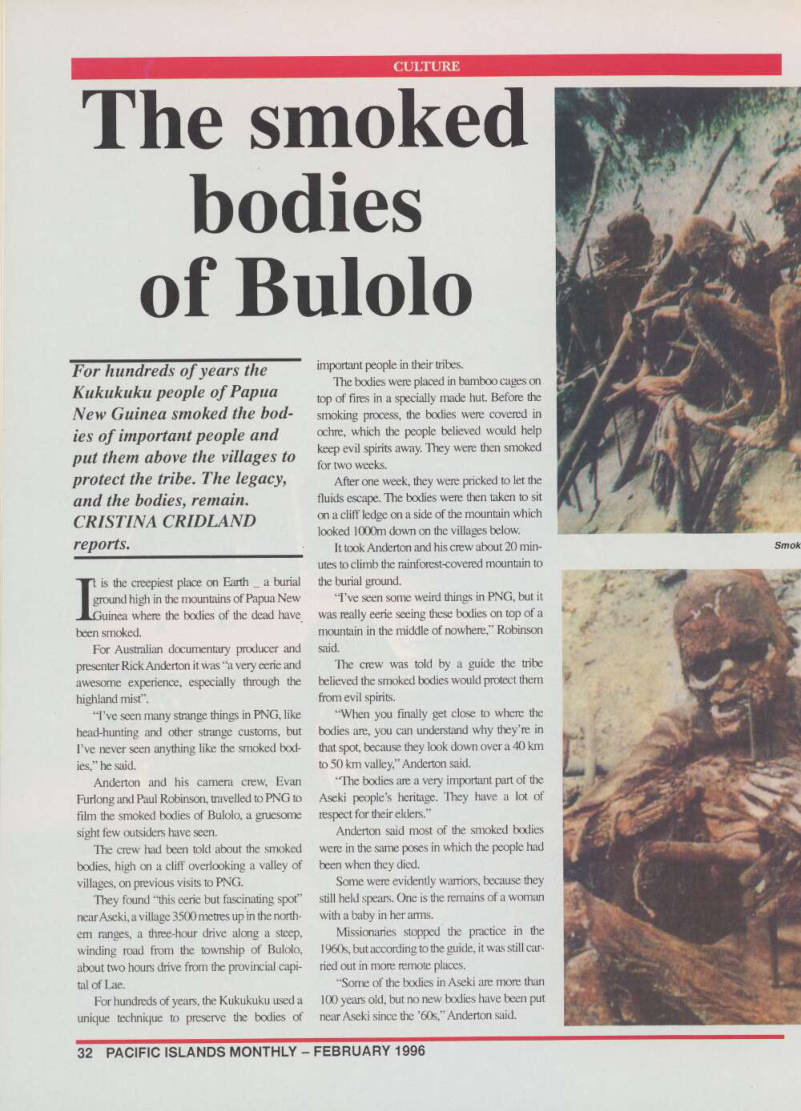
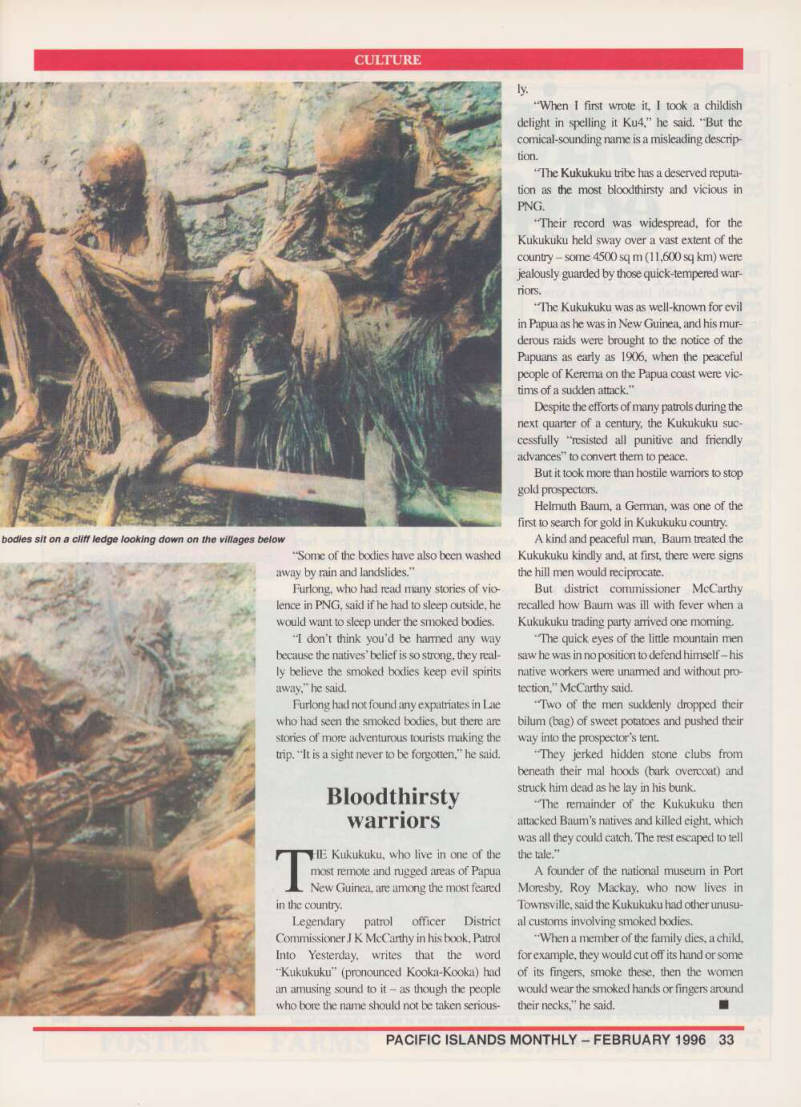
The bodies were placed in bamboo cages on top of fires in a specially made hut. Before the smoking process, the bodies were covered in ochre, which the people believed would help keep evil spirits away. They were then smoked for two weeks.
After one week, they were pricked to let the fluids escape. The bodies were then taken to sit on a cliff ledge on a side of the mountain which looked 1000 m down on the villages below.
It took Anderton and his crew about 20 min utes to climb the rainforest-covered mountain to the burial ground.
“I’ve seen some weird things in PNG, but it was really eerie seeing these bodies on top of a mountain in the middle of nowhere,” Robinson said.
The crew was told by a guide the tribe believed the smoked bodies would protect them from evil spirits.
"When you finally get close to where the bodies are, you can understand why they’re in that spot, because they look down over a 40 km to 50 km valley,” Anderton said.
"The bodies are a very important part of the Aseki people’s heritage. They have a lot of respect for their elders.”
Anderton said most of the smoked bodies were in the same poses in which the people had been when they died.
Some were evidently warriors, because they still held spears. One is the remains of a woman with a baby in her arms.
Missionaries stopped the practice in the 19605, but according to the guide, it was still car ried out in more remote places.
"Some of the bodies in Aseki are more than 100 years old, but no new bodies have been put near Aseki since the ’6os,” Anderton said.
Smok
“Some of the bodies have also been washed away by rain and landslides.”
Furlong, who had read many stories of vio lence in PNG, said if he had to sleep outside, he would want to sleep under the smoked bodies.
"I don’t think you’d be harmed any way because the natives’ belief is so strong, they real ly believe the smoked bodies keep evil spirits away,” he said.
Furlong had not found any expatriates in Lae who had seen the smoked bodies, but there are stories of more adventurous tourists making the trip. “It is a sight never to be forgotten,” he said.
bodies sit on a cliff ledge looking down on the villages below